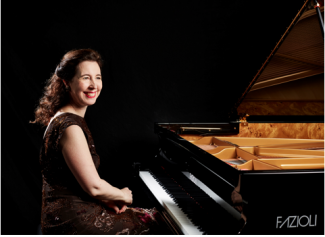
Concert Review: Angela Hewitt/ Musica Viva

Capture14-325x237

Angela Hewitt

Music Viva

City Recital Hall, May 8, 2017

In August 2016 Angela Hewitt embarked on a Bach Odyssey. Her mission was to perform all the major keyboard works of J.S. Bach over 4 years, in a series of 12 recitals. Daniel Barenboim performed the piano works of Beethoven and Eliot Gardiner with his ensemble, took on the sacred choral works of JS Bach as their odysseys. Hewitt will perform the complete cycle of Bach in London, New York, Ottawa, Italy, and Tokyo; however, she has promised that there will be many other concerts along the way.

One of those took place in Sydney this week where, under the auspices of Musica Viva, Angela Hewitt played the music of JS Bach, D Scarlatti, Ravel and Chabrier, performing on her choice of grand piano, the Italian Fazioli. Although not explicitly stated, Hewitt’s programme was infused with ideas related to dance and she filled the City Recital Hall with the vibrancy of these rhythms and her unparalleled playing.

The music of Bach may well be coded into Hewitt’s DNA. Her fame arose on winning the International Bach Piano Competition in Toronto in 1985. She was the child of a cathedral organist and a music teacher; she played Bach from the time she started to learn the piano as a toddler and she sang his music at church. Hearing her play this music is a singular privilege.

The first half of the concert was taken up with two of JS Bach’s keyboard partitas – No1 in B flat major BWV 825 and No 4 in D major, BWV 828. After a graceful opening Praeludium of the Partita No1 Hewitt created a palpable sense of movement in the dance forms of the ensuing movements. Sprightly rhythms, delicate ornamentation and exquisite phrasing emerged as she wove through the lines of counterpoint. There was a total evenness of line as one hand, indistinguishably took over the subject from the other; the Sarabande was especially beautiful – stately and polished; the final Gigue, an agile romp to the end.

Following this was the longer Partita No 4 in D major BWV 828 which Hewitt introduced with majestic rolling phrases and a cascading fugue. This partita is replete with contrasting moods from the deeply expressive Allemande and the levity of the Courante heading relentlessly to the Gigue, luxurious in counterpoint.

The second half of the programme featured 5 short sonatas in major keys by Domenico Scarlatti (Kk491 and 492 in D major, Kk 377 in B major, Kk 380 in E major and Kk 24 in A major), eloquently performed, showcasing the differences and similarities between the two contemporaries, JS Bach and D Scarlatti.

Pivoting on the French style Ouverture of the Partita No 4, Hewitt looked to Ravel and Chabrier for her final two items – Ravel’s Sonatine, shimmering with brilliance and the formidable and rarely heard Bourrée fantasque by Chabrier. 

Returning for a much-appreciated encore, Hewitt bade her audience goodnight with Debussy’s Clair de Lune, creating a wash of muted colours which gently echoed in my mind as I fell asleep that night.

The Fazioli grand piano was a crucial aspect of this recital. The unique, hand-crafted Fazioli has an abundantly resonant and versatile sound, expressing well, in Hewitt’s hands, the contrasting styles of the evening. No doubt this is in part, a result of its select raw materials and technical specifications. The rest of the evening’s success surely lay in the extraordinary gifts and insights of the incomparable Angela Hewitt.

Shamistha de Soysa for SoundsLikeSydney©
Similar Posts

  • Concert Review: Splendour And Mystery/Sydney Chamber Choir

    Splendour and Mystery/ Sydney Chamber Choir
    Verbrugghen Hall, Sydney Conservatorium of Music
    Australian Digital Concert Hall
    25 March, 2023
    In Splendour and Mystery, Sydney Chamber Choir under the direction of Sam Allchurch joined forces with Camerata Antica led by Matthew Manchester and organist Thomas Wilson in an adventurous anthology of music written for double choir. Specialising in the music of the 16th and 17th centuries, the founder of Camerata Antica, Matthew Manchester playing the fiendishly difficult cornetto, was joined by Michael Wyborn, William Kinmont and Paolo Franks playing the equally challenging alto, tenor and bass sackbutts respectively.
    Bookended with pieces by Giovanni Gabrieli with one of his refreshing Canzonas in the middle, the program also contained music by living Australasian composers Clare Maclean and Brooke Shelley, Gabrieli’s contemporary and student Heinrich Schütz and 20th century composers John Tavener and Frank Martin. Together these composers explore and exploit the potential of the double choir with its opportunities for super-rich harmonies, added melodic lines, imitation, choral interplay and variations in the positioning of the singers.
    The opening motet, Gabrieli’s Jubilate Deo omnis terra, C 65 was quite literally a musical shout for joy. A major part of this journey back in time to Renaissance Venice was the unique sound of Camerata Antica. Heralded by the instruments, the 10 lines of the choir sang an uplifting, lively and tightly dotted chorus, alternating with homophonic passages. Allchurch and his ensemble clearly delineated the rhythms, changing time signatures, hemiolas and other displaced accents which created the buoyancy of this celebratory piece.
    John Tavener’s brilliant A Hymn to the Mother of God transcends the mortal and looks to the cosmic powers of Mother Mary. Writing in the style of canon, with imitative lines that start in quick succession and not necessarily in harmony, Tavener creates a sense of ‘other-worldliness’ in this simple but awe-inducing piece in three-sections. It was a slow burn as the two choirs sang with shimmering lightness and a sense of spinning through space, creating vivid colours and  clusters of clashing chords with impressive control as the voices rose in range and dynamic to its full-bodied climax.
    The program moved imperceptibly to the German Magnificat by Heinrich Schütz, as the choirs were joined by organ and instruments. This was a relevant and important inclusion as Gabrieli himself taught Schütz in this multi-choral technique which Schütz then developed in his own style.
    Clare Maclean’s moving Christ the King was sublimely sung, opening in the manner of a plainchant by the female voices which peeled off into mirroring phrases by the other voices, ending in a reprise of the plainchant. Premiered by this choir in 1984, it is precisely opportunities like these which new composers need for their music to be heard and re-heard until it becomes recognizable to listeners and enters the DNA of the concert repertoire.
    The short and brilliant burst of Gabrieli’s Canzona seconda, C 187  from Camerata Antica showcased these rudimentary instruments in all their imperfect glory as the choir positioned itself for Frank’s only unaccompanied choral work, the demanding  Mass for double choir, considered to be one of the finest and most complex pieces of 20th century choral music. The choir did ample justice to this piece which incorporates the aesthetics of Renaissance music, French Impressionism, Schoenberg’s twelve-note system and J S Bach. The altos began the Kyrie with a freely-flowing, supplicating melody; the Gloria built step-wise to cluster chords; the Credo was a business-like affirmation of faith; the canon-styled Et Resurrexit was levity, hope and word-painting to perfection; the Sanctus introduced softer harmonies from the male voices. The mass, Version 1, ended with a powerful Benedictus. Fast forward to 1926 and Martin added the Agnus Dei, the crowning glory to this choral magnum opus. The mass culminated in a glorious unification of the choirs.
    Brooke Shelley’s Heavenly Father, composed in 2022, performed in the presence of the composer was premiered in November 2022, by the Sydney Chamber Choir. A lyrical and beautifully textured piece, it is very pleasing that it has quickly been programmed again. Like the slightly older piece by Maclean, it is critical that new pieces of merit such as these, are given regular and frequent hearings so that they may be heard widely and face the test of time.
    Finally, Gabrieli’s Magnificat a 14, C 79 brought together the full instrumental and vocal forces of the ensemble. Using the 16th century Venetian technique of cori spezzati (split choirs), the brighter sound of the female voices and cornetto took to the left gallery with the male voices and the thrilling grunt of the bass and other sackbutts in the right gallery with a mixed ensemble placed and organ placed centrally on stage.
    This was an intelligent and audacious program from Allchurch, performed with glorious sound by a choir secure in technique, pitch and musicianship.

  • CD Review: SOAR/ Gondwana Chorale

    The national youth choir Gondwana Chorale, conducted by Paul Holley and Carl Crossin, has released its debut recording SOAR. Featuring 16 tracks, both sacred and secular, most works are by living Antipodean composers. This repertoire is the hallmark of the ensemble, established in 2008, which has drawn its singers from around the nation. Contrasting with the…

  • Concert Review: The Sonata Project/ Bernadette Harvey

    The Sonata Project Bernadette Harvey Verbrugghen Hall, Sydney Conservatorium of Music 11 November 2017 Written by Ria Andriani One of the aims of Bernadette Harvey’s new concert venture The Sonata Project is to bring back the atmosphere of Romantic soirees in European salons, offering a new experience in  classical piano music for contemporary audiences. This…

  • Album Review: The Garden Party/ The Marais Project

    The Garden Party, The Marais Project/ Move Records Celebrating two decades of professional music making, The Marais Project has released a new recording, The Garden Party on the Move label, featuring fresh repertoire and new collaborators alongside some previously recorded pieces with older friends. The Marais Project was founded by viola da gamba player Jennifer…

  • extraordinary tale – extraordinary singing from the idea of north

    As always, The Idea of North delight listeners with their  new CD. Their freshness,  purity of tone and unerring pitch, blend like the strands of a braid that start and end their journey together, meandering their own part in between, independent, but never losing sight of being part of the single design. Extraordinary Tale (ABC…

Leave a Reply