CD Review: ‘Alleluia’ – Brilliance and beauty from Julia Lezhneva

This review was first published in June 2013. The album contains four motets by composers whose music Julia Lezhneva will perform during her October tour of Australia with the Australian Chamber Orchestra.

“From time to time a really outstanding talent appears and I believe that Julia Lezhneva is just that. The brilliance of her voice and technique are extremely impressive.” High praise from Dame Kiri Te Kanawa, herself one of the most brilliant singers of our time.

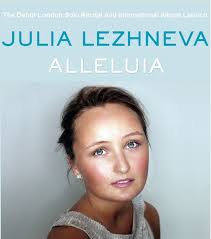
The precociously talented Russian coloratura soprano, Julia Lezhneva, just 23, has released Alleluia, her second solo album and her first on the Decca label, with Il Giardino Armonico and Giovanni Antonini.

Alleluia features four sacred motets for solo voices by Vivaldi, Handel, Porpora and Mozart. All the motets contain an Alleluia as their final movement and they have carefully handpicked by Lezhneva to showcase her voice in its tonal beauty and technical brilliance.

The motets are amongst the finest examples of Baroque and early classical music for  soprano solo. Vivaldi’s tempestuous In furore iustissimae irae, RV 626 scored in 3 movements for soprano, 2 violins, viola and basso, has the soloist storming in with bravura scales and leaps. In contrast, the second movement calls for a more sustained and even line and the Alleluia is as exuberant as it is demanding.

Handel’s Saeviat tellus inter rigores, HWV 240 in 4 movements for soprano, violin and oboe is a divine piece of music divinely performed. Composed to celebrate the Feast of Our Lady of Mount Carmel in July 1707 it too has a bravura beginning with the soloist reaching for a high D in the early bars. The middle two movements evoke the tranquillity of the night before embarking on the roller-coaster ride that is the Alleluia. Sung by a less capable singer it could sound frenzied, but Lezhneva shapes her delivery and its nuances with complete control. 

Nicola Porpora’s music is enjoying a renaissance and this recording of In Caelo stelle clare is a world premiere. He was a highly regarded singing teacher, whose students included Farinelli; as a composer he was Handel’s great rival. The cantata is written in the style galant, an idiom which Lezhneva adopts with ease. Although Porpora was  considered to embellish his writing at the expense of musicality, his writing presents no obstacles to Lezhneva who tackles its demands with aplomb.

Finally the elegant Exultate Jubilate K165 written by Mozart before he turned 17, shimmers with a joyful reverence and remains as fresh as  clear winter’s morning in Sydney.

Lezhneva is a pleasure to listen to. The maturity of her voice and of her interpretation exceed her youth. She skips up the heights with sublime ease and maintains her luscious tone throughout the registers of her voice. Her virtuosic ornamentation informs the style of each motet and in case the listener needed convincing, underscores her complete command of her instrument.

The 22 piece ensemble Il Giardino Armonico, directed by Giovanni Antonini, gives an exceptional performance on a breathtaking array of period and reproduction instruments which date back to 1675.

There’s an added element to Lezhneva’s story which contains an Australian connection. Her foundation in music studies were acquired in Moscow. However, 2008  she began studying with tenor Dennis O’Neill (who has performed in Sydney numerous times) in Cardiff, and then, completed her training with the much loved Australian soprano Yvonne Kenny at London’s Guildhall School.

This CD is a must for lovers of Baroque vocal music.

Shamistha de Soysa for SoundsLikeSydney© 

Alleluia/Julia Lezhneva, soprano/Il Giardino Harmonico/Giovanni Antonini

Decca 478 5242
 

Similar Posts

  • Concert Review: Australian Haydn Ensemble / Melbourne Digital Concert Hall

    Haydn’s Dream & Bach’s Goldberg Australian Haydn Ensemble/Melbourne Digital Concert Hall 8 October, 2020 The Australian Haydn Ensemble pitted slumber against insomnia in its programme Haydn’s Dream & Bach’s Goldberg for Melbourne Digital Concert Hall. Led by artistic director and violinist Skye McIntosh, who was joined by violinist Matthew Greco, viola player Karina Schmitz and…

  • Album Review: The Garden Party/ The Marais Project

    The Garden Party, The Marais Project/ Move Records Celebrating two decades of professional music making, The Marais Project has released a new recording, The Garden Party on the Move label, featuring fresh repertoire and new collaborators alongside some previously recorded pieces with older friends. The Marais Project was founded by viola da gamba player Jennifer…

  • Concert Review: Beethoven’s Seventh/ Omega Ensemble

     Beethoven’s Seventh – Omega Ensemble  Lisa Osmialowski (flute), Alex Fontaine (oboe), Matthew Bubb (oboe), David Rowden (clarinet), John Lewis (clarinet), Ben Hoadley (bassoon), Simone Walters (bassoon), Melissa Woodroffe (contra bassoon), Michael Dixon (horn), Phil Wilson (horn), Ike See (violin), James Eccles (viola), Paul Stender (cello), Alex Henery (double bass), Timothy Brigden (timpani) 11 July 2016,…

  • Concert Review: St John Passion/JS Bach/ The Choir Of St James’ King Street/ The Australian Haydn Ensemble

    St John Passion – J S Bach The Choir of St James’ with The Australian Haydn Ensemble St James’ Church, King Street, Sydney 28 March 2015 J S Bach’s St John Passion is not performed as often as his better-known St Matthew Passion, The St James’ performance in the church’s sympathetic acoustic was conducted by Warren Trevelyan-Jones who…

  • Concert Review: Splendour And Mystery/Sydney Chamber Choir

    Splendour and Mystery/ Sydney Chamber Choir
    Verbrugghen Hall, Sydney Conservatorium of Music
    Australian Digital Concert Hall
    25 March, 2023
    In Splendour and Mystery, Sydney Chamber Choir under the direction of Sam Allchurch joined forces with Camerata Antica led by Matthew Manchester and organist Thomas Wilson in an adventurous anthology of music written for double choir. Specialising in the music of the 16th and 17th centuries, the founder of Camerata Antica, Matthew Manchester playing the fiendishly difficult cornetto, was joined by Michael Wyborn, William Kinmont and Paolo Franks playing the equally challenging alto, tenor and bass sackbutts respectively.
    Bookended with pieces by Giovanni Gabrieli with one of his refreshing Canzonas in the middle, the program also contained music by living Australasian composers Clare Maclean and Brooke Shelley, Gabrieli’s contemporary and student Heinrich Schütz and 20th century composers John Tavener and Frank Martin. Together these composers explore and exploit the potential of the double choir with its opportunities for super-rich harmonies, added melodic lines, imitation, choral interplay and variations in the positioning of the singers.
    The opening motet, Gabrieli’s Jubilate Deo omnis terra, C 65 was quite literally a musical shout for joy. A major part of this journey back in time to Renaissance Venice was the unique sound of Camerata Antica. Heralded by the instruments, the 10 lines of the choir sang an uplifting, lively and tightly dotted chorus, alternating with homophonic passages. Allchurch and his ensemble clearly delineated the rhythms, changing time signatures, hemiolas and other displaced accents which created the buoyancy of this celebratory piece.
    John Tavener’s brilliant A Hymn to the Mother of God transcends the mortal and looks to the cosmic powers of Mother Mary. Writing in the style of canon, with imitative lines that start in quick succession and not necessarily in harmony, Tavener creates a sense of ‘other-worldliness’ in this simple but awe-inducing piece in three-sections. It was a slow burn as the two choirs sang with shimmering lightness and a sense of spinning through space, creating vivid colours and  clusters of clashing chords with impressive control as the voices rose in range and dynamic to its full-bodied climax.
    The program moved imperceptibly to the German Magnificat by Heinrich Schütz, as the choirs were joined by organ and instruments. This was a relevant and important inclusion as Gabrieli himself taught Schütz in this multi-choral technique which Schütz then developed in his own style.
    Clare Maclean’s moving Christ the King was sublimely sung, opening in the manner of a plainchant by the female voices which peeled off into mirroring phrases by the other voices, ending in a reprise of the plainchant. Premiered by this choir in 1984, it is precisely opportunities like these which new composers need for their music to be heard and re-heard until it becomes recognizable to listeners and enters the DNA of the concert repertoire.
    The short and brilliant burst of Gabrieli’s Canzona seconda, C 187  from Camerata Antica showcased these rudimentary instruments in all their imperfect glory as the choir positioned itself for Frank’s only unaccompanied choral work, the demanding  Mass for double choir, considered to be one of the finest and most complex pieces of 20th century choral music. The choir did ample justice to this piece which incorporates the aesthetics of Renaissance music, French Impressionism, Schoenberg’s twelve-note system and J S Bach. The altos began the Kyrie with a freely-flowing, supplicating melody; the Gloria built step-wise to cluster chords; the Credo was a business-like affirmation of faith; the canon-styled Et Resurrexit was levity, hope and word-painting to perfection; the Sanctus introduced softer harmonies from the male voices. The mass, Version 1, ended with a powerful Benedictus. Fast forward to 1926 and Martin added the Agnus Dei, the crowning glory to this choral magnum opus. The mass culminated in a glorious unification of the choirs.
    Brooke Shelley’s Heavenly Father, composed in 2022, performed in the presence of the composer was premiered in November 2022, by the Sydney Chamber Choir. A lyrical and beautifully textured piece, it is very pleasing that it has quickly been programmed again. Like the slightly older piece by Maclean, it is critical that new pieces of merit such as these, are given regular and frequent hearings so that they may be heard widely and face the test of time.
    Finally, Gabrieli’s Magnificat a 14, C 79 brought together the full instrumental and vocal forces of the ensemble. Using the 16th century Venetian technique of cori spezzati (split choirs), the brighter sound of the female voices and cornetto took to the left gallery with the male voices and the thrilling grunt of the bass and other sackbutts in the right gallery with a mixed ensemble placed and organ placed centrally on stage.
    This was an intelligent and audacious program from Allchurch, performed with glorious sound by a choir secure in technique, pitch and musicianship.

Leave a Reply