Concert Review: The Nutcracker/Omega Ensemble

O

Omega Ensemble

The Nutcracker – Virtuoso Series

City Recital Hall

16 November 2015

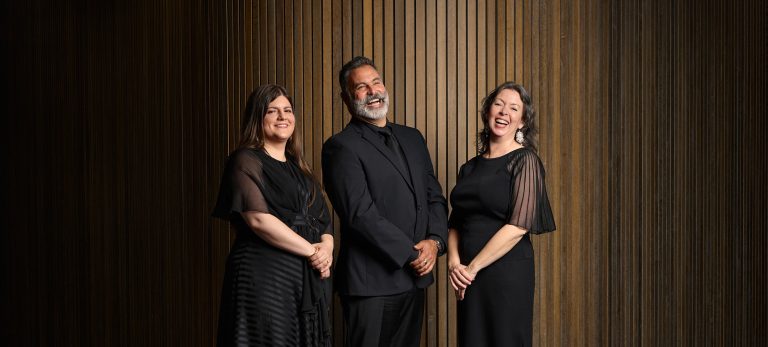
Celia Craig (oboe), Georgina Roberts (oboe / cor anglais), David Rowden (Artistic Director and clarinet), John Lewis (clarinet / bass clarinet), Ben Hoadley (bassoon), Simone Walters (bassoon), Michael Dixon (horn), Jenny Mcleod-Sneyd (horn), Lisa Osmialowski (flute), Paul Stender (cello), Alex Henery (double bass)

The Omega Ensemble has ended its tenth anniversary year with another delightfully mixed programme of wind music contrasting the known, the unknown and familiar music in new dress.

The concert opened with Carl Nielsen’s rarely performed Serenata in Vano (Serenade in Vain).  This is a ten minute trifle he produced in less than a week for an imminent regional concert tour of the Danish provinces.  It is an amiable work in three sections which came across well in the sympathetic acoustic of the City Recital Hall.  Nielsen described the first section as ‘chivalric and showy’, and this was well brought out by Celia Craig playing the first oboe and also by the enjoyable interchanges between the first clarinet and bassoon, played by David Rowden and Ben Hoadley.  The plaintive middle section displayed the ensemble’s fine blend and in the jaunty final section they nicely captured the playful spirit of the immediately hummable tune.  

The main work in the first half was Mozart’s superb Serenade in C minor K.388 for wind octet which was given a stylish and nicely balanced performance.  The first movement was very elegantly played – especially the graceful exchanges between Celia Craig and David Rowden.  The long phrases of the slow movement were well sustained and blended.  The minuet was also well-played, though some of the cross-rhythms occasionally seemed a little unstable.   The performance ended with a lively rendition of the sprightly finale.

After interval, the approaching Christmas season was acknowledged by Tchaikovsky’s Nutcracker Suite performed in a version for nine wind players and double bass in an arrangement by the modern German composer and arranger Andreas Tarkmann.  The items in this version differ slightly from those in the popular orchestral suite but include those best suited for performance by a wind ensemble.  This was a delightful performance that brought out the charm of Tchaikovsky’s ever-popular music.  Flautist Lisa Osmialowski extended the tone colour of the ensemble with attractive, fluent playing.  The tone colour of the ensemble was further widened with Georgina Roberts sometimes switching to cor anglais and John Lewis employing the bass clarinet.

Throughout the concert the Omega Ensemble displayed a unanimity of style and cohesion which is not always evident in groups with varying membership.  Playing first oboe, Celia Craig led with a fine sense of style.  Playing first clarinet, the ensemble’s Artistic Director David Rowden also displayed his customary fine playing, though he was uncharacteristically a little more reticent than necessary.  The performances were well supported by sensitive playing and a lightness of touch from the two bassoons and also by reliable support from the well-behaved horns.  Alex Henery’s double bass provided the only deep bass tone in the ensemble and he successfully switched between delicate pizzicato support and an expanded, full-tone underpinning of the whole ensemble as the musical context required.

Atmospheric coloured lighting has recently become fashionable in the City Recital Hall and whilst this is relatively harmless, I would put in a plea to keep it stationary.  Moving lighting effects create an unwelcome distraction from the performances.

A more welcome innovation is the establishment of the Omega Ensemble’s Digital Concert Hall (http://omegaensemble.com.au/digital-concert-hall/) which provides free access to videos of some of their previous performances.  This is a generous initiative which showcases the ensemble’s high standards of performance.  It also allows their regular audience members to enjoy their performances once again.

In addition to marking the successful end of the Omega Ensemble’s tenth anniversary season the concert was also the occasion for launching their programme for 2016 when they will again be the Ensemble in Residence for the City Recital Hall.  Next year promises a number of intriguing performances and signals the ensemble’s occasional expansion to chamber orchestra size.

Larry Turner for SoundsLikeSydney©

Larry Turner has been singing in choirs for many years – both in Sydney and London.  He is an avid attender of operas and concerts, with an emphasis on vocal music.  He particularly enjoys music from both the great a capella period and the baroque – especially the lesser-known works of Bach and Handel.  He has written programme notes for Sydney Philharmonia, the Intervarsity Choral Festival and the Sydneian Bach Choir and is currently part of a team researching the history of Sydney Philharmonia for its forthcoming centenary.


Similar Posts

  • The Reservoir Trio And Ella Brinch Perform Legendary Piano Quartets

    Special guest, viola player Ella Brinch, will join violinist Ursula Nelius, cellist Paul Stender and pianist Chris Cartner who make up the Reservoir Trio in December to perform two legendary piano quartets. Mozart’s Piano Quartet no 1 in G minor, K 478, is considered to be the genesis of music for this combination, and is a…

  • The Omega Ensemble – A World Premiere by Mark Isaacs,Stanhope and Mahler’s Fourth

    The Omega Ensemble presents an unusual and intimate performance of the music of Mahler in the July concert of their Virtuoso Series with guest artist, New York based Australian soprano, Jane Sheldon. Accompanying this German epic are two Australian works including a world premiere of  Chamber Symphony for ensemble and soprano, composed by Mark Isaacs and commissioned especially…

  • Concert Review: Splendour And Mystery/Sydney Chamber Choir

    Splendour and Mystery/ Sydney Chamber Choir
    Verbrugghen Hall, Sydney Conservatorium of Music
    Australian Digital Concert Hall
    25 March, 2023
    In Splendour and Mystery, Sydney Chamber Choir under the direction of Sam Allchurch joined forces with Camerata Antica led by Matthew Manchester and organist Thomas Wilson in an adventurous anthology of music written for double choir. Specialising in the music of the 16th and 17th centuries, the founder of Camerata Antica, Matthew Manchester playing the fiendishly difficult cornetto, was joined by Michael Wyborn, William Kinmont and Paolo Franks playing the equally challenging alto, tenor and bass sackbutts respectively.
    Bookended with pieces by Giovanni Gabrieli with one of his refreshing Canzonas in the middle, the program also contained music by living Australasian composers Clare Maclean and Brooke Shelley, Gabrieli’s contemporary and student Heinrich Schütz and 20th century composers John Tavener and Frank Martin. Together these composers explore and exploit the potential of the double choir with its opportunities for super-rich harmonies, added melodic lines, imitation, choral interplay and variations in the positioning of the singers.
    The opening motet, Gabrieli’s Jubilate Deo omnis terra, C 65 was quite literally a musical shout for joy. A major part of this journey back in time to Renaissance Venice was the unique sound of Camerata Antica. Heralded by the instruments, the 10 lines of the choir sang an uplifting, lively and tightly dotted chorus, alternating with homophonic passages. Allchurch and his ensemble clearly delineated the rhythms, changing time signatures, hemiolas and other displaced accents which created the buoyancy of this celebratory piece.
    John Tavener’s brilliant A Hymn to the Mother of God transcends the mortal and looks to the cosmic powers of Mother Mary. Writing in the style of canon, with imitative lines that start in quick succession and not necessarily in harmony, Tavener creates a sense of ‘other-worldliness’ in this simple but awe-inducing piece in three-sections. It was a slow burn as the two choirs sang with shimmering lightness and a sense of spinning through space, creating vivid colours and  clusters of clashing chords with impressive control as the voices rose in range and dynamic to its full-bodied climax.
    The program moved imperceptibly to the German Magnificat by Heinrich Schütz, as the choirs were joined by organ and instruments. This was a relevant and important inclusion as Gabrieli himself taught Schütz in this multi-choral technique which Schütz then developed in his own style.
    Clare Maclean’s moving Christ the King was sublimely sung, opening in the manner of a plainchant by the female voices which peeled off into mirroring phrases by the other voices, ending in a reprise of the plainchant. Premiered by this choir in 1984, it is precisely opportunities like these which new composers need for their music to be heard and re-heard until it becomes recognizable to listeners and enters the DNA of the concert repertoire.
    The short and brilliant burst of Gabrieli’s Canzona seconda, C 187  from Camerata Antica showcased these rudimentary instruments in all their imperfect glory as the choir positioned itself for Frank’s only unaccompanied choral work, the demanding  Mass for double choir, considered to be one of the finest and most complex pieces of 20th century choral music. The choir did ample justice to this piece which incorporates the aesthetics of Renaissance music, French Impressionism, Schoenberg’s twelve-note system and J S Bach. The altos began the Kyrie with a freely-flowing, supplicating melody; the Gloria built step-wise to cluster chords; the Credo was a business-like affirmation of faith; the canon-styled Et Resurrexit was levity, hope and word-painting to perfection; the Sanctus introduced softer harmonies from the male voices. The mass, Version 1, ended with a powerful Benedictus. Fast forward to 1926 and Martin added the Agnus Dei, the crowning glory to this choral magnum opus. The mass culminated in a glorious unification of the choirs.
    Brooke Shelley’s Heavenly Father, composed in 2022, performed in the presence of the composer was premiered in November 2022, by the Sydney Chamber Choir. A lyrical and beautifully textured piece, it is very pleasing that it has quickly been programmed again. Like the slightly older piece by Maclean, it is critical that new pieces of merit such as these, are given regular and frequent hearings so that they may be heard widely and face the test of time.
    Finally, Gabrieli’s Magnificat a 14, C 79 brought together the full instrumental and vocal forces of the ensemble. Using the 16th century Venetian technique of cori spezzati (split choirs), the brighter sound of the female voices and cornetto took to the left gallery with the male voices and the thrilling grunt of the bass and other sackbutts in the right gallery with a mixed ensemble placed and organ placed centrally on stage.
    This was an intelligent and audacious program from Allchurch, performed with glorious sound by a choir secure in technique, pitch and musicianship.

  • CD Review: Pillar Of Wisdom,Cantigas De Santa Maria IV/The Renaissance Players

    Cantigas de Santa Maria Volume IV Pillar of Wisdom The Renaissance Players, Tall Poppies, TP231 The Renaissance Players have released the penultimate volume in their 5 CD collection collectively called the Cantigas de Santa Maria. This CD, Pillar of Wisdom contains 10 songs, performed by the Renaissance Players, directed by Winsome Evans. A Spanish and…

One Comment

Leave a Reply

Your email address will not be published. Required fields are marked *