‘La Traviata’ – Demonstrates the Best Qualities of Traditional Productions
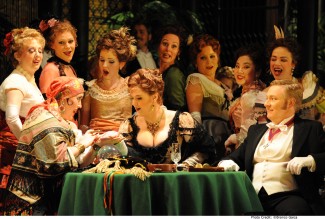
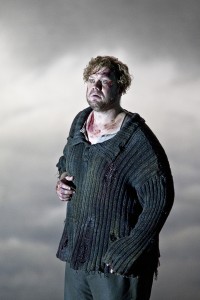
'La Traviata' - Dominica Matthews as Flora Bervoix, Michael Honeyman as Marquis d'Obigny & the Opera Australia Chorus.
‘La Traviata’ – Dominica Matthews as Flora Bervoix, Michael Honeyman as Marquis d’Obigny & the Opera Australia Chorus.

La Traviata  –  Giuseppe Verdi

Opera Australia, 30 July 2013

On 30 July Opera Australia continued its celebration of the bi-centenary of Verdi’s birth with a revival of Elijah Moshinsky’s sumptuous 1994 production of La Traviata.  This is a traditional view of the work which vividly brings to life the world of fashionable Parisian salons during the Belle Époque.  The premiere was held in the welcome presence of NSW’s music-loving governor, Professor Marie Bashir, who is often seen at Sydney performances.

The title role of Violetta was superbly sung by Emma Matthews who also sang Violetta last year in Opera Australia’s Handa Opera on Sydney Harbour.  Matthews again shines in the role whose coloratura and tessitura she tackles fearlessly.  Her performance spans the full expressive range from ethereal pianissimo up to full-voice climaxes in which she rides the orchestra with apparent ease.  Her interpretation is passionate and dramatically convincing throughout and underlines the emotional vulnerability of the character from the beginning.

The Polish tenor Arnold Rutkowski is well cast as Alfredo.  He creates a sympathetic stage presence and in the first act appears suitably diffident and unassuming, becoming more assertive as the character develops.  Rutkowski phrases sensitively and his even production opens out well at the top although on opening night he took some time to find his best voice.

José Carbó sang Giorgio Germont with his customary rich and full baritone.  He produced some very attractive legato singing and comfortably negotiated the role’s high tessitura.  Carbó projected a convincingly stern father, but there was little transformation or warmth as the character realises he has wrongly judged Violetta.  The numerous smaller roles were all well sung.

Moshinsky’s production has been successfully revived by Roger Press who has had extensive experience working on other opera productions.  The ornate Parisian salon stage sets originally designed by Michael Yeargan are full of detail and are again beautiful to behold.  They suggest the decadence that is bound to end badly.  The evocative autumnal scene which opens Act 2 is particularly successful in mirroring the approaching downturn in the plot.  Nigel Levings’s lighting is well judged throughout and is especially successful in conveying the internal and external worlds in the last act.

Patrick Lange, currently the musical director of the Berlin Komische Oper, conducted with a welcome expressiveness and flexibility of tempo that was noticeably absent in the previous revival of the production three years ago.  The orchestra played well, with some nicely phrased solos from the oboe and clarinet.  The occasional brief lapse of synchronisation between stage and pit, and the intonation of the exposed unison violin passages in the Act 3 prelude will probably benefit from further performances.

The chorus again displayed their full tone and clarity of attack.  They also demonstrated their dramatic flexibility as they became, in turn, habitués of the salons, gypsies, matadors and finally carnival revellers.

The production is now nearly 20 years old, but it displays the best qualities of traditional productions.  Apart from being glorious to look at, it focuses well on the opera’s narrative.  It has provided a vehicle for generations of singers to present their own interpretations and it must also have been a sound financial investment over the years.

La Traviata continues to be one of the most popular operas.  In this production it provides an ideal introduction for opera newcomers.  The experience of an exciting night at the theatre has been enhanced by placing several Belle Époque props in the northern foyer.
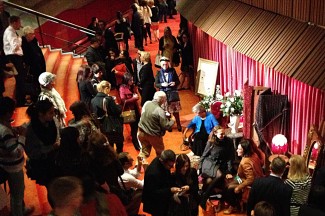
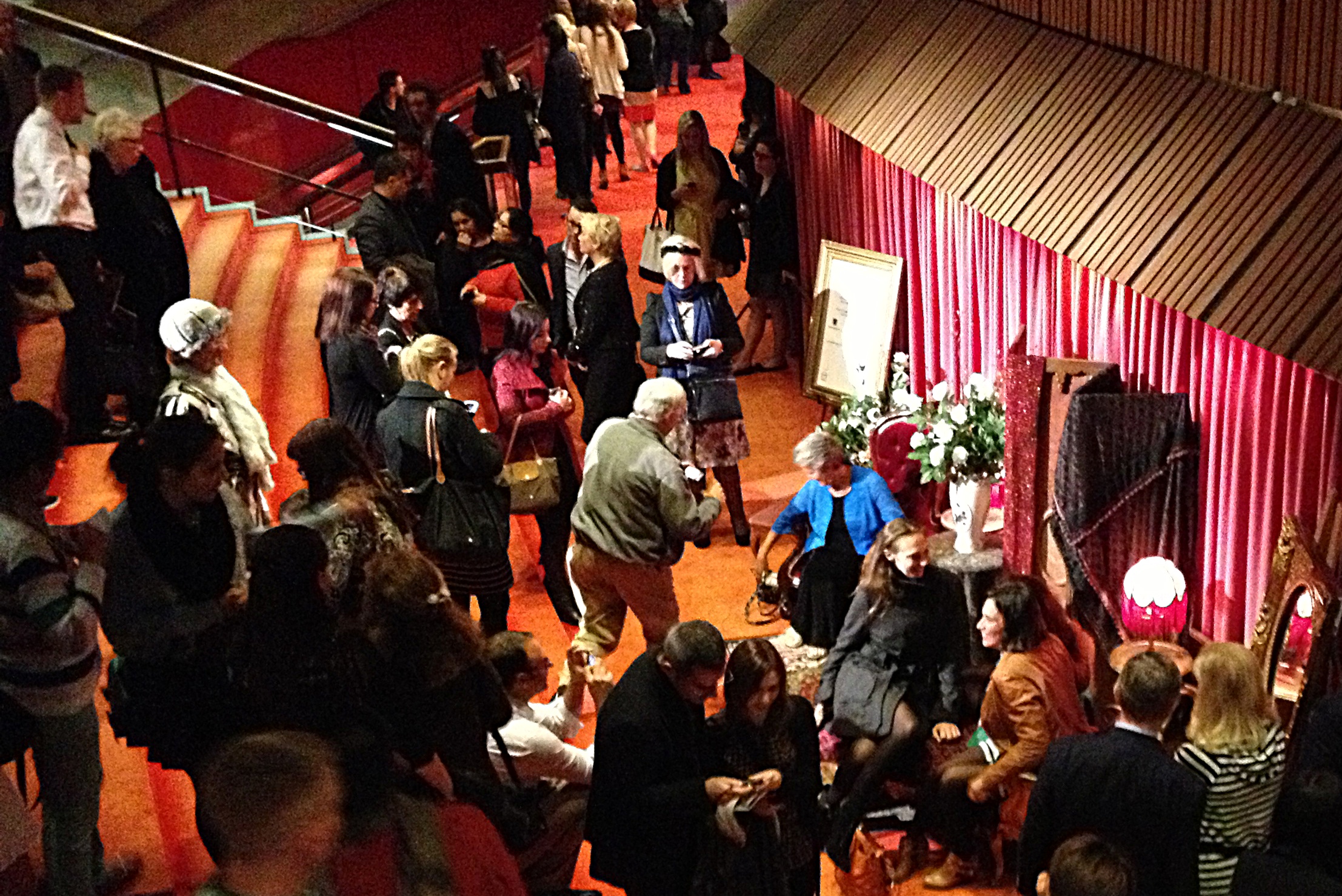
'Becoming Traviata' - the audience test  props from the production in the northern foyer of the opera theatre on opening night. Image Larry Turner
‘Becoming Traviata’ – the audience test props from the production in the northern foyer of the opera theatre on opening night. Image Larry Turner

During the intervals people can have their photos taken with the props, reclining on a chaise longue or standing inside a picture frame with an ornate background.  This proved to be very popular, especially with younger members of the audience.  Performances of La Traviata continue until the end of August.

Larry Turner for SoundsLikeSydney©

Larry Turner has been singing in choirs for many years – both in Sydney and London.  He is an avid attendee of operas and concerts, with an emphasis on vocal music.  He particularly enjoys music from both the great a capella period and the baroque – especially the lesser-known works of Bach and Handel.  He has written programme notes for Sydney Philharmonia, the Intervarsity Choral Festival and the Sydneian Bach Choir and is currently part of a team researching the history of Sydney Philharmonia for its forthcoming centenary.
 

Similar Posts

  • January Highlights

    January. It’s a good month to spend in Sydney. The frenzy of Christmas is over; New Year has been cast off with a stretch and a yawn. It’s time to sniff the air of what’s new and enjoy the unbridled ‘eclecticosm’ of Sydney in January before the relative safety of the year’s subscription series. Top…

  • Concert Review: Splendour And Mystery/Sydney Chamber Choir

    Splendour and Mystery/ Sydney Chamber Choir
    Verbrugghen Hall, Sydney Conservatorium of Music
    Australian Digital Concert Hall
    25 March, 2023
    In Splendour and Mystery, Sydney Chamber Choir under the direction of Sam Allchurch joined forces with Camerata Antica led by Matthew Manchester and organist Thomas Wilson in an adventurous anthology of music written for double choir. Specialising in the music of the 16th and 17th centuries, the founder of Camerata Antica, Matthew Manchester playing the fiendishly difficult cornetto, was joined by Michael Wyborn, William Kinmont and Paolo Franks playing the equally challenging alto, tenor and bass sackbutts respectively.
    Bookended with pieces by Giovanni Gabrieli with one of his refreshing Canzonas in the middle, the program also contained music by living Australasian composers Clare Maclean and Brooke Shelley, Gabrieli’s contemporary and student Heinrich Schütz and 20th century composers John Tavener and Frank Martin. Together these composers explore and exploit the potential of the double choir with its opportunities for super-rich harmonies, added melodic lines, imitation, choral interplay and variations in the positioning of the singers.
    The opening motet, Gabrieli’s Jubilate Deo omnis terra, C 65 was quite literally a musical shout for joy. A major part of this journey back in time to Renaissance Venice was the unique sound of Camerata Antica. Heralded by the instruments, the 10 lines of the choir sang an uplifting, lively and tightly dotted chorus, alternating with homophonic passages. Allchurch and his ensemble clearly delineated the rhythms, changing time signatures, hemiolas and other displaced accents which created the buoyancy of this celebratory piece.
    John Tavener’s brilliant A Hymn to the Mother of God transcends the mortal and looks to the cosmic powers of Mother Mary. Writing in the style of canon, with imitative lines that start in quick succession and not necessarily in harmony, Tavener creates a sense of ‘other-worldliness’ in this simple but awe-inducing piece in three-sections. It was a slow burn as the two choirs sang with shimmering lightness and a sense of spinning through space, creating vivid colours and  clusters of clashing chords with impressive control as the voices rose in range and dynamic to its full-bodied climax.
    The program moved imperceptibly to the German Magnificat by Heinrich Schütz, as the choirs were joined by organ and instruments. This was a relevant and important inclusion as Gabrieli himself taught Schütz in this multi-choral technique which Schütz then developed in his own style.
    Clare Maclean’s moving Christ the King was sublimely sung, opening in the manner of a plainchant by the female voices which peeled off into mirroring phrases by the other voices, ending in a reprise of the plainchant. Premiered by this choir in 1984, it is precisely opportunities like these which new composers need for their music to be heard and re-heard until it becomes recognizable to listeners and enters the DNA of the concert repertoire.
    The short and brilliant burst of Gabrieli’s Canzona seconda, C 187  from Camerata Antica showcased these rudimentary instruments in all their imperfect glory as the choir positioned itself for Frank’s only unaccompanied choral work, the demanding  Mass for double choir, considered to be one of the finest and most complex pieces of 20th century choral music. The choir did ample justice to this piece which incorporates the aesthetics of Renaissance music, French Impressionism, Schoenberg’s twelve-note system and J S Bach. The altos began the Kyrie with a freely-flowing, supplicating melody; the Gloria built step-wise to cluster chords; the Credo was a business-like affirmation of faith; the canon-styled Et Resurrexit was levity, hope and word-painting to perfection; the Sanctus introduced softer harmonies from the male voices. The mass, Version 1, ended with a powerful Benedictus. Fast forward to 1926 and Martin added the Agnus Dei, the crowning glory to this choral magnum opus. The mass culminated in a glorious unification of the choirs.
    Brooke Shelley’s Heavenly Father, composed in 2022, performed in the presence of the composer was premiered in November 2022, by the Sydney Chamber Choir. A lyrical and beautifully textured piece, it is very pleasing that it has quickly been programmed again. Like the slightly older piece by Maclean, it is critical that new pieces of merit such as these, are given regular and frequent hearings so that they may be heard widely and face the test of time.
    Finally, Gabrieli’s Magnificat a 14, C 79 brought together the full instrumental and vocal forces of the ensemble. Using the 16th century Venetian technique of cori spezzati (split choirs), the brighter sound of the female voices and cornetto took to the left gallery with the male voices and the thrilling grunt of the bass and other sackbutts in the right gallery with a mixed ensemble placed and organ placed centrally on stage.
    This was an intelligent and audacious program from Allchurch, performed with glorious sound by a choir secure in technique, pitch and musicianship.

  • Review: The Rabbits/ Opera Australia

      The Rabbits – Opera Australia/Barking Gecko Theatre Company/ Sydney Festival Roslyn Packer Theatre, Walsh Bay, 14 January, 2016 With four Helpmann Awards under its belt and successful seasons at the Perth International Arts Festival in February 2015 and the Melbourne Festival a few months later, The Rabbits had already established its credentials before its…

Leave a Reply

Your email address will not be published. Required fields are marked *