Review: ‘Siegfried’ Opera Australia
Opera Australia: Der Ring des Nibelungen: Siegfried
Arts Centre Melbourne/22 November 2013
*****
Brünnhilde’s final outpouring to Siegfried at the end of the second day of Wagner’s music drama begins: ‘O kindischer Held! O herrlischer Knabe! Du hehrster Taten töriger Hort!’ The terms ‘childish’, ‘boy’ and ‘foolish’ are among several along these lines that may point to why Neil Armfield and his creative production team staged Act I of Siegfried as they did.
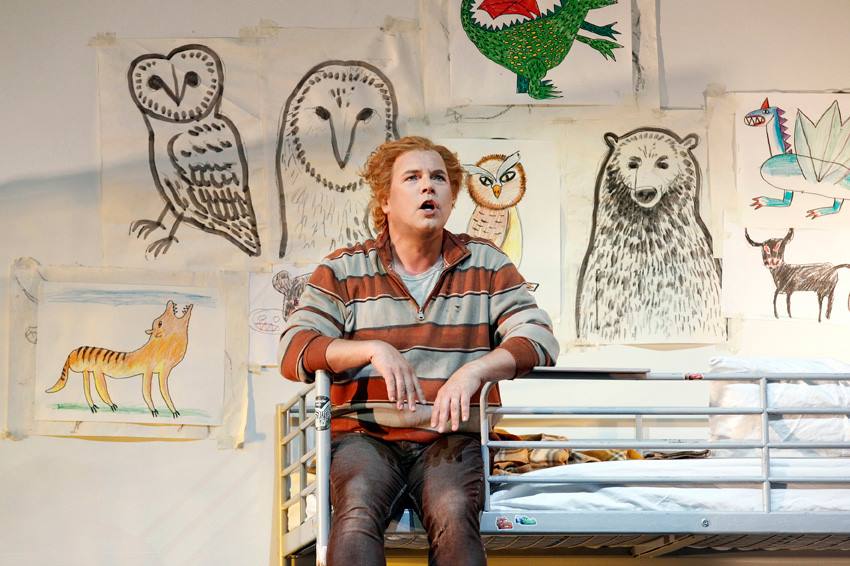
Mime’s home was a shallow white proscenium stage within a stage, which dominated a simple domestic setting comprising a kitchen, complete with microwave oven, a small forge and bunk beds. Siegfried sat on the upper bunk cutting paper animals and did his best throughout the scene to act like a brat. There was certainly nothing heroic in continually abusing Mime, throwing his food away and scattering rubbish for Mime to pick up. Pretending to be a bear rather than bringing home a real one, as described in the libretto, further reinforced the notion of childish ways, as did his delight in his wooden sword. Graeme Macfarlane’s interpretation of Mime tended to emphasise that character’s more positive, playful characteristics, thereby making Siegfried’s petulant outbursts even more alienating.
It soon became clear, however, that Siegfried is a victim of secrets, lies and Mime’s self interest. Macfarlane’s animated depiction of childish glee at point scoring against the Wanderer’s riddles also went some way to explaining Siegfried’s attitude; he had a very poor role model. In addition, the high, sterile walls were relieved only by Siegfried’s drawings of animals, which provided his only consolation. Stefan Vinke’s portrayal of an adolescent, raging with pent-up frustration and longing for true human companionship, was infused with youthful energy. His clear, vibrant tenor was pushed close to its limits a couple of times, but always conveyed a sense of the hero even when the character’s behavior did not. Vinke’s engaging personality also persuaded the audience to make allowances for the hero’s bumptious bravado and to share his triumphant exhilaration as he sliced through the walls of his white prison with his newly forged sword at the end of the act.
In Siegfried Wotan makes his final appearance, this time as the Wanderer in search of wisdom. He shows Mime how the sword can be forged, alerts Alberich of danger in front of the dragon’s cave and, finally, after waking and releasing Erda, confronts Siegfried as he goes to release Brünnhilde from the ring of fire. With long white hair and wearing sunglasses to act as a disguise, rather than the customary broad-brimmed hat, Terje Stensvold continued to radiate authority. A powerful, sculpted bare chest showing between the edges of a grizzled fur coat reinforced this impression. In addition to his imposing presence, Stensvold’s voice was enough to command instant respect. Even Warwick Fyfe’s terrific Albrecht paled slightly beside the power and beauty of Stensvold’s voice as he made this a ‘Ring’ to treasure. His acceptance of his loss of power when his defiant son smashes his staff was delivered with dignified stoicism; he knows that he cannot stop the turning of the wheel of Fate.
Strangely, there was no mention of Wotan’s encounter with Erda at the beginning of Act III in the Cast list/Synopsis sheet, nor was there any acknowledgement of the actress who mimed the part from a wheelchair, dressed in the suit previously worn by Deborah Humble in Das Rheingold. Wearing a black dress and veil, Humble stood behind the wheelchair, almost as an Erda shadow. Her response to Wotan’s summons was intense and darkly weighted as she referred him to their daughter Brünnhilde for advice. The interaction between Stensvold’s Wanderer and the elderly lady in the wheelchair may have been curious, but it was surprisingly moving as he bent over her and finally released Erda into eternal sleep.
The most forceful vocal contribution came from a judiciously amplified Jud Arthur in his role of Fafner/dragon. Jud Arthur’s resonant bass, combined with some superb weighty playing of Fafner’s hoard motif by the tuba and other lower reaches of the orchestra, served to create a chilling atmosphere of brooding threat. A giant projected image of Fafner’s head appeared behind the real Fafner as he slowly applied a clown’s makeup, seated before a mirror. Any resemblance to Pagliacci ended as he bared his teeth, painted his tongue red and his head white. He was also naked.
A visual motif of ‘The Ring Cycle’ as a particular type of theatre continued as the set revolved to reveal the outside of Fafner’s cave in a form that references Wagner’s Festspielhaus and the replica ‘Festspielhaus’ cladding the tram in the Arts Centre courtyard. Even the light bulbs surrounding the latter’s name find a parallel in the flashing light bulbs around the proscenium arch as the Wanderer first appears and as Siegfried passes through the fire. When the dragon is slain by fearless Siegfried inside the cave, a shower of red confetti spurted from the opening and Fafner then staggered out wearing only a liberal coating of red paint. Doubtless, some in the audience would have been shocked at Jud Arthur’s manly frame being exposed in this way and deemed it another gratuitous gimmick designed to shock rather than enlighten; theatre stripped bare taken a step too far. Others might have seen pathos in the vulnerability of the last of the giants and a telling reminder of Alberich’s curse.
In contrast, Siegfried’s nonchalance in the face of threat and his joy in nature provided welcome relief. His Papageno style attempts to communicate with the Woodbird were humorous and endearing. Taryn Fiebig made a vocally and physically delightful Woodbird. Flitting around the stage in a pale gold shimmering dress, her warning of Mime’s treachery further reinforced the value of nature as opposed to greed for wealth and power. Siegfried’s earlier bad behavior also became more understandable and forgivable as Mime’s true intentions were revealed to him through the power of the dragon’s blood.
The choice of having a glittering golden curtain slowly descend from the proscenium arch structure to depict the ring of fire appeared to be a renewed reference to Tivoli theatricals and the Rhine maidens. After all, Siegfried had claimed (and was wearing) the ring by this time. As the stage revolved, a life-sized representation of Brünnhilde’s horse appeared along with Brünnhilde herself in a crate covered with transparent plastic. While there is obviously a connection with the crated animals of Das Rheingold, a pantomime Snow White in her glass casket also sprang to mind, especially as Siegfried parted the glitter curtain with his sword, cut through the plastic and kissed her.
Whatever the intentions of Neil Armfield and his team, Stefan Vinke and Susan Bullock were superb. Vinke gave a most credible account of Siegfried’s bewildered naiveté and his sense of wonderment and joy at finding his companion. Bullock’s portrayal of Brünnhilde was finely layered as she moved from gradual awakening, along with a joyful recognition of her shining hero, to ambivalence concerning her loss of godhead. The staging of their final rapturous interchange focused on the sublime music and what these singers were able to bring vocally and emotionally to their roles. Underpinned by more fabulous playing from the orchestra under Pietari Inkinen, especially from the strings, their laughing abandon in the face of doom provided a thrilling climax to another absorbing evening.
Melbourne Ring Orchestra/ Conductor: Pietari Inkinen
Director: Neil Armfield/ Set Designer: Robert Cousins/ Costume Designer: Alice Babidge / Lighting Designer: Damian Cooper/ Sound Designer: Jim Atkins
CAST in order of appearance
Mime: Graeme Macfarlane/ Siegfried: Stefan Vinke/ Wanderer: Terje Stensvold/ Fafner: Jud Arthur/ Alberich: Warwick Fyfe/ Woodbird: Taryn Fiebig/ Erda: Deborah Humble/ Brünnhilde: Susan Bullock
Heather Leviston for SoundsLikeSydney©
Heather Leviston has devoted much of her life to listening to classical music and attending concerts. An addiction to vocal and string music has led her to undertake extensive training in singing and perform as a member of the Victoria State Opera chorus and as a soloist with various musical organisations. As a founding academic teacher of the Victorian College of the Arts Secondary School, she has had the privilege of witnessing the progress of many talented students, keenly following their careers by attending their performances both in Australia and overseas. As a reviewer, recently for artsHub, she has been keen to bring attention to the fine music-making that is on offer in Australia, especially in the form of live performance.