Album Review: Liquid Crystal/ Carbon And Raineri

Liquid Crystal

Luke Carbon/ Alex Raineri

Move Records MCD 615

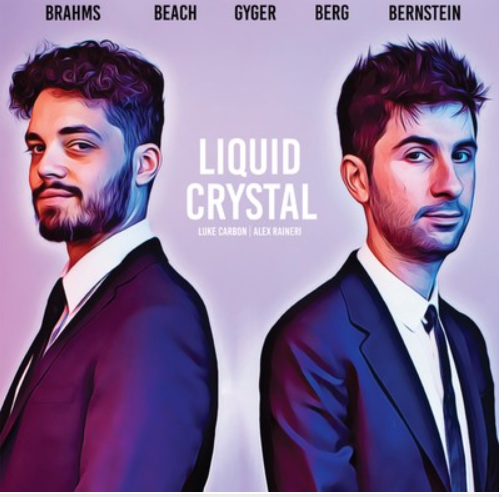
Liquid Crystal, a new CD release on the Move label, packs a lot of punch into just 1 hour of music. It features Melbourne-based clarinetist Luke Carbon with pianist Alex Raineri, performing an appealing program of music, comprising mostly bespoke pieces for clarinet and piano (Brahms, Berg, Bernstein and Gyger), with one piece by Amy Beach for violin and piano which Carbon has transcribed for clarinet and piano. Carbon and Raineri explore these pieces from the Romantic to the Modern, showcasing both traditional and newer aesthetics along with the rich tapestry of colours, tones phrasing and dynamics intrinsic to both the clarinet and the piano.

Brahms’ love affair with the clarinet is evident in the excitement of his writing in the two opus 120 sonatas for clarinet and piano of which the no 1 is on this recording. Inspired by the prowess of Richard Mühlfeld, principal clarinettist of the Meiningen Orchestra, Brahms himself was the pianist in the premieres of these sonatas by Mühlfeld. Brahms would have been very familiar with the rich possibilities afforded by the Romantic era piano which matched Brahms’ exploration of the full range of the clarinet and its tonal possibilities, ably explored by Carbon. Although the piano makes the first move with its brief introduction, Carbon and Raineri are equal partners with as much virtuosity demanded of the pianist as of the clarinetist. The graceful first movement has a stormy middle section returning to the subject and concluding in a coda that is expertly sustained and expressive as per Brahms’ instructions. The second movement, Andante un poco adagio, is played with limpid beauty. The third movement Allegro grazioso is bright and rhythmically reminiscent of a rambunctious Austrian ländler with the clarinet in a 3/4 feel, pitted against the piano in 6/8. The final Vivace is sprightly, its triplet rhythms adding to the complex textures.

Berg’s Four pieces for Clarinet and piano, opus 5 were dedicated to the Society for Private Musical Performances in Vienna and to its founder and president, Arnold Schönberg. Acknowledged as “miniatures” and composed in 1913 (though premiering in 1919), this small-scale style drew criticism from Schönberg himself. No Matter. The art of the miniature is that it narrates larger stories with fewer words and the duo give full vent to the many changes in tempo, the extreme dynamic range, articulation devices and shifts in mood of the Vier Stücke. Carbon introduces a cheeky motif in the first movement, Mäßig, moving later to a fluttered descending passage, the movement fading away into nothing. The second movement, Sehr langsam is taken very slowly with distinctive cross rhythms and excellent dynamic contrast. The contrast continues in the various tempi of the skittish third movement, Sehr rasch and finally, Langsam, where Carbon’s slow fluttering is mirrored by trills in the piano and its cross rhythms against Raineri’s piano line blur the metre, creating a long and languid aria for the soloist.

Amy Beach’s Romance for Violin and Piano, Op. 23 relives the intensity of Berg’s music with mellow, passionate, swoon-worthy stanzas. The piece transfers well to Carbon’s arrangement for the clarinet.

Bernstein’s Sonata for Clarinet and Piano, his only sonata for a wind instrument, is a piece with two dramatically different movements which embrace the aesthetics of the New World, with its sweeping phrases, brashness and jazzy idioms. Carbon and Raineri play the first movement, Grazioso with sustained lyricism and deftly accomplish the complex time changes and tempi of the second movement. As the pianist Brahms premiered his sonata with Mühlfeld, a 23-year-old Bernstein was the pianist at the premiere of this sonata performed by David Glazer on clarinet at the Institute of Modern Art in Boston.

The CD closes with the pieces from which it takes its title, Elliot Gyger’s Liquid Crystal, for which the composer won the 1990 2MBS-FM Young Composers’ Competition.

Liquid Crystal is a demanding and complex flurry of notes vividly illustrating what cascading liquid crystal might be like in sound. Comprising 12 shorter sections played continuously, the composer notes that “The twelve sections of the piece are arranged in a cycle of ever-increasing tension.” Carbon and Raineri affirm with their partnership, Gyger’s observation that “the two instruments are treated very much on equal terms, with neither predominating.” Described as lasting 12 minutes on the composer’s manuscript, Carbon and Raineri clock in at under 11 minutes in a time-defying and technically audacious performance.

Liquid Crystal is good listening as well as being a snapshot of two gifted artists. Students of the clarinet and piano would also find inspiration in this repertoire and performance.


Shamistha de Soysa for SoundsLikeSydney


Similar Posts

  • ‘Thoroughly enjoyable’ – Britten’s ‘Albert Herring’ from Opera Australia

    Albert Herring  –  Benjamin Britten Opera Australia, 16 August 2013 Amid the flurry of celebrations for this year’s Verdi and Wagner bicentenaries the centenary of the birth of Benjamin Britten has been overshadowed.  Opera Australia is commemorating it with a revival of John Cox’s 1976 production of Albert Herring – probably the earliest production to…

  • CD Review: Leonard Grigoryan’s ‘Solo’

    Guitarist Leonard Grigoryan has made an emphatic statement with the release of his first solo CD, not surprisingly called Solo. Part of a brilliant music family, Leonard has appeared with his brother Slava as an extremely successful and highly regarded duo, The Grigoryan Brothers. With this CD, he demonstrates that he is as accomplished a solo artist…

  • Concert Review: Dido And Aeneas/ Sydney Chamber Choir/ Muffat collective

    Sydney Chamber Choir/Muffat Collective Great Hall, University of Sydney 6 October 2017 Written by Wendy McLeod The Great Hall of the University of Sydney was packed out when the Sydney Chamber Choir conducted by Roland Peelman and accompanied by the Muffat Collective, presented an early music programme of love and loss which featured madrigals by…

  • Concert Review: Splendour And Mystery/Sydney Chamber Choir

    Splendour and Mystery/ Sydney Chamber Choir
    Verbrugghen Hall, Sydney Conservatorium of Music
    Australian Digital Concert Hall
    25 March, 2023
    In Splendour and Mystery, Sydney Chamber Choir under the direction of Sam Allchurch joined forces with Camerata Antica led by Matthew Manchester and organist Thomas Wilson in an adventurous anthology of music written for double choir. Specialising in the music of the 16th and 17th centuries, the founder of Camerata Antica, Matthew Manchester playing the fiendishly difficult cornetto, was joined by Michael Wyborn, William Kinmont and Paolo Franks playing the equally challenging alto, tenor and bass sackbutts respectively.
    Bookended with pieces by Giovanni Gabrieli with one of his refreshing Canzonas in the middle, the program also contained music by living Australasian composers Clare Maclean and Brooke Shelley, Gabrieli’s contemporary and student Heinrich Schütz and 20th century composers John Tavener and Frank Martin. Together these composers explore and exploit the potential of the double choir with its opportunities for super-rich harmonies, added melodic lines, imitation, choral interplay and variations in the positioning of the singers.
    The opening motet, Gabrieli’s Jubilate Deo omnis terra, C 65 was quite literally a musical shout for joy. A major part of this journey back in time to Renaissance Venice was the unique sound of Camerata Antica. Heralded by the instruments, the 10 lines of the choir sang an uplifting, lively and tightly dotted chorus, alternating with homophonic passages. Allchurch and his ensemble clearly delineated the rhythms, changing time signatures, hemiolas and other displaced accents which created the buoyancy of this celebratory piece.
    John Tavener’s brilliant A Hymn to the Mother of God transcends the mortal and looks to the cosmic powers of Mother Mary. Writing in the style of canon, with imitative lines that start in quick succession and not necessarily in harmony, Tavener creates a sense of ‘other-worldliness’ in this simple but awe-inducing piece in three-sections. It was a slow burn as the two choirs sang with shimmering lightness and a sense of spinning through space, creating vivid colours and  clusters of clashing chords with impressive control as the voices rose in range and dynamic to its full-bodied climax.
    The program moved imperceptibly to the German Magnificat by Heinrich Schütz, as the choirs were joined by organ and instruments. This was a relevant and important inclusion as Gabrieli himself taught Schütz in this multi-choral technique which Schütz then developed in his own style.
    Clare Maclean’s moving Christ the King was sublimely sung, opening in the manner of a plainchant by the female voices which peeled off into mirroring phrases by the other voices, ending in a reprise of the plainchant. Premiered by this choir in 1984, it is precisely opportunities like these which new composers need for their music to be heard and re-heard until it becomes recognizable to listeners and enters the DNA of the concert repertoire.
    The short and brilliant burst of Gabrieli’s Canzona seconda, C 187  from Camerata Antica showcased these rudimentary instruments in all their imperfect glory as the choir positioned itself for Frank’s only unaccompanied choral work, the demanding  Mass for double choir, considered to be one of the finest and most complex pieces of 20th century choral music. The choir did ample justice to this piece which incorporates the aesthetics of Renaissance music, French Impressionism, Schoenberg’s twelve-note system and J S Bach. The altos began the Kyrie with a freely-flowing, supplicating melody; the Gloria built step-wise to cluster chords; the Credo was a business-like affirmation of faith; the canon-styled Et Resurrexit was levity, hope and word-painting to perfection; the Sanctus introduced softer harmonies from the male voices. The mass, Version 1, ended with a powerful Benedictus. Fast forward to 1926 and Martin added the Agnus Dei, the crowning glory to this choral magnum opus. The mass culminated in a glorious unification of the choirs.
    Brooke Shelley’s Heavenly Father, composed in 2022, performed in the presence of the composer was premiered in November 2022, by the Sydney Chamber Choir. A lyrical and beautifully textured piece, it is very pleasing that it has quickly been programmed again. Like the slightly older piece by Maclean, it is critical that new pieces of merit such as these, are given regular and frequent hearings so that they may be heard widely and face the test of time.
    Finally, Gabrieli’s Magnificat a 14, C 79 brought together the full instrumental and vocal forces of the ensemble. Using the 16th century Venetian technique of cori spezzati (split choirs), the brighter sound of the female voices and cornetto took to the left gallery with the male voices and the thrilling grunt of the bass and other sackbutts in the right gallery with a mixed ensemble placed and organ placed centrally on stage.
    This was an intelligent and audacious program from Allchurch, performed with glorious sound by a choir secure in technique, pitch and musicianship.

  • Concert Review: Music On Music/ Sydney Chamber Choir

    Music on Music Sydney Chamber Choir Great Hall, The University of Sydney  Saturday 30 March 2019 7.30pm Written by Victoria Watson Sydney Chamber Choir was formed in the 1970s by students of Sydney University. In the decades since, it has evolved into a fine, tightly knit ensemble of musicians, dedicated to presenting choral works that…

Leave a Reply

Your email address will not be published. Required fields are marked *