
Album Review: Living/ Paul Cutlan String Project

Living/ Paul Cutlan String Project/ Earshift Music

The Paul Cutlan String Project’s second album Living is an eclectic and entertaining collection of mostly original pieces expertly played. Released on the Earshift label, the 6 tracks on the album make up just over 60 mts of music with the final piece in five continuous movements. Comprising Paul Cutlan (clarinet, bass clarinet/soprano saxophone), Liisa Pallandi (violin), Caroline Hopson (violin), James Eccles (viola), Oliver Miller (cello), Brett Hirst (bass), Gary Daley (piano) and Tunji Beier (cajon, kanjira, konnakol)) the ensemble “traces a narrative which traverses human life and its myriad experiences” in pieces by Cutlan, Daley, Jann Rutherford, John Coltrane and Jenna Cave.

The opening track also titled Living, is written by Cutlan himself. It is a pulsating multi-metric piece introduced by Tunji Beier on the cajón, a box-shaped percussion instrument which originated in Peru, played by striking the faces of the box with the hands or implements like brushes, mallets, or sticks. Cutlan writes that the inspiration for this piece came to him whilst on a train ride. Indeed, it conjures up the feeling of the rhythms and cross-rhythms of a train clattering along the tracks. The bass clarinet and strings provide melody and texture while the pizzicato double-bass anchors a walking rhythm.

Jenna Cave’s Sleep in my Arms is an account of her experiences as a new mother rocking her infant to sleep. It incorporates the sounds of soothing the baby, along with a hypnotic melody improvised by Cutlan on the clarinet.  The melody is intended to create “a magical feeling of bliss.” One by one the instruments join in, swelling the narrative, then fading to nothing as sleep descends with a final notated lullaby sung by the violin.

If espresso is your morning heart-starter then Thanks for the Espresso will truly counteract and calm with its delicate riffs. Cutlan has arranged this piece by the late New Zealand composer Jann Rutherford, as a tribute to her. The soprano saxophone is the star, but gives way to the other instruments in the middle section. A rolling 5-figure piano accompaniment underpins the saxophone until the strings provide a bridge to punctuated rhythms with a plucked double-bass as the piano takes over the improvisation.

The railway metaphor returns in Gary Daley’s Middle of the Moment. Bookended by recordings made at the Venice railway station, a motoric ostinato bass propels the piece forward, fading to silky lines on the piano which alternate with knots of cluster chords. Daley calls on the experience of suspending the brain’s “ceaseless wandering and bringing our focus down to the moment.” The closing bars are distinctive for the recitation of Konnakol by Tunji Beier, evoking the dance rhythms of South India.

John Coltrane’s After the Rain is an iridescent perfection of bass clarinet and cello in combination. The piano sparkles as if through breaks in the rain showers; tremolo strings and harmonics gather to create a magical soundscape in this freely metred gem.

Paul Cutlan’s The Eleventh Hour occupies most of the album and is a dramatic contrast in mood and aesthetic. Written in 5 movements – Prelude, Portent, Intransigence, Conflict and Desolation, it is more confronting than the previous pieces and commemorates the centenary of the end of the First World War in the form of Cutlan’s response to the human propensity to war and destruction. It is an expressive use of the instruments and differentiates amongst the various effects they can create. The bass clarinet is unusually used in a sombre fanfare; the strings create a chorale with the double bass spiking through; Intransigence sits uneasily with jagged strings, tremolo and unresolved discords. Conflict stabs and bursts with numerous percussive effects. Haunting strains of The Last Post and Silent Night (symbolising the Christmas truce of 1914) emerge through the texture.

Cutlan recounts that this album was devised between the time of Australia’s devastating bushfires in January 2020, and the COVID-19 pandemic the following March. He adds “The repertoire on this album serves as an antidote to the shock and trauma of this time as well as an affirmation of continuing existence of life.” The album was recorded over two days during the week before lockdown.

The CD booklet, illuminates with its insights and musician biographies. With its empathetic ensemble work and individual virtuosity, sit back and relax to the cool jazz that Living offers; or be challenged with its more confronting and cathartic pieces. Either way, Living will take you deep into the folds of another world.

Shamistha de Soysa for SoundsLikeSydney©


Similar Posts

  • A truly dazzling virtuoso – the keyed trumpet premieres in Sydney

    Gabriele Cassone playing the keyed trumpet with The Australian Brandenburg Orchestra, directed from the fortepiano by Paul Dyer, truly brought to life the title of the present series Dazzling Virtuoso with a breathtaking performance. A deliberate choice of adjective. The keyed trumpet, an instrument of the 18th century sits between the Baroque and the newer valved instruments, representing…

  • Concert Review: Splendour And Mystery/Sydney Chamber Choir

    Splendour and Mystery/ Sydney Chamber Choir
    Verbrugghen Hall, Sydney Conservatorium of Music
    Australian Digital Concert Hall
    25 March, 2023
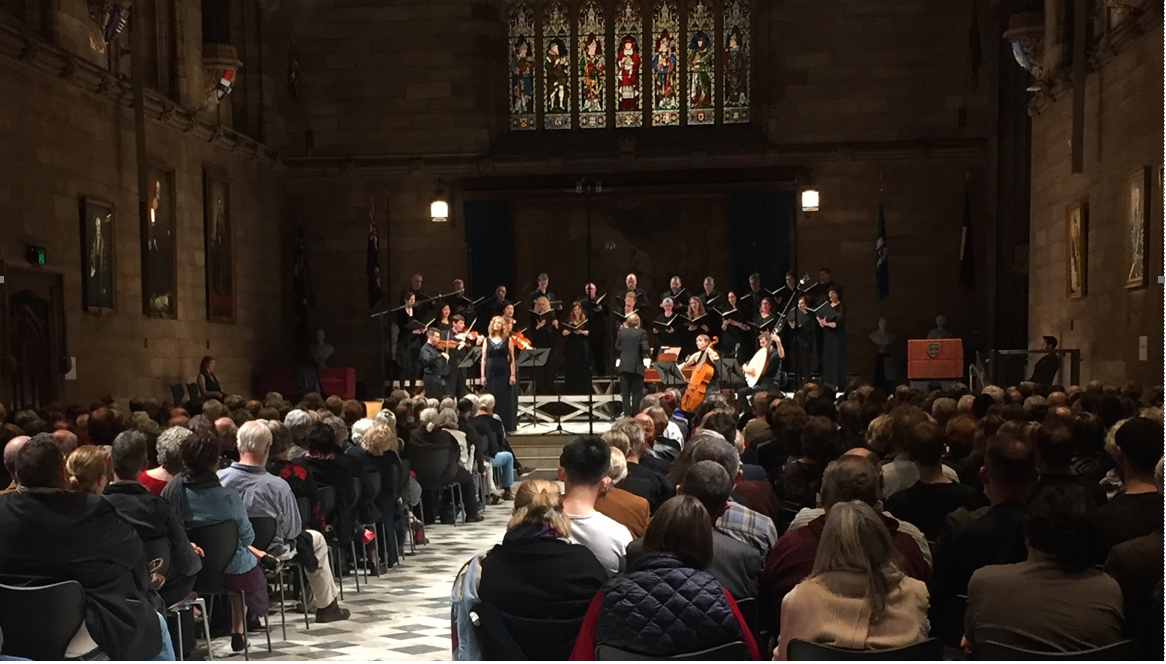
    In Splendour and Mystery, Sydney Chamber Choir under the direction of Sam Allchurch joined forces with Camerata Antica led by Matthew Manchester and organist Thomas Wilson in an adventurous anthology of music written for double choir. Specialising in the music of the 16th and 17th centuries, the founder of Camerata Antica, Matthew Manchester playing the fiendishly difficult cornetto, was joined by Michael Wyborn, William Kinmont and Paolo Franks playing the equally challenging alto, tenor and bass sackbutts respectively.
    Bookended with pieces by Giovanni Gabrieli with one of his refreshing Canzonas in the middle, the program also contained music by living Australasian composers Clare Maclean and Brooke Shelley, Gabrieli’s contemporary and student Heinrich Schütz and 20th century composers John Tavener and Frank Martin. Together these composers explore and exploit the potential of the double choir with its opportunities for super-rich harmonies, added melodic lines, imitation, choral interplay and variations in the positioning of the singers.
    The opening motet, Gabrieli’s Jubilate Deo omnis terra, C 65 was quite literally a musical shout for joy. A major part of this journey back in time to Renaissance Venice was the unique sound of Camerata Antica. Heralded by the instruments, the 10 lines of the choir sang an uplifting, lively and tightly dotted chorus, alternating with homophonic passages. Allchurch and his ensemble clearly delineated the rhythms, changing time signatures, hemiolas and other displaced accents which created the buoyancy of this celebratory piece.
    John Tavener’s brilliant A Hymn to the Mother of God transcends the mortal and looks to the cosmic powers of Mother Mary. Writing in the style of canon, with imitative lines that start in quick succession and not necessarily in harmony, Tavener creates a sense of ‘other-worldliness’ in this simple but awe-inducing piece in three-sections. It was a slow burn as the two choirs sang with shimmering lightness and a sense of spinning through space, creating vivid colours and  clusters of clashing chords with impressive control as the voices rose in range and dynamic to its full-bodied climax.
    The program moved imperceptibly to the German Magnificat by Heinrich Schütz, as the choirs were joined by organ and instruments. This was a relevant and important inclusion as Gabrieli himself taught Schütz in this multi-choral technique which Schütz then developed in his own style.
    Clare Maclean’s moving Christ the King was sublimely sung, opening in the manner of a plainchant by the female voices which peeled off into mirroring phrases by the other voices, ending in a reprise of the plainchant. Premiered by this choir in 1984, it is precisely opportunities like these which new composers need for their music to be heard and re-heard until it becomes recognizable to listeners and enters the DNA of the concert repertoire.
    The short and brilliant burst of Gabrieli’s Canzona seconda, C 187  from Camerata Antica showcased these rudimentary instruments in all their imperfect glory as the choir positioned itself for Frank’s only unaccompanied choral work, the demanding  Mass for double choir, considered to be one of the finest and most complex pieces of 20th century choral music. The choir did ample justice to this piece which incorporates the aesthetics of Renaissance music, French Impressionism, Schoenberg’s twelve-note system and J S Bach. The altos began the Kyrie with a freely-flowing, supplicating melody; the Gloria built step-wise to cluster chords; the Credo was a business-like affirmation of faith; the canon-styled Et Resurrexit was levity, hope and word-painting to perfection; the Sanctus introduced softer harmonies from the male voices. The mass, Version 1, ended with a powerful Benedictus. Fast forward to 1926 and Martin added the Agnus Dei, the crowning glory to this choral magnum opus. The mass culminated in a glorious unification of the choirs.
    Brooke Shelley’s Heavenly Father, composed in 2022, performed in the presence of the composer was premiered in November 2022, by the Sydney Chamber Choir. A lyrical and beautifully textured piece, it is very pleasing that it has quickly been programmed again. Like the slightly older piece by Maclean, it is critical that new pieces of merit such as these, are given regular and frequent hearings so that they may be heard widely and face the test of time.
    Finally, Gabrieli’s Magnificat a 14, C 79 brought together the full instrumental and vocal forces of the ensemble. Using the 16th century Venetian technique of cori spezzati (split choirs), the brighter sound of the female voices and cornetto took to the left gallery with the male voices and the thrilling grunt of the bass and other sackbutts in the right gallery with a mixed ensemble placed and organ placed centrally on stage.
    This was an intelligent and audacious program from Allchurch, performed with glorious sound by a choir secure in technique, pitch and musicianship.

  • Concert Review: Haydn and Mozart/Omega Ensemble

    Omega Ensemble: David Rowden (Artistic Director and basset clarinet), Natsuko Yoshimoto (violin), Ike See (violin), Neil Thompson (viola), Paul Stender (cello)  February 19, Utzon Room, Sydney Opera House Written by Larry Turner The Omega Ensemble’s weekend concert Haydn and Mozart was a superb performance of high calibre which suggests that it might more aptly be…

Leave a Reply

Your email address will not be published. Required fields are marked *