CD review ‘Spheres’: Music meets metaphysics
“The Heavenly Spheres make music for us,…….All things join in the dance!”

Gustav Holst

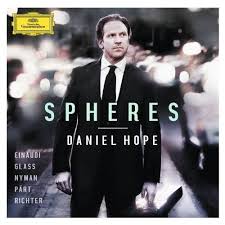
Having recently recorded Max Richter’s re-composition of Vivaldi’s Four Seasons for Deutsche Grammophon, violinist Daniel Hope looks to the elements yet again for inspiration in this recording called Spheres (DG 0289479 0571), which debuted at number 3 in the US BIllboard Classical charts.

With this collection, Hope has sought the common ground between music and astronomy – two subjects which he says, have fascinated him since childhood. He refers to philosophers like Pythagoras and Kepler “who were convinced that music was created when planets move or collide, and that music had a mathematical foundation, a kind of astronomical harmony”.

And so, he “bring(s) together music and time, including works by composers from different centuries who…are united by the age-old question: is there anything out there?”

In fact most of the 18 works on the recording are from the 20th century with just 2 -Johann Paul von Westhoff’s Imitazione delle campane (arr Badzura) and Johann Sebastian Bach’s Prelude in E minor BWV 855 from Das Wohltemperierte Clavier 1, arranged for string ensemble – deriving from the Baroque era. The other composers include Arvo Part (b 1935) the oldest, Philip Glass (b 1937), Elena Kats-Chernin ( 1957), Gabriel Prokofiev (grandson of Sergei, b 1975) and Alex Baranowski ( b 1983), UK based composer, arranger and alumni of Paul McCartney’s Liverpool  Institute for the Performing Arts, being the youngest.

The repertoire moves from the familiar, like Faure’s Cantique de Jean Racine opus 11 (ar. Rutter) to the more adventurous Spheres by the young Prokofiev, and includes four  world premiere recordings – Spheres, Baranowski’s Musica universalis, Aleksey Igudesman’s Lento and Karsten Gunderman’s Faust – Episode 2-Nachspiel. Some works have an obvious reference to the astral; others, like Kats-Chernin’s Eliza Aria and Nyman’s Trysting Fields have been selected for their compositional features which reflect the properties of spheres in orbit.

The idea of combining  music with metaphysics is not new. Haydn and Holst have already been there with The Creation and The Planets Suite, as has Stanley Kubrick in the cinematic, mind-bending experience that is 2001: A Space Odyssey. What this collection achieves is a mood of serene introspection,  a sense of  weightless travel  through time, of reverence and wonderment at the mysteries of creation. The string combinations create sonic textures as rare and as thin as the air in outer space; the inclusion of some choral items swells the texture and adds a sense of veneration without reference to creed.

Spheres typifies Hope’s creativity and his ability to adopt different perspectives. As well as an award winning international performing career and respected discography  – he has several Grammy nominations, a Classical BRIT award, the Deutsche Schallplattenpreis, and five ECHO Klassik Prizes – Hope also directs chamber ensembles from the violin, and has written three novels and several scripts for stage and presents on radio, film and TV. As described by The New York Times,  “he puts classical works within a broader context – not just among other styles and genres but amid history, literature, and drama – to emphasize music’s role as a mirror for struggle and aspiration.”

Hope’s collaborators on this recording include pianist Jacques Ammon, violinist Chiè Peters, cellist Christiane Starke and cellist Jochen Carls. As well, he has recruited the Deutsches Kammerorchester Berlin and members of the Rundfunkchor Berlin, all guided by conductor and chorus master Simon Halsey.

Now 39, Daniel Hope was spotted by Yehudi Menuhin when he was 11. Menuhin invited the young violinist to  join him in performing Bartók duos on German television. The mentorship blossomed and together, they performed over 60 concerts, including Lord Menuhin’s final concert appearance on March 7th 1999, in which he conducted Hope performing Alfred Schnittke’s Sonata for Violin and Chamber Orchestra.

If there were to be a shortcoming, it is that some works are too brief and take their leave before the ideas introduced have time to develop and be absorbed.

Daniel Hope plays the 1742 “Ex-Lipinski” Guarneri del Gesù violin, lent to him by an anonymous family from Germany.

Shamistha de Soysa for SoundsLikeSydney©


Similar Posts

  • ‘Messiah’ at St James’ King Street: a listener’s perspective

      Whatever the diet of musicians in Handel’s time, his performers must certainly have had tremendous stamina. ‘Messiah’ as Handel intended, for a chamber sized ensemble is a massive test of endurance, requiring a technique that supports the power of the ‘Hallelujah Chorus’, the coloratura of ‘All we like sheep’ and the hushed sostenuto of ‘Since by man came death’. After all this comes the mighty…

  • Opera Review: The Magic Flute/ Opera Australia

     The Magic Flute  –  W. A. Mozart Opera Australia, 7 January 2016 Joan Sutherland Opera Theatre, Sydney Opera House. Julie Taymor’s 2005 New York Metropolitan Opera production of Mozart’s The Magic Flute was first adapted for Sydney in 2012 and is now having its fourth series of performances in Opera Australia’s summer season.  It is…

  • New Alden production of “Dream” an abstraction of Britten’s life.

    Once in a while in opera, a new production comes along that fits so perfectly with the narrative, history and legend, that you wonder why it took so long for the concept to be realized. Christopher Alden’s new production of Britten’s “Midsummer Night’s Dream” at the ENO, is one such offering. More “Scream” than “Dream”,…

  • Concert Review: Splendour And Mystery/Sydney Chamber Choir

    Splendour and Mystery/ Sydney Chamber Choir
    Verbrugghen Hall, Sydney Conservatorium of Music
    Australian Digital Concert Hall
    25 March, 2023
    In Splendour and Mystery, Sydney Chamber Choir under the direction of Sam Allchurch joined forces with Camerata Antica led by Matthew Manchester and organist Thomas Wilson in an adventurous anthology of music written for double choir. Specialising in the music of the 16th and 17th centuries, the founder of Camerata Antica, Matthew Manchester playing the fiendishly difficult cornetto, was joined by Michael Wyborn, William Kinmont and Paolo Franks playing the equally challenging alto, tenor and bass sackbutts respectively.
    Bookended with pieces by Giovanni Gabrieli with one of his refreshing Canzonas in the middle, the program also contained music by living Australasian composers Clare Maclean and Brooke Shelley, Gabrieli’s contemporary and student Heinrich Schütz and 20th century composers John Tavener and Frank Martin. Together these composers explore and exploit the potential of the double choir with its opportunities for super-rich harmonies, added melodic lines, imitation, choral interplay and variations in the positioning of the singers.
    The opening motet, Gabrieli’s Jubilate Deo omnis terra, C 65 was quite literally a musical shout for joy. A major part of this journey back in time to Renaissance Venice was the unique sound of Camerata Antica. Heralded by the instruments, the 10 lines of the choir sang an uplifting, lively and tightly dotted chorus, alternating with homophonic passages. Allchurch and his ensemble clearly delineated the rhythms, changing time signatures, hemiolas and other displaced accents which created the buoyancy of this celebratory piece.
    John Tavener’s brilliant A Hymn to the Mother of God transcends the mortal and looks to the cosmic powers of Mother Mary. Writing in the style of canon, with imitative lines that start in quick succession and not necessarily in harmony, Tavener creates a sense of ‘other-worldliness’ in this simple but awe-inducing piece in three-sections. It was a slow burn as the two choirs sang with shimmering lightness and a sense of spinning through space, creating vivid colours and  clusters of clashing chords with impressive control as the voices rose in range and dynamic to its full-bodied climax.
    The program moved imperceptibly to the German Magnificat by Heinrich Schütz, as the choirs were joined by organ and instruments. This was a relevant and important inclusion as Gabrieli himself taught Schütz in this multi-choral technique which Schütz then developed in his own style.
    Clare Maclean’s moving Christ the King was sublimely sung, opening in the manner of a plainchant by the female voices which peeled off into mirroring phrases by the other voices, ending in a reprise of the plainchant. Premiered by this choir in 1984, it is precisely opportunities like these which new composers need for their music to be heard and re-heard until it becomes recognizable to listeners and enters the DNA of the concert repertoire.
    The short and brilliant burst of Gabrieli’s Canzona seconda, C 187  from Camerata Antica showcased these rudimentary instruments in all their imperfect glory as the choir positioned itself for Frank’s only unaccompanied choral work, the demanding  Mass for double choir, considered to be one of the finest and most complex pieces of 20th century choral music. The choir did ample justice to this piece which incorporates the aesthetics of Renaissance music, French Impressionism, Schoenberg’s twelve-note system and J S Bach. The altos began the Kyrie with a freely-flowing, supplicating melody; the Gloria built step-wise to cluster chords; the Credo was a business-like affirmation of faith; the canon-styled Et Resurrexit was levity, hope and word-painting to perfection; the Sanctus introduced softer harmonies from the male voices. The mass, Version 1, ended with a powerful Benedictus. Fast forward to 1926 and Martin added the Agnus Dei, the crowning glory to this choral magnum opus. The mass culminated in a glorious unification of the choirs.
    Brooke Shelley’s Heavenly Father, composed in 2022, performed in the presence of the composer was premiered in November 2022, by the Sydney Chamber Choir. A lyrical and beautifully textured piece, it is very pleasing that it has quickly been programmed again. Like the slightly older piece by Maclean, it is critical that new pieces of merit such as these, are given regular and frequent hearings so that they may be heard widely and face the test of time.
    Finally, Gabrieli’s Magnificat a 14, C 79 brought together the full instrumental and vocal forces of the ensemble. Using the 16th century Venetian technique of cori spezzati (split choirs), the brighter sound of the female voices and cornetto took to the left gallery with the male voices and the thrilling grunt of the bass and other sackbutts in the right gallery with a mixed ensemble placed and organ placed centrally on stage.
    This was an intelligent and audacious program from Allchurch, performed with glorious sound by a choir secure in technique, pitch and musicianship.

Leave a Reply

Your email address will not be published. Required fields are marked *