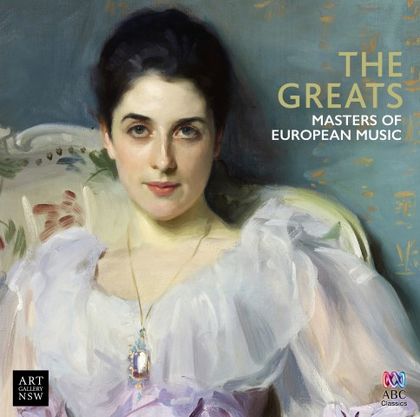
CD Review: The Greats – Masters Of European Music
Greats

Last weekend I had the exceptional pleasure of strolling through the Art Gallery of New South Wales, viewing its spring/summer exhibition of over 70 paintings – The Greats: masterpieces from the National Galleries of Scotland. The collection spans more than four centuries of art with works from the Renaissance (Botticelli’s The Virgin adoring the sleeping Christ child), Raeburn’s whimsical Reverend Robert Walker Skating on Duddingston Loch and Gauguin’s exotic Three Tahitians, keeping company with classics by Watteau, El Greco, Rembrandt, Monet, Pisarro and John Singer Sargent amongst others.

Far be it for the art enthusiasts to have all the fun – ABC Classics and the Art Gallery of New South Wales have released a compilation CD of music to accompany the paintings – The Greats: Masters of European Music  (ABC Classics 481 2236). Like the paintings, the fourteen tracks of just over 74 minutes of music, begin with the Renaissance (Ave Maria by Josquin des Prez) and end in the first decade of the 20th century (Debussy’s Clair de lune).

Some of these tracks may be on recordings that are already on iPods and in CD collections. However, The Greats: Masters of European Music is special because it takes some of the best of these tracks not just pairing them with great paintings, but itself creating a chronological thread of musical masterpieces which influenced musical writing through time.

A foreword by art historian Dr Josephine Touma explains the choice of music and muses on what makes art ‘great’. The musicians featured on the album are drawn from around the nation and include some of the best vocal and instrumental ensembles, soloists, chamber groups and orchestras.

Following the hushed reverence of the motet by des Prez, impeccably performed by Cantillation, conducted by Brett Weymark, The Song Company, conducted by Roland Peelman sings a brightly coloured rendition of Vessozi  augelli, a madrigal about the joys of nature by Franco-Flemish composer Giaches de Wert (1535 – 1596). de Wert was considered one of the most influential of madrigal composers.  Said to have influenced Monteverdi, de Wert  took the madrigal to new heights in Italy where he lived and worked.

Then follows an incomparable version of Allegri’s Miserere by Cantillation, conducted on this occasion by Antony Walker, with the crystal clear and seamlessly blended tones of sopranos Jane Sheldon and Belinda Montgomery, mezzo-soprano Jenny Duck-Chong and bass Richard Anderson forming the solo quartet.

Latitude 37, an ensemble comprising Baroque violinist Julia Fredersdorff, viola da gamba player Laura Vaughan, and Donald Nicolson on chamber organ deliver historically informed performances of two tracks – Canzon a due, canto e basso by Bartolomé de Selma Y Salaverde from 16th century Venice and the first movement of the Trio Sonata in D minor Opus 1 No 6 by Buxtehude.

There’s Pachelbel’s ubiquitous Canon in D major from the Adelaide Symphony Orchestra conducted by David Stanhope. Orchestra Victoria conducted by Richard Divall deliver a vibrant rendition of Rameau’s Overture to Naïs to accompany the viewing of his contemporary compatriot’s world of The Feasts of Venice.

Acknowledging the provenance of this touring collection, musically speaking, are an achingly beautiful Bovaglie’s Plaid composed by Scottish violinist, fiddler and composer James Scott Skinner (1843-1927), played by Australian-Scottish fiddle and piano duo Chris Duncan and Catherine Strutt, and Mendelssohn’s concert piece, the Overture to The Hebrides, inspired by a visit to Fingal’s Cave on the island of Staffa, in the Hebrides islands off Scotland’s west coast, and played by the Queensland Symphony Orchestra conducted by Wilfred Lehmann.

There are fine performances also from flautist Hans-Dieter Michatz with the Australian Brandenburg Orchestra and Artistic Director Paul Dyer AO, oboeist Diana Doherty with violinists Anna McDonald and Alice Evans and Sinfonia Australis. The Seraphim trio play the fourth movements of Schubert’s  Piano Quintet in A major, D667, (Trout), the Sydney Symphony Orchestra with conductor Matthias Bamert play Faure’s Pavane, Opus 50 and pianist John Chen closes the collection with Debussy’s Clair de lune breathing life into Monet’s Poplars on the Epte.

In addition to Dr Touma’s insights, the booklet accompanying the CD contains images from the exhibition, a full list of artists and the text of the songs in the collection.

It’s a cracker of an idea. Listen to the music as you marvel at the artworks and your immersion will be complete. The music lends a historical and narrative context to the art. And when the exhibition is long past, you have the music by which to remember it.

Shamistha de Soysa for SoundsLikeSydney©
 

Similar Posts

  • Australian Brandenburg’s Noël! Noël! On CD And DVD

    The Australian Brandenburg Orchestra and Choir under Artistic Director Paul Dyer AO, have released a recording of their popular annual Noël! Noël! Christmas concert. This release was recorded live at St Francis of Assisi Church, Paddington NSW in December 2016 and is a  Christmas celebration like only the charismatic Paul Dyer and the Australian Brandenburg Orchestra and Choir…

  • Concert Review: Sarah Grunstein/ Beethoven, Brahms And Schumann

    Sarah Grunstein, Beethoven, Brahms And Schumann Utzon Room, Sydney Opera House 23, September, 2018 Based on the concept of improvisation, pianist Sarah Grunstein performed a program of 19th century masterworks in the Utzon Room of the Sydney Opera House. It was a creative pairing of two late works – Beethoven’s Sonata no 30 in E…

  • Avi Avital Picture Gallery

    Check out these sumptuous images from virtuoso mandolin player Avi Avital’s opening night in Sydney with the Australian Brandenburg Orchestra at the City Recital Hall. Our reviewer Larry Turner was there and said the auditorium “was colourfully lit, strewn with candles and with  Middle-Eastern lamps suspended above the stage to evoke what Paul Dyer described…

  • Concert Review: Splendour And Mystery/Sydney Chamber Choir

    Splendour and Mystery/ Sydney Chamber Choir
    Verbrugghen Hall, Sydney Conservatorium of Music
    Australian Digital Concert Hall
    25 March, 2023
    In Splendour and Mystery, Sydney Chamber Choir under the direction of Sam Allchurch joined forces with Camerata Antica led by Matthew Manchester and organist Thomas Wilson in an adventurous anthology of music written for double choir. Specialising in the music of the 16th and 17th centuries, the founder of Camerata Antica, Matthew Manchester playing the fiendishly difficult cornetto, was joined by Michael Wyborn, William Kinmont and Paolo Franks playing the equally challenging alto, tenor and bass sackbutts respectively.
    Bookended with pieces by Giovanni Gabrieli with one of his refreshing Canzonas in the middle, the program also contained music by living Australasian composers Clare Maclean and Brooke Shelley, Gabrieli’s contemporary and student Heinrich Schütz and 20th century composers John Tavener and Frank Martin. Together these composers explore and exploit the potential of the double choir with its opportunities for super-rich harmonies, added melodic lines, imitation, choral interplay and variations in the positioning of the singers.
    The opening motet, Gabrieli’s Jubilate Deo omnis terra, C 65 was quite literally a musical shout for joy. A major part of this journey back in time to Renaissance Venice was the unique sound of Camerata Antica. Heralded by the instruments, the 10 lines of the choir sang an uplifting, lively and tightly dotted chorus, alternating with homophonic passages. Allchurch and his ensemble clearly delineated the rhythms, changing time signatures, hemiolas and other displaced accents which created the buoyancy of this celebratory piece.
    John Tavener’s brilliant A Hymn to the Mother of God transcends the mortal and looks to the cosmic powers of Mother Mary. Writing in the style of canon, with imitative lines that start in quick succession and not necessarily in harmony, Tavener creates a sense of ‘other-worldliness’ in this simple but awe-inducing piece in three-sections. It was a slow burn as the two choirs sang with shimmering lightness and a sense of spinning through space, creating vivid colours and  clusters of clashing chords with impressive control as the voices rose in range and dynamic to its full-bodied climax.
    The program moved imperceptibly to the German Magnificat by Heinrich Schütz, as the choirs were joined by organ and instruments. This was a relevant and important inclusion as Gabrieli himself taught Schütz in this multi-choral technique which Schütz then developed in his own style.
    Clare Maclean’s moving Christ the King was sublimely sung, opening in the manner of a plainchant by the female voices which peeled off into mirroring phrases by the other voices, ending in a reprise of the plainchant. Premiered by this choir in 1984, it is precisely opportunities like these which new composers need for their music to be heard and re-heard until it becomes recognizable to listeners and enters the DNA of the concert repertoire.
    The short and brilliant burst of Gabrieli’s Canzona seconda, C 187  from Camerata Antica showcased these rudimentary instruments in all their imperfect glory as the choir positioned itself for Frank’s only unaccompanied choral work, the demanding  Mass for double choir, considered to be one of the finest and most complex pieces of 20th century choral music. The choir did ample justice to this piece which incorporates the aesthetics of Renaissance music, French Impressionism, Schoenberg’s twelve-note system and J S Bach. The altos began the Kyrie with a freely-flowing, supplicating melody; the Gloria built step-wise to cluster chords; the Credo was a business-like affirmation of faith; the canon-styled Et Resurrexit was levity, hope and word-painting to perfection; the Sanctus introduced softer harmonies from the male voices. The mass, Version 1, ended with a powerful Benedictus. Fast forward to 1926 and Martin added the Agnus Dei, the crowning glory to this choral magnum opus. The mass culminated in a glorious unification of the choirs.
    Brooke Shelley’s Heavenly Father, composed in 2022, performed in the presence of the composer was premiered in November 2022, by the Sydney Chamber Choir. A lyrical and beautifully textured piece, it is very pleasing that it has quickly been programmed again. Like the slightly older piece by Maclean, it is critical that new pieces of merit such as these, are given regular and frequent hearings so that they may be heard widely and face the test of time.
    Finally, Gabrieli’s Magnificat a 14, C 79 brought together the full instrumental and vocal forces of the ensemble. Using the 16th century Venetian technique of cori spezzati (split choirs), the brighter sound of the female voices and cornetto took to the left gallery with the male voices and the thrilling grunt of the bass and other sackbutts in the right gallery with a mixed ensemble placed and organ placed centrally on stage.
    This was an intelligent and audacious program from Allchurch, performed with glorious sound by a choir secure in technique, pitch and musicianship.

Leave a Reply

Your email address will not be published. Required fields are marked *