CD Review: Water/ Hélène Grimaud

download

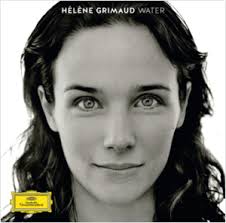
Pianist Hélène Grimaud’s recent recording Water, is an intensely pleasurable album which, at one level is a purely visceral experience which beckons you to immerse yourself in its calm and cooling waters, emerging cleansed and refreshed.

At another level, it serves as an elegant reminder of the fragility of our environment and the preciousness of water as an essential resource. Ironically, this week, news broke that Sydney had experienced its longest hot spell ever as temperatures rose above 26 degrees Celsius for 36 days in a row.

For this release on Deutsche Grammophon, Grimaud has collaborated with the eclectic British-Indian composer, performer and producer, Nitin Sawhney. Eight water themed piano compositions – Berio’s Wasserklavier , Takemitsu’s Rain Tree Sketch II, Fauré’s Barcarolle No.5, Ravel’s Jeux d’eau, Almería from Albéniz’s Iberia, Liszt’s Les Jeux d’eau à la Villa d’Este, the first movement of Janáček’s In the Mists and Debussy’s La cathédrale engloutie – are linked by seven distinctive bridging pieces, Transitions, written, performed on the keyboards and guitar, recorded and produced by Sawhney.

By selecting mostly 20th/21st century composers, Grimaud has eschewed romantic excess. Her playing is brilliant, simple and minimalist, allowing the colours and shimmering elemental effects of the many moods of water to emerge.

Appealing at a conceptual level as well, this is more than a collection of ambient music. The barely- there silences between the tracks, the well-considered sequence of works and Sawhney’s bridges create a soundscape that seems to be one continuous statement – or stream – than fifteen separate works.

The project embraces Grimaud’s twin passions of music and nature. She aims to entertain but also aims to “represent Nature…to interpret it and to stimulate change.” The inclusion of  aesthetics from diverse cultures, Takemitsu to Albeniz, Berio to Debussy and Sawhney’s own cameos underscore the global nature of Grimaud’s message.

Although Grimaud has observed that the message of the album is that it be experienced as a “journey from beginning to end, with that overarching structure and line running through,” she acknowledges the beauty of each track as a standalone piece and there will no doubt be listeners who may download individual tracks in isolation of her broader theme.

The disc was recorded live at the Wade Thompson Drill Hall at New York’s Park Avenue Armory in December 2014 during a collaboration between Grimaud and Turner Prize-winning artist Douglas Gordon. Their installation tears become… streams become… blended art, music and architecture centred on Grimaud’s water-themed programme. As Grimaud played, Gordon slowly flooded the vast floor of the Drill Hall to create the impression of what he described as an endless “field of water,” surrounding the grand piano on which Grimaud performed. The recording was then transformed into the album with Sawhney’s Transitions.

The CD booklet contains vivid images by Mat Henneck, images of the artists and insights from Grimaud.

Shamistha de Soysa for SoundsLikeSydney©

Water is available on Deutsche Grammophon 479 5268


Similar Posts

  • Concert Review: Splendour And Mystery/Sydney Chamber Choir

    Splendour and Mystery/ Sydney Chamber Choir
    Verbrugghen Hall, Sydney Conservatorium of Music
    Australian Digital Concert Hall
    25 March, 2023
    In Splendour and Mystery, Sydney Chamber Choir under the direction of Sam Allchurch joined forces with Camerata Antica led by Matthew Manchester and organist Thomas Wilson in an adventurous anthology of music written for double choir. Specialising in the music of the 16th and 17th centuries, the founder of Camerata Antica, Matthew Manchester playing the fiendishly difficult cornetto, was joined by Michael Wyborn, William Kinmont and Paolo Franks playing the equally challenging alto, tenor and bass sackbutts respectively.
    Bookended with pieces by Giovanni Gabrieli with one of his refreshing Canzonas in the middle, the program also contained music by living Australasian composers Clare Maclean and Brooke Shelley, Gabrieli’s contemporary and student Heinrich Schütz and 20th century composers John Tavener and Frank Martin. Together these composers explore and exploit the potential of the double choir with its opportunities for super-rich harmonies, added melodic lines, imitation, choral interplay and variations in the positioning of the singers.
    The opening motet, Gabrieli’s Jubilate Deo omnis terra, C 65 was quite literally a musical shout for joy. A major part of this journey back in time to Renaissance Venice was the unique sound of Camerata Antica. Heralded by the instruments, the 10 lines of the choir sang an uplifting, lively and tightly dotted chorus, alternating with homophonic passages. Allchurch and his ensemble clearly delineated the rhythms, changing time signatures, hemiolas and other displaced accents which created the buoyancy of this celebratory piece.
    John Tavener’s brilliant A Hymn to the Mother of God transcends the mortal and looks to the cosmic powers of Mother Mary. Writing in the style of canon, with imitative lines that start in quick succession and not necessarily in harmony, Tavener creates a sense of ‘other-worldliness’ in this simple but awe-inducing piece in three-sections. It was a slow burn as the two choirs sang with shimmering lightness and a sense of spinning through space, creating vivid colours and  clusters of clashing chords with impressive control as the voices rose in range and dynamic to its full-bodied climax.
    The program moved imperceptibly to the German Magnificat by Heinrich Schütz, as the choirs were joined by organ and instruments. This was a relevant and important inclusion as Gabrieli himself taught Schütz in this multi-choral technique which Schütz then developed in his own style.
    Clare Maclean’s moving Christ the King was sublimely sung, opening in the manner of a plainchant by the female voices which peeled off into mirroring phrases by the other voices, ending in a reprise of the plainchant. Premiered by this choir in 1984, it is precisely opportunities like these which new composers need for their music to be heard and re-heard until it becomes recognizable to listeners and enters the DNA of the concert repertoire.
    The short and brilliant burst of Gabrieli’s Canzona seconda, C 187  from Camerata Antica showcased these rudimentary instruments in all their imperfect glory as the choir positioned itself for Frank’s only unaccompanied choral work, the demanding  Mass for double choir, considered to be one of the finest and most complex pieces of 20th century choral music. The choir did ample justice to this piece which incorporates the aesthetics of Renaissance music, French Impressionism, Schoenberg’s twelve-note system and J S Bach. The altos began the Kyrie with a freely-flowing, supplicating melody; the Gloria built step-wise to cluster chords; the Credo was a business-like affirmation of faith; the canon-styled Et Resurrexit was levity, hope and word-painting to perfection; the Sanctus introduced softer harmonies from the male voices. The mass, Version 1, ended with a powerful Benedictus. Fast forward to 1926 and Martin added the Agnus Dei, the crowning glory to this choral magnum opus. The mass culminated in a glorious unification of the choirs.
    Brooke Shelley’s Heavenly Father, composed in 2022, performed in the presence of the composer was premiered in November 2022, by the Sydney Chamber Choir. A lyrical and beautifully textured piece, it is very pleasing that it has quickly been programmed again. Like the slightly older piece by Maclean, it is critical that new pieces of merit such as these, are given regular and frequent hearings so that they may be heard widely and face the test of time.
    Finally, Gabrieli’s Magnificat a 14, C 79 brought together the full instrumental and vocal forces of the ensemble. Using the 16th century Venetian technique of cori spezzati (split choirs), the brighter sound of the female voices and cornetto took to the left gallery with the male voices and the thrilling grunt of the bass and other sackbutts in the right gallery with a mixed ensemble placed and organ placed centrally on stage.
    This was an intelligent and audacious program from Allchurch, performed with glorious sound by a choir secure in technique, pitch and musicianship.

  • Arrebato fuses flameno, jazz and the world in their second CD “Absolucion”

    The style is possibly as difficult to define as the English meaning of their name – “Arrebato”, variously translated as “fury”, “something that rises rapidly” or “a wave of emotion”.  It’s fair to say that any and all of these describe the music of this ensemble. Arrebato release their second CD “Absolucion” in June 2011….

  • Concert Review: Faure’s Requiem From The Sydney Chamber Choir:Shining Light Into Worlds Beyond

     Faure’s Requiem The Sydney Chamber Choir and The Metropolitan Orchestra, April 12 2014. the City Recital Hall, Sydney.   In a world where concert producers seem to draw on a dizzying array of devices to tantalise audiences, the Sydney Chamber Choir delivered a potent reminder of the power of music, dispensing with distractions and focusing…

  • Concert Review: orchestra seventeen88 Chamber Soloists

    orchestra seventeen88 Chamber Soloists “Big Schoolroom”, Sydney Grammar School, Darlinghurst Saturday 21st November 2015 Kate Clark, flute/ Nicole van Bruggen, clarinet/ Darryl Poulsen, horn/ Lisa Goldberg, bassoon/ Jakob Lehmann, violin /Caroline Henbest, viola /Daniel Yeadon, cello/ Maxime Bibeau, double bass The ‘Big School’ room of Sydney Grammar School on College Street was an apt setting for orchestra seventeen88’s end of year…

  • Album Review: Günter Raphael streichquartette/ Acacia Quartet

    Acacia Quartet’s latest CD release Günter Raphael streichquartette features three string quartets by the German composer Günter Raphael (1903 – 1960). It is the fruition of a recent project which took the quartet to Berlin for a residency, in the spring of 2017. As with many stories, personal connections bring them to life. Acacia’s first…

Leave a Reply

Your email address will not be published. Required fields are marked *