CD Review: Yuja Wang – Ravel

download (1)

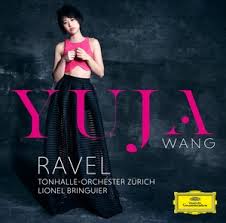
Turning twenty-nine next month, pianist Yuja Wang has released her sixth recording with Deutsche Grammophon, Yuja Wang: Ravel. On it she performs Maurice Ravel’s two piano concertos  – the G major and the Concerto for the Left Hand in D major. The palate cleanser between these two is Gabriel Fauré’s Ballade in F# minor for solo piano opus 19. It is Wang’s first exploration of French repertoire on disc. Performing with her is Zurich’s Tonhalle Orchestra conducted by its newly appointed Chief Conductor and Music Director, Lionel Bringuier.

Though written contemporaneously, the two concertos are strikingly different and their pairing on this recording is a convincing statement of Yuja Wang’s versatility and brilliance. The first movement of the G major concerto (Allegramente) is a parade of saucy jazz rhythms, Spanish aesthetics, the shimmering colours of Impressionism and a toccata-like section . Wang plays the second movement (Adagio assai) with tenderness and a clarity that is sustained through the rippling phrases, culminating in an intimate dialogue with the cor anglais. Wang maintains a fearsome Presto in the third movement, brash and intense.

The Concerto for the Left Hand is an altogether darker and more raucous piece, though still heavily influenced by jazz. Ravel composed it at the behest of pianist  Paul Wittgenstein, older brother of the philosopher Ludwig. The concerto is remarkable because Wittgenstein lost his right arm doing battle in World War I and Ravel composed the concerto without allowing Wittgenstein’ disability to compromise the concerto’s technical and expressive demands.  Yuja Wang gives a brilliant account of the concerto, opening with the growling cadenza and negotiating its many rhythmic and technical complexities with aplomb.

Fauré presented his Ballade in F# minor opus 19  to Liszt in when they met in Weimar in 1877. Astonishingly, Liszt said he found it too difficult to play. Not so Yuja Wang who delivers a sensitive and lyrical performance with a shimmering lightness of touch that is in stark contrast to the more percussive sound of the left hand concerto which follows.

Conducting the Zurich Tonhalle Orchestra is Lionel Bringuier, (b Nice, 1986), just a year older than a the pianist and a pianist and cellist himself. Bringuier was appointed in 2014 to succeeded the legendary David Zinman as the Chief Conductor and Music Director of the Zurich Tonhalle. The collaboration between Wang, Bringuier  and the Tonhalle Orchestra promises to be a prodigious one. Wang has already performed as Artist in Residence with the ensemble and there are plans afoot to work together on music by Brahms and Mozart.

Highly Recommended.

Shamistha de Soysa for SoundsLikeSydney© 

Insights from both the pianist and the conductor during the recording of the CD.


Similar Posts

  • Album Review: From Darkness To Light/ Hewgill/ Ashkenazy/ Decca

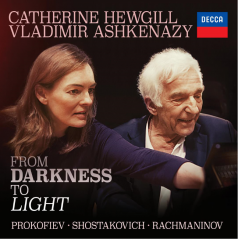
    From Darkness to Light is a new single CD release from Decca Classics on which cellist Catherine Hewgill and conductor and pianist Vladimir Ashkenazy perform the cello sonatas of Prokofiev and Shostakovich followed by Rachmaninov’s Vocalise.  The pairing of the sonatas is undeniably suitable on many counts. Hewgill and Ashkenazy have collaborated closely over many…

  • Concert Review: Splendour And Mystery/Sydney Chamber Choir

    Splendour and Mystery/ Sydney Chamber Choir
    Verbrugghen Hall, Sydney Conservatorium of Music
    Australian Digital Concert Hall
    25 March, 2023
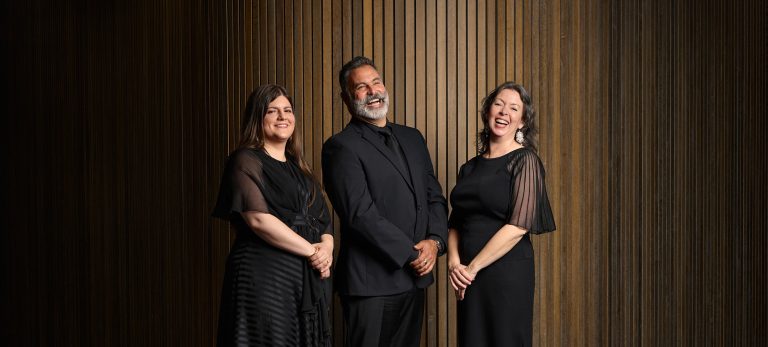
    In Splendour and Mystery, Sydney Chamber Choir under the direction of Sam Allchurch joined forces with Camerata Antica led by Matthew Manchester and organist Thomas Wilson in an adventurous anthology of music written for double choir. Specialising in the music of the 16th and 17th centuries, the founder of Camerata Antica, Matthew Manchester playing the fiendishly difficult cornetto, was joined by Michael Wyborn, William Kinmont and Paolo Franks playing the equally challenging alto, tenor and bass sackbutts respectively.
    Bookended with pieces by Giovanni Gabrieli with one of his refreshing Canzonas in the middle, the program also contained music by living Australasian composers Clare Maclean and Brooke Shelley, Gabrieli’s contemporary and student Heinrich Schütz and 20th century composers John Tavener and Frank Martin. Together these composers explore and exploit the potential of the double choir with its opportunities for super-rich harmonies, added melodic lines, imitation, choral interplay and variations in the positioning of the singers.
    The opening motet, Gabrieli’s Jubilate Deo omnis terra, C 65 was quite literally a musical shout for joy. A major part of this journey back in time to Renaissance Venice was the unique sound of Camerata Antica. Heralded by the instruments, the 10 lines of the choir sang an uplifting, lively and tightly dotted chorus, alternating with homophonic passages. Allchurch and his ensemble clearly delineated the rhythms, changing time signatures, hemiolas and other displaced accents which created the buoyancy of this celebratory piece.
    John Tavener’s brilliant A Hymn to the Mother of God transcends the mortal and looks to the cosmic powers of Mother Mary. Writing in the style of canon, with imitative lines that start in quick succession and not necessarily in harmony, Tavener creates a sense of ‘other-worldliness’ in this simple but awe-inducing piece in three-sections. It was a slow burn as the two choirs sang with shimmering lightness and a sense of spinning through space, creating vivid colours and  clusters of clashing chords with impressive control as the voices rose in range and dynamic to its full-bodied climax.
    The program moved imperceptibly to the German Magnificat by Heinrich Schütz, as the choirs were joined by organ and instruments. This was a relevant and important inclusion as Gabrieli himself taught Schütz in this multi-choral technique which Schütz then developed in his own style.
    Clare Maclean’s moving Christ the King was sublimely sung, opening in the manner of a plainchant by the female voices which peeled off into mirroring phrases by the other voices, ending in a reprise of the plainchant. Premiered by this choir in 1984, it is precisely opportunities like these which new composers need for their music to be heard and re-heard until it becomes recognizable to listeners and enters the DNA of the concert repertoire.
    The short and brilliant burst of Gabrieli’s Canzona seconda, C 187  from Camerata Antica showcased these rudimentary instruments in all their imperfect glory as the choir positioned itself for Frank’s only unaccompanied choral work, the demanding  Mass for double choir, considered to be one of the finest and most complex pieces of 20th century choral music. The choir did ample justice to this piece which incorporates the aesthetics of Renaissance music, French Impressionism, Schoenberg’s twelve-note system and J S Bach. The altos began the Kyrie with a freely-flowing, supplicating melody; the Gloria built step-wise to cluster chords; the Credo was a business-like affirmation of faith; the canon-styled Et Resurrexit was levity, hope and word-painting to perfection; the Sanctus introduced softer harmonies from the male voices. The mass, Version 1, ended with a powerful Benedictus. Fast forward to 1926 and Martin added the Agnus Dei, the crowning glory to this choral magnum opus. The mass culminated in a glorious unification of the choirs.
    Brooke Shelley’s Heavenly Father, composed in 2022, performed in the presence of the composer was premiered in November 2022, by the Sydney Chamber Choir. A lyrical and beautifully textured piece, it is very pleasing that it has quickly been programmed again. Like the slightly older piece by Maclean, it is critical that new pieces of merit such as these, are given regular and frequent hearings so that they may be heard widely and face the test of time.
    Finally, Gabrieli’s Magnificat a 14, C 79 brought together the full instrumental and vocal forces of the ensemble. Using the 16th century Venetian technique of cori spezzati (split choirs), the brighter sound of the female voices and cornetto took to the left gallery with the male voices and the thrilling grunt of the bass and other sackbutts in the right gallery with a mixed ensemble placed and organ placed centrally on stage.
    This was an intelligent and audacious program from Allchurch, performed with glorious sound by a choir secure in technique, pitch and musicianship.

  • Concert Review: Haydn’s Creation/Australian Haydn Ensemble

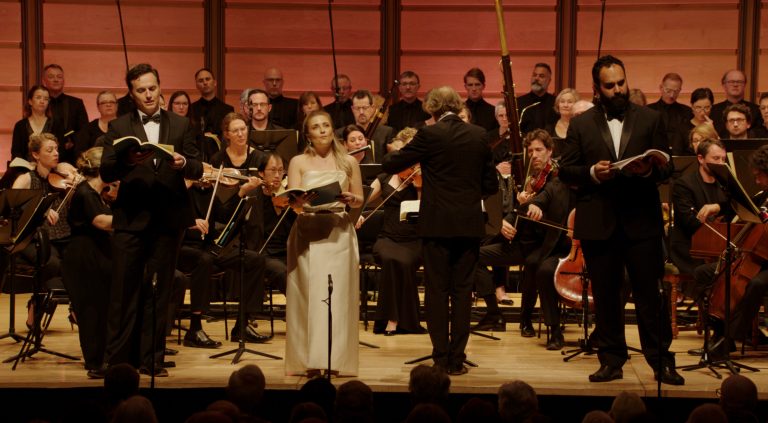
    The Australian Haydn Ensemble celebrated its tenth anniversary with a with a resplendent performance of Josef Haydn’s 1798 hero oratorio, The Creation, in collaboration with exceptional vocal soloists, an augmented ensemble of period and replica instruments and the Sydney Chamber Choir, all under the direction of Roland Peelman.

  • Mahler2/SSO:’A thrilling valediction’

    Peter McCallum reviews the opening night performance of Mahler’s Symphony No 2 ‘Resurrection’ by the Sydney Symphony Orchestra with soprano Emma Matthews, mezzo-soprano Michelle DeYoung and the Sydney Philhamonia Choirs, conducted by Vladimir Ashkenazy: http://www.smh.com.au/entertainment/music/a-rich-and-brooding-farewell-to-majestic-mahler-odyssey-20111124-1nwtb.html The performance is repeated on Friday 25th, Saturday 26th and Monday 28th November, with a live broadcast on ABC Classic…

5 Comments

Leave a Reply

Your email address will not be published. Required fields are marked *