Concert Review: Chancellor’s Concert / Sydney Conservatorium Of Music Symphony Orchestra
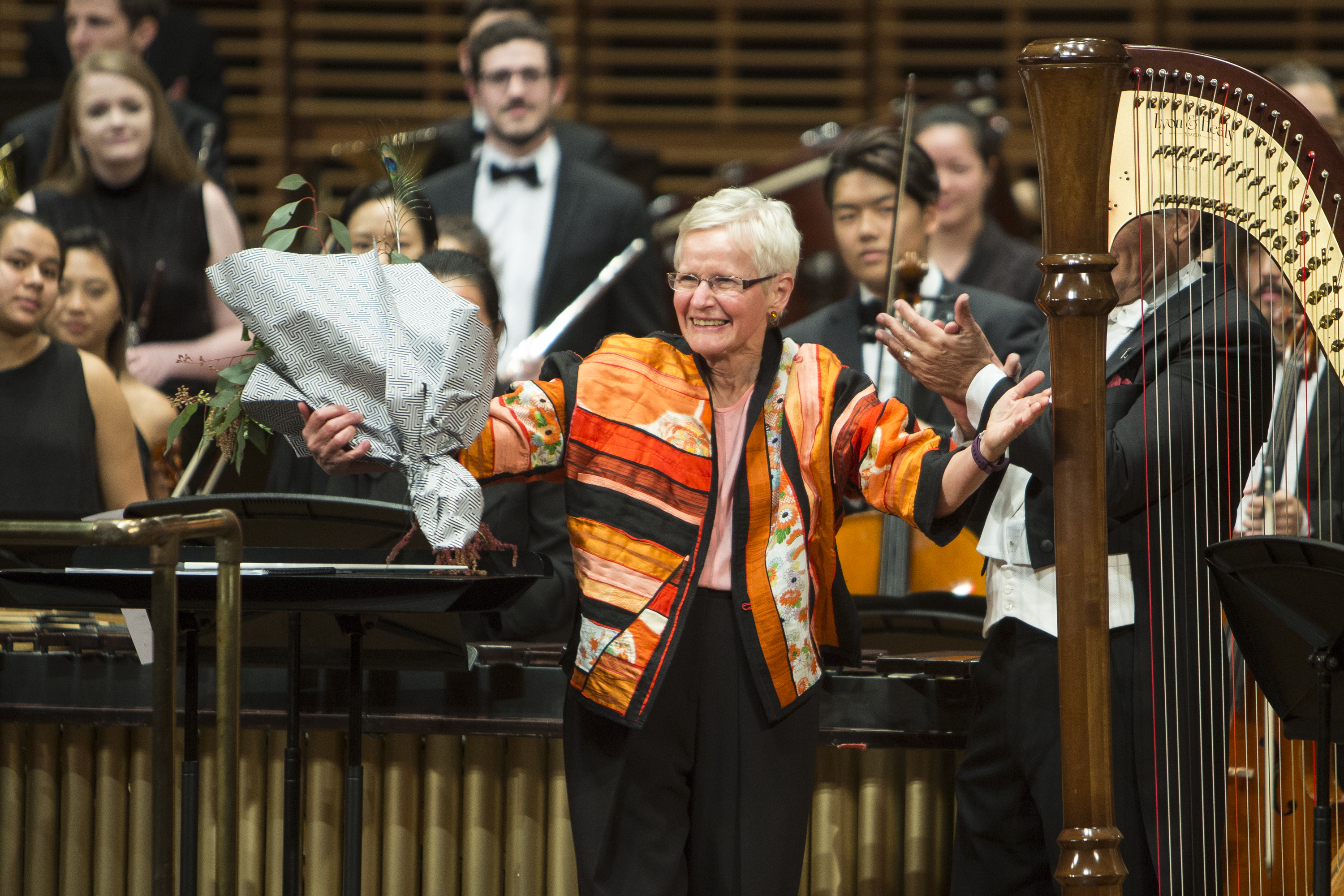
Professor Anne Boyd Am takes a bow at the Chancellor's Concert, Sydney Conservatorium of Music (photo by Jamie Williams Photography)
Professor Anne Boyd AM, takes a bow at the Chancellor’s Concert, Sydney Conservatorium of Music (photo by Jamie Williams Photography)

Chancellor’s Concert, Sydney Conservatorium of Music Symphony Orchestra,

Verbrugghen Hall

March 31 2017

Written by Ria Andriani

The fourth in Sydney Conservatorium’s Chancellor’s Concert series, this outstanding performance brought an exciting program which Maestro Eduardo Diazmuñoz had designed as an homage to women in music as composers, performers and as muses. Aptly enough it was performed in honour of Belinda Hutchinson AM, Chancellor of the University of Sydney.

The concert opened with the world premiere of Professor Anne Boyd AM’s orchestral piece, Olive Pink’s Garden. The work was inspired by Olive Muriel Pink, an artist and scientist who made a garden out of the desert landscape of Alice Springs. It was rich in its use of orchestral tropes which evoked this magical place. The connection to the land was conveyed through the presence of constant ostinato which contrasted with the pentatonic melody played by the harp, strings and marimba. In its simplicity, it painted the dramatic yet arid landscape in which the garden is set, as well as the many birds and animals who have made it their home. As I listened to the music, I could well conjure up visions of the sunrise, sunset and rain in this wonderful desert garden.

Gordon Jacob’s Flute Concerto No 1 featured Breeanna Moore, the winner of the 2016 Sydney Conservatorium of Music Woodwind Concerto Competition. It called for a smaller ensemble made up mostly of strings. The work is quite conservative in its compositional technique, showcasing Breeanna Moore’s virtuosity as a flautist, and the string section’s capacity as accompanists. Throughout the four-movement work the flute was never lost in the rich texture of the strings, yet when the occasion demanded, they answered her as equal partners.

The program’s most ambitious item was Stravinsky’s Rite of Spring, performed after the interval. It was no mean feat for the Sydney Conservatorium of Music Orchestra, considering how much preparation each and every performer must make. It is famous for inciting a riot during its premiere in 1913 because of its daring and primitive subject matter. The Rite of Spring tells the story of a pagan girl who dances herself to death in honour of the coming spring. Although I felt the underlying narrative was lacking, as a performance challenge the members of SCMO rose to it magnificently. Many of these musicians will now go on to perform this work as part of their standard repertoire. My biggest kudos goes to bassoonist Jordy Meulenbroeks and the percussion section who truly brought this work to life in the final movement.

Ria Andriani graduated with Bachelor of Music/ Bachelor of Arts from UNSW in 2015. She now sings as a soprano with various choirs in Sydney, and presents recitals in collaboration with other musicians. Follow Ria on www.facebook.com/RiaAndrianiSoprano

SoundsLikeSydney©


Similar Posts

  • Review: Handel’s Messiah/St Mary’s Singers

    Handel: Messiah St Mary’s Singers St Mary’s Cathedral, Sydney 6 December 2014   Performances of Handel’s Messiah are a habitual prelude to the Christmas season, with presentations in churches and concert halls throughout the country.  Musical styles are as varied as the performance locations, ranging from attempts to recreate original eighteenth century practices to massed…

  • Concert Review: Splendour And Mystery/Sydney Chamber Choir

    Splendour and Mystery/ Sydney Chamber Choir
    Verbrugghen Hall, Sydney Conservatorium of Music
    Australian Digital Concert Hall
    25 March, 2023
    In Splendour and Mystery, Sydney Chamber Choir under the direction of Sam Allchurch joined forces with Camerata Antica led by Matthew Manchester and organist Thomas Wilson in an adventurous anthology of music written for double choir. Specialising in the music of the 16th and 17th centuries, the founder of Camerata Antica, Matthew Manchester playing the fiendishly difficult cornetto, was joined by Michael Wyborn, William Kinmont and Paolo Franks playing the equally challenging alto, tenor and bass sackbutts respectively.
    Bookended with pieces by Giovanni Gabrieli with one of his refreshing Canzonas in the middle, the program also contained music by living Australasian composers Clare Maclean and Brooke Shelley, Gabrieli’s contemporary and student Heinrich Schütz and 20th century composers John Tavener and Frank Martin. Together these composers explore and exploit the potential of the double choir with its opportunities for super-rich harmonies, added melodic lines, imitation, choral interplay and variations in the positioning of the singers.
    The opening motet, Gabrieli’s Jubilate Deo omnis terra, C 65 was quite literally a musical shout for joy. A major part of this journey back in time to Renaissance Venice was the unique sound of Camerata Antica. Heralded by the instruments, the 10 lines of the choir sang an uplifting, lively and tightly dotted chorus, alternating with homophonic passages. Allchurch and his ensemble clearly delineated the rhythms, changing time signatures, hemiolas and other displaced accents which created the buoyancy of this celebratory piece.
    John Tavener’s brilliant A Hymn to the Mother of God transcends the mortal and looks to the cosmic powers of Mother Mary. Writing in the style of canon, with imitative lines that start in quick succession and not necessarily in harmony, Tavener creates a sense of ‘other-worldliness’ in this simple but awe-inducing piece in three-sections. It was a slow burn as the two choirs sang with shimmering lightness and a sense of spinning through space, creating vivid colours and  clusters of clashing chords with impressive control as the voices rose in range and dynamic to its full-bodied climax.
    The program moved imperceptibly to the German Magnificat by Heinrich Schütz, as the choirs were joined by organ and instruments. This was a relevant and important inclusion as Gabrieli himself taught Schütz in this multi-choral technique which Schütz then developed in his own style.
    Clare Maclean’s moving Christ the King was sublimely sung, opening in the manner of a plainchant by the female voices which peeled off into mirroring phrases by the other voices, ending in a reprise of the plainchant. Premiered by this choir in 1984, it is precisely opportunities like these which new composers need for their music to be heard and re-heard until it becomes recognizable to listeners and enters the DNA of the concert repertoire.
    The short and brilliant burst of Gabrieli’s Canzona seconda, C 187  from Camerata Antica showcased these rudimentary instruments in all their imperfect glory as the choir positioned itself for Frank’s only unaccompanied choral work, the demanding  Mass for double choir, considered to be one of the finest and most complex pieces of 20th century choral music. The choir did ample justice to this piece which incorporates the aesthetics of Renaissance music, French Impressionism, Schoenberg’s twelve-note system and J S Bach. The altos began the Kyrie with a freely-flowing, supplicating melody; the Gloria built step-wise to cluster chords; the Credo was a business-like affirmation of faith; the canon-styled Et Resurrexit was levity, hope and word-painting to perfection; the Sanctus introduced softer harmonies from the male voices. The mass, Version 1, ended with a powerful Benedictus. Fast forward to 1926 and Martin added the Agnus Dei, the crowning glory to this choral magnum opus. The mass culminated in a glorious unification of the choirs.
    Brooke Shelley’s Heavenly Father, composed in 2022, performed in the presence of the composer was premiered in November 2022, by the Sydney Chamber Choir. A lyrical and beautifully textured piece, it is very pleasing that it has quickly been programmed again. Like the slightly older piece by Maclean, it is critical that new pieces of merit such as these, are given regular and frequent hearings so that they may be heard widely and face the test of time.
    Finally, Gabrieli’s Magnificat a 14, C 79 brought together the full instrumental and vocal forces of the ensemble. Using the 16th century Venetian technique of cori spezzati (split choirs), the brighter sound of the female voices and cornetto took to the left gallery with the male voices and the thrilling grunt of the bass and other sackbutts in the right gallery with a mixed ensemble placed and organ placed centrally on stage.
    This was an intelligent and audacious program from Allchurch, performed with glorious sound by a choir secure in technique, pitch and musicianship.

  • Opera Review: The Marriage Of Figaro/ Opera Australia

    Le nozze di Figaro (The Marriage of Figaro) Opera Australia Joan Sutherland Theatre, Sydney opera House 18 October 2019 Written by Deen Hamaker Based on Pierre Beaumarchais’ 1778 play La Folle Journée, ou Le Mariage de Figaro (The Mad Day, or The Marriage of Figaro), Wolfgang Amadeus Mozart’s opera is among the most popular of…

Leave a Reply

Your email address will not be published. Required fields are marked *