Concert Review: Cycles/ Australia Ensemble UNSW

Cycles/ Australia Ensemble UNSW

John Clancy Auditorium

May 21, 2022

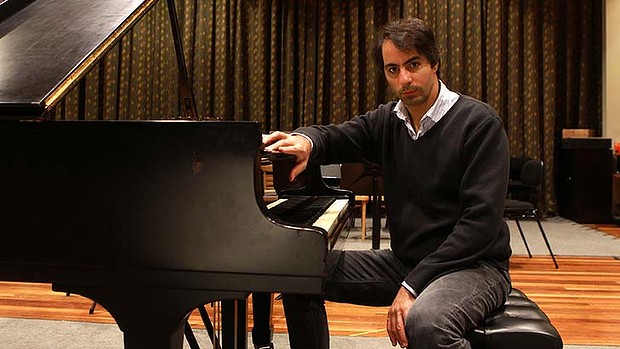
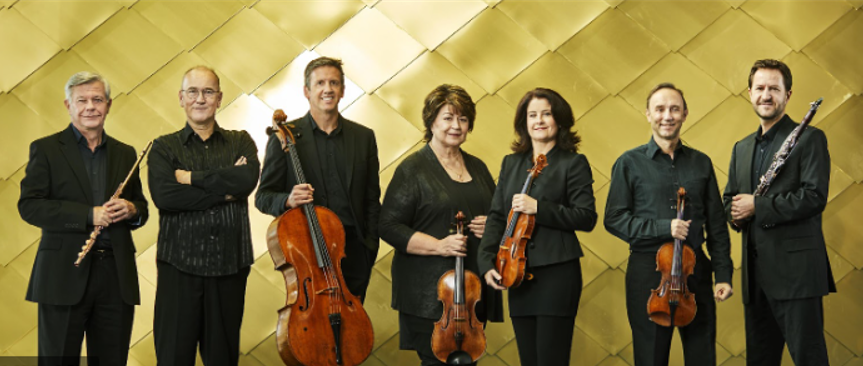
The Sir John Clancy Auditorium at the University of New South Wales, was the setting for the Australia Ensemble’s “Cycles” concert last Saturday. The Australia Ensemble, comprising core members violinists Dene Olding, Dimity Hall, violist Irina Morozova and cellist Julian Smiles with flautist Lisa Osmialowski, clarinetist David Griffiths, bassoonist Andrew Barnes and pianist Ian Munro presented an evening of music by Beethoven, Glanville-Hicks, Greenbaum and Brahms.

The players worked well to create a genuine sense of ensemble in Beethoven’s Trio Op. 87 in the challenging acoustic of the John Clancy. Sizeable wooden panels which surround the stage and part of the auditorium create a peformance space which is resonant but lacking in warmth. This makes it challenging for the blending of bigger ensembles, let alone smaller ones. The early composition date (contemporaneous with his Op. 1) is clear from the quality of the music if not the high opus number. Flautist Lisa Osmialowski acquitted the rapid scales throughout the work with ease, and clarinettist David Griffiths’ tone was pleasantly strong, especially in the higher register. They, alongside bassoonist Andrew Barnes, created a pleasing sound, very likely more appealing than the original instrumentation of two cors anglais and bassoon might have been.

In a break from the published programme order, the Concertino da Camera (1946) for flute, clarinet, bassoon and piano by Peggy Glanville-Hicks followed. This work, arguably the highlight of the programme, was an effective three-movement essay in a more neoclassical style than listeners would be used to from her Etruscan Concerto or Concerto Romantico, but the work does not suffer for it. The handling of harmony is the main driver throughout, with dissonances used to preserve momentum between diatonic spaces, and effective use of major chords for what are effectively ‘cadence points’ for example, at the end of the slow middle movement. Osmialowski, Griffiths and Barnes all played with appropriate verve and colour in their own right, working in favour of the clarity of the individual lines, over the piano.

Stuart Greenbaum’s Easter Island, (2008) a septet for flute, bass clarinet, string quartet and piano, is a seven-movement piece played continuously which narrates the rise and fall of civilisations on the eponymous island. It was commissioned by the Australia Ensemble, resident at the University of New South Wales and is dedicated to the composer’s children in the hope of inheriting a peaceful and viable planet. While the music depicts this with some success, the piece when considered on its own, is not quite satisfying. The programmatic elements depicting the settling of Easter Island and its subsequent overpopulation, whilst a powerful message, should not distract from the importance of evaluating the music itself.  The opening solo flute passage, depicting the island and well played by Osmialowski, and the dance music, depicting the people, contain engaging material. However, the flute theme only returns right at the end with no development, and the dance music is simply repeated in large sections, in different keys with different instrumentation. The low, loud theme depicting the famous moai (which Greenbaum refers to as “stone heads”) is unheralded and apparently unconnected to what happens around it, except for the programmatic purpose. Griffiths’ talents on bass clarinet were exhibited in one short solo, and left me wanting more. Greenbaum uses the string quartet of Dene Oldling, Dimity Hall, Irina Morozov and Julian Smiles as a separate block, with little opportunity for them to explore more unusual or interesting colours with other ensemble members.

Brahms’ Piano Quartet No. 3 is his best work for this scoring. The first movement plays itself, though Oldling’s violin could become thin-toned in higher registers. The second movement is more challenging, as exhibited by a slipped passage at the climax. The real challenge in this work, however, is in the third and fourth movements, which can often drag, due to the writing and which need a strong sense of momentum with a broad colour palette to maintain interest. Smiles was largely responsible for the success of the third movement, with a round-toned, well-executed initial solo, and supporting pizzicato which provided some light but very present bass throughout. It was a feature of his playing throughout the night. The last movement didn’t carry the momentum of the third movement, as Brahms’ noodling between the subject returns began to weigh down on an ensemble which I sensed was slightly holding back on the extremes of dynamics, expression and colour.

Leaving the auditorium, it struck me that the concert title “Cycles” was only tenuously linked with the programming. Some established, truly cyclical works, from composers at the peak of their powers, more broadly representative of what the ensemble’s website called “cycles of time and nature with the associated themes of regeneration and vitality” might have created a better thematic fit. The night was nonetheless a display of solid, skilful ensemble playing, of music which was interesting if not an unqualified success.

Stephen McCarthy for SoundsLikeSydney©

Stephen McCarthy is an emerging writer and composer from Sydney, Australia. His writings on music include a series of essays on various operas; the first of these, “A Redefinition of Opera? Lay Thoughts on Seeing Philip Glass’ Akhnaten”, was published in the UNSWeetened Literary Journal. He also won the Nan Manefield Young Writers’ Award and the Senior Poetry Prize in the Mosman Youth Awards in Literature for his poem, “On the Ellipsis”.

As a composer, Stephen’s works include: for solo piano, an Improvisation, a Sonatina and a ballet after Thomas Hardy’s novel Far From the Madding Crowd; and a setting of Robert Bridges’ “Noel: Christmas Eve, 1913” for SSATBB choir.



Similar Posts

  • Album Review: Günter Raphael streichquartette/ Acacia Quartet

    Acacia Quartet’s latest CD release Günter Raphael streichquartette features three string quartets by the German composer Günter Raphael (1903 – 1960). It is the fruition of a recent project which took the quartet to Berlin for a residency, in the spring of 2017. As with many stories, personal connections bring them to life. Acacia’s first…

  • Concert Review: Splendour And Mystery/Sydney Chamber Choir

    Splendour and Mystery/ Sydney Chamber Choir
    Verbrugghen Hall, Sydney Conservatorium of Music
    Australian Digital Concert Hall
    25 March, 2023
    In Splendour and Mystery, Sydney Chamber Choir under the direction of Sam Allchurch joined forces with Camerata Antica led by Matthew Manchester and organist Thomas Wilson in an adventurous anthology of music written for double choir. Specialising in the music of the 16th and 17th centuries, the founder of Camerata Antica, Matthew Manchester playing the fiendishly difficult cornetto, was joined by Michael Wyborn, William Kinmont and Paolo Franks playing the equally challenging alto, tenor and bass sackbutts respectively.
    Bookended with pieces by Giovanni Gabrieli with one of his refreshing Canzonas in the middle, the program also contained music by living Australasian composers Clare Maclean and Brooke Shelley, Gabrieli’s contemporary and student Heinrich Schütz and 20th century composers John Tavener and Frank Martin. Together these composers explore and exploit the potential of the double choir with its opportunities for super-rich harmonies, added melodic lines, imitation, choral interplay and variations in the positioning of the singers.
    The opening motet, Gabrieli’s Jubilate Deo omnis terra, C 65 was quite literally a musical shout for joy. A major part of this journey back in time to Renaissance Venice was the unique sound of Camerata Antica. Heralded by the instruments, the 10 lines of the choir sang an uplifting, lively and tightly dotted chorus, alternating with homophonic passages. Allchurch and his ensemble clearly delineated the rhythms, changing time signatures, hemiolas and other displaced accents which created the buoyancy of this celebratory piece.
    John Tavener’s brilliant A Hymn to the Mother of God transcends the mortal and looks to the cosmic powers of Mother Mary. Writing in the style of canon, with imitative lines that start in quick succession and not necessarily in harmony, Tavener creates a sense of ‘other-worldliness’ in this simple but awe-inducing piece in three-sections. It was a slow burn as the two choirs sang with shimmering lightness and a sense of spinning through space, creating vivid colours and  clusters of clashing chords with impressive control as the voices rose in range and dynamic to its full-bodied climax.
    The program moved imperceptibly to the German Magnificat by Heinrich Schütz, as the choirs were joined by organ and instruments. This was a relevant and important inclusion as Gabrieli himself taught Schütz in this multi-choral technique which Schütz then developed in his own style.
    Clare Maclean’s moving Christ the King was sublimely sung, opening in the manner of a plainchant by the female voices which peeled off into mirroring phrases by the other voices, ending in a reprise of the plainchant. Premiered by this choir in 1984, it is precisely opportunities like these which new composers need for their music to be heard and re-heard until it becomes recognizable to listeners and enters the DNA of the concert repertoire.
    The short and brilliant burst of Gabrieli’s Canzona seconda, C 187  from Camerata Antica showcased these rudimentary instruments in all their imperfect glory as the choir positioned itself for Frank’s only unaccompanied choral work, the demanding  Mass for double choir, considered to be one of the finest and most complex pieces of 20th century choral music. The choir did ample justice to this piece which incorporates the aesthetics of Renaissance music, French Impressionism, Schoenberg’s twelve-note system and J S Bach. The altos began the Kyrie with a freely-flowing, supplicating melody; the Gloria built step-wise to cluster chords; the Credo was a business-like affirmation of faith; the canon-styled Et Resurrexit was levity, hope and word-painting to perfection; the Sanctus introduced softer harmonies from the male voices. The mass, Version 1, ended with a powerful Benedictus. Fast forward to 1926 and Martin added the Agnus Dei, the crowning glory to this choral magnum opus. The mass culminated in a glorious unification of the choirs.
    Brooke Shelley’s Heavenly Father, composed in 2022, performed in the presence of the composer was premiered in November 2022, by the Sydney Chamber Choir. A lyrical and beautifully textured piece, it is very pleasing that it has quickly been programmed again. Like the slightly older piece by Maclean, it is critical that new pieces of merit such as these, are given regular and frequent hearings so that they may be heard widely and face the test of time.
    Finally, Gabrieli’s Magnificat a 14, C 79 brought together the full instrumental and vocal forces of the ensemble. Using the 16th century Venetian technique of cori spezzati (split choirs), the brighter sound of the female voices and cornetto took to the left gallery with the male voices and the thrilling grunt of the bass and other sackbutts in the right gallery with a mixed ensemble placed and organ placed centrally on stage.
    This was an intelligent and audacious program from Allchurch, performed with glorious sound by a choir secure in technique, pitch and musicianship.

  • CD Review: ‘Alleluia’ – Brilliance and beauty from Julia Lezhneva

    This review was first published in June 2013. The album contains four motets by composers whose music Julia Lezhneva will perform during her October tour of Australia with the Australian Chamber Orchestra. “From time to time a really outstanding talent appears and I believe that Julia Lezhneva is just that. The brilliance of her voice…

  • Sydney Symphony returns to Chatswood with ‘Symphonic Mozart’

        The Sydney Symphony returns to Chatswood with its inaugural performance in the new Concourse Concert Hall. Sydney Symphony Concertmaster Dene Olding steps up to the helm in a programme they have called Symphonic Mozart. The core works by Mozart are complemented by Gounod’s Petite Symphonie  and Berlioz’ Rêverie et Caprice. Mozart’s Symphony No 33 in B flat major K319…

One Comment

Leave a Reply

Your email address will not be published. Required fields are marked *