Concert Review: Haydn, Mozart And Friends/ Australian Brandenburg Orchestra
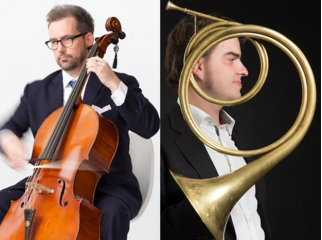
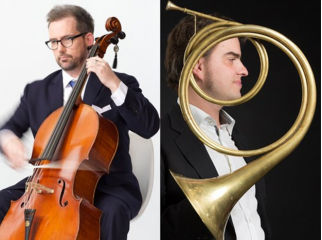
Jamie Hey and Bart Aerbeydt

Haydn, Mozart and Friends/ Australian Brandenburg Orchestra

City Recital Hall,

13 September, 2017

In a programme anchored by two brilliantly performed favourites of the classical canon, it was as much the left-of-field inclusions that had the audience captivated, when the Australian Brandenburg Orchestra directed from the fortepiano by Paul Dyer AO, presented Haydn, Mozart and Friends.

Featuring guest Belgian horn player Bart Aerbeydt playing Mozart’s Concerto for Horn No. 4 in E flat major K495 and Brandenburg cellist Jamie Hey performing Haydn’s Cello Concerto in C major, Hob.VIIb:1, it was the openings of the two halves of the programme which drew attention firstly, to the music of Christian Cannabich (1731-1798), a lesser known contemporary of both Mozart and Haydn and later, to the concept of the Harmonie – a small wind band of the 18th century, supported by European aristocracy for whom the musicians performed entertainment and background music.

Cannabich – composer, violinist and conductor, grew up in a family of musicians, was prominent in the Mannheim symphonic tradition and conducted the Mannheim court orchestra during its golden age before continuing his career in Munich. By all accounts he was extraordinarily gifted, which led Mozart to write to his father Leopold, that Cannabich was the best director he had ever seen, despite the more critical words of Leopold in 1778 describing Cannabich as a “wretched scribbler of symphonies.”

Cannabich produced over 70 symphonies and 20 ballets with an unerring flair for bringing out the best of sounds and style in an instrument. The opening Sinfonia in E flat major contains some of his trademark ideas – simple triad-based themes and ‘the use of two violas for decoration, the prominence of the wind instruments, and the crescendos and decrescendos of the parts, especially the raging and fiery crescendos’ as noted by the German musician Vogler. Led by concertmaster Shaun Lee-Chen, the opening movement featured glorious heraldic arpeggios from the two period horns expertly delivered by Daryl Poulsen and Dorée Dixon with fine responses, matched in mood by the two period clarinets performed by Craig Hill and Marie Ross. The fortepiano – an exquisite looking piece – took centre-stage with Dyer directing from the keyboard. The genteel Andante led without break into a bustling Presto, building to a flourishing end.

An ensemble of 13 musicians gathered to accompany Jamie Hey in his showpiece Haydn cello concerto. This is a brilliant exercise in contrasting large and small instrumental forces against the soloist. Hey, supported by just one player from each string section produced sections of delicate beauty. The challenges of the first movement – full chords played across all four strings, rapid changes in register and a langourous cadenza, conveying Haydn’s characteristic jollity were deftly negotiated by Hey.

In the second movement, written without parts for the wind section, the string players and soloist offered up an intimate dialogue between the violin and cello layered with interjections from the fortepiano and a leaping cadenza from Hey before the  Allegro molto finale, the most effervescent of the movements, brilliantly played by Hey, much of it with the left hand placed high on the fingerboard. Returning for a warmly welcomed encore, Hey performed a hypnotic rendering of the Prelude from JS Bach’s Cello Suite No 1.

All the musicians played on instruments that were true to the time, however, bassist Rob Nairn’s violone was of particular interest as a copy of an instrument that belonged to the Esterhazy family at the time that the concerto was premiered.

The second of the novelties was Mozart’s Harmoniemusik based on his Orientalist opera Die Entführung aus dem Serail (K. 384; The Abduction from the Seraglio). Last performed in Sydney as an opera in 2007, the overture is perhaps well-known but not so some of its arias. The Harmonie, as an ensemble, underwent various configurations until it emerged firmly as an octet in the late 18th century when Emperor Joseph appointed a Harmonie consisting of expert performers on oboe, clarinet, horn and bassoon. These were no liveried servants; they were first-class professionals playing repertoire that was technically and musically demanding, often full-length transcriptions of operas and ballets. The Harmoniemusik from Die Entführung aus dem Serail was transcribed by Mozart himself.

Here we had an expert ensemble in the 18th century configuration of a pair each of period horns, clarinets, oboes and bassoons. It was a superb opportunity to hear their distinctive sounds as well as to feast on their visual beauty. The overture was succeeded by instrumental versions of four arias – the lyrical Durch Zärtlichkeit und Schmeicheln, the declamatory Frisch zum Kampfe! Frisch zum Streite!, Ich baue ganz auf deine Stärke and the celebratory Ha, wie will ich triumphieren. Special mention goes to oboeist Emma Black and (again) period clarinetists Craig Hill and Marie Ross, especially for their interplay in Ich baue ganz.

Finally, Bart Aerbeydt arrived on stage with his 1810 natural horn tucked under his arm to perform Mozart’s K 495. But first, a crash course in the construction and performance of the natural horn which illustrated just how hard it is to coax notes from this coil of brass tubing. A member of the prestigious Freiburger Barockorchester, Aerbeydt’s instrument is diabolically challenging to play. Its sound of imperfect beauty, is achieved without valves, reliant on natural harmonics, embouchure, breath control and manipulation of the right hand in the bell of the horn. A daring cadenza in the first movement, a hauntingly beautiful and silken smooth Romance for a second movement and the rousing hunt-like Allegro vivace of the final movement were negotiated with aplomb. Pleasingly, Aerbeydt returned for an encore which he performed with the two horn players of the orchestra, Poulsen and Dixon.

Distinctive sounds, musical artistry, entertaining and informative.

Shamistha de Soysa for SoundsLikeSydney©

The Australian Brandenburg Orchestra’s Haydn Mozart and friends continues with soloists Bart Aerbeydt and Jamie Hey continues on selected evenings until 23 September at the City Recital Hall, and at the Joan Sutherland Performing Arts Centre, Penrith on 16 September.
Similar Posts

  • Review: ‘Siegfried’ Opera Australia

    Opera Australia: Der Ring des Nibelungen: Siegfried Arts Centre Melbourne/22 November 2013 *****   Brünnhilde’s final outpouring to Siegfried at the end of the second day of Wagner’s music drama begins: ‘O kindischer Held! O herrlischer Knabe! Du hehrster Taten töriger Hort!’ The terms ‘childish’, ‘boy’ and ‘foolish’ are among several along these lines that may…

  • Concert Review: Master And Pupil/ The Marais Project

    Master and Pupil – The Marais Project  Jennifer Eriksson – director and viola da gamba/ James Fraser – actor and writer/ Belinda Montgomery – soprano/ Tommie Andersson – lute and theorbo/ Catherine Upex – viola da gamba  29 May 2016, The Independent Theatre, North Sydney The Prelude in Tea concerts in the Independent Theatre at North Sydney are an…

  • Concert Review: Splendour And Mystery/Sydney Chamber Choir

    Splendour and Mystery/ Sydney Chamber Choir
    Verbrugghen Hall, Sydney Conservatorium of Music
    Australian Digital Concert Hall
    25 March, 2023
    In Splendour and Mystery, Sydney Chamber Choir under the direction of Sam Allchurch joined forces with Camerata Antica led by Matthew Manchester and organist Thomas Wilson in an adventurous anthology of music written for double choir. Specialising in the music of the 16th and 17th centuries, the founder of Camerata Antica, Matthew Manchester playing the fiendishly difficult cornetto, was joined by Michael Wyborn, William Kinmont and Paolo Franks playing the equally challenging alto, tenor and bass sackbutts respectively.
    Bookended with pieces by Giovanni Gabrieli with one of his refreshing Canzonas in the middle, the program also contained music by living Australasian composers Clare Maclean and Brooke Shelley, Gabrieli’s contemporary and student Heinrich Schütz and 20th century composers John Tavener and Frank Martin. Together these composers explore and exploit the potential of the double choir with its opportunities for super-rich harmonies, added melodic lines, imitation, choral interplay and variations in the positioning of the singers.
    The opening motet, Gabrieli’s Jubilate Deo omnis terra, C 65 was quite literally a musical shout for joy. A major part of this journey back in time to Renaissance Venice was the unique sound of Camerata Antica. Heralded by the instruments, the 10 lines of the choir sang an uplifting, lively and tightly dotted chorus, alternating with homophonic passages. Allchurch and his ensemble clearly delineated the rhythms, changing time signatures, hemiolas and other displaced accents which created the buoyancy of this celebratory piece.
    John Tavener’s brilliant A Hymn to the Mother of God transcends the mortal and looks to the cosmic powers of Mother Mary. Writing in the style of canon, with imitative lines that start in quick succession and not necessarily in harmony, Tavener creates a sense of ‘other-worldliness’ in this simple but awe-inducing piece in three-sections. It was a slow burn as the two choirs sang with shimmering lightness and a sense of spinning through space, creating vivid colours and  clusters of clashing chords with impressive control as the voices rose in range and dynamic to its full-bodied climax.
    The program moved imperceptibly to the German Magnificat by Heinrich Schütz, as the choirs were joined by organ and instruments. This was a relevant and important inclusion as Gabrieli himself taught Schütz in this multi-choral technique which Schütz then developed in his own style.
    Clare Maclean’s moving Christ the King was sublimely sung, opening in the manner of a plainchant by the female voices which peeled off into mirroring phrases by the other voices, ending in a reprise of the plainchant. Premiered by this choir in 1984, it is precisely opportunities like these which new composers need for their music to be heard and re-heard until it becomes recognizable to listeners and enters the DNA of the concert repertoire.
    The short and brilliant burst of Gabrieli’s Canzona seconda, C 187  from Camerata Antica showcased these rudimentary instruments in all their imperfect glory as the choir positioned itself for Frank’s only unaccompanied choral work, the demanding  Mass for double choir, considered to be one of the finest and most complex pieces of 20th century choral music. The choir did ample justice to this piece which incorporates the aesthetics of Renaissance music, French Impressionism, Schoenberg’s twelve-note system and J S Bach. The altos began the Kyrie with a freely-flowing, supplicating melody; the Gloria built step-wise to cluster chords; the Credo was a business-like affirmation of faith; the canon-styled Et Resurrexit was levity, hope and word-painting to perfection; the Sanctus introduced softer harmonies from the male voices. The mass, Version 1, ended with a powerful Benedictus. Fast forward to 1926 and Martin added the Agnus Dei, the crowning glory to this choral magnum opus. The mass culminated in a glorious unification of the choirs.
    Brooke Shelley’s Heavenly Father, composed in 2022, performed in the presence of the composer was premiered in November 2022, by the Sydney Chamber Choir. A lyrical and beautifully textured piece, it is very pleasing that it has quickly been programmed again. Like the slightly older piece by Maclean, it is critical that new pieces of merit such as these, are given regular and frequent hearings so that they may be heard widely and face the test of time.
    Finally, Gabrieli’s Magnificat a 14, C 79 brought together the full instrumental and vocal forces of the ensemble. Using the 16th century Venetian technique of cori spezzati (split choirs), the brighter sound of the female voices and cornetto took to the left gallery with the male voices and the thrilling grunt of the bass and other sackbutts in the right gallery with a mixed ensemble placed and organ placed centrally on stage.
    This was an intelligent and audacious program from Allchurch, performed with glorious sound by a choir secure in technique, pitch and musicianship.

  • Review: The Chimney Sweep/ Pinchgut Opera

     The Chimney Sweep (Der Rauchfangkehrer) Musikalisches Lustspiel in three acts by Antonio Salieri, libretto by Joseph Leopold Auenbrugger. Performed in the vernacular. City Recital Hall, Monday July 7th 2014. Pinchgut Opera. At a time when opera companies are wringing their hands over budgets and trimming expenses back to the core, Sydney’s Pinchgut Opera has made a courageous venture in presenting for the first…

Leave a Reply

Your email address will not be published. Required fields are marked *