Concert Review: Reuben Tsang/ Piano+ Recitals

Concert Review: Reuben Tsang

Piano + Recitals

Verbrugghen Hall, Sydney Conservatorium of Music 

23 March, 2024

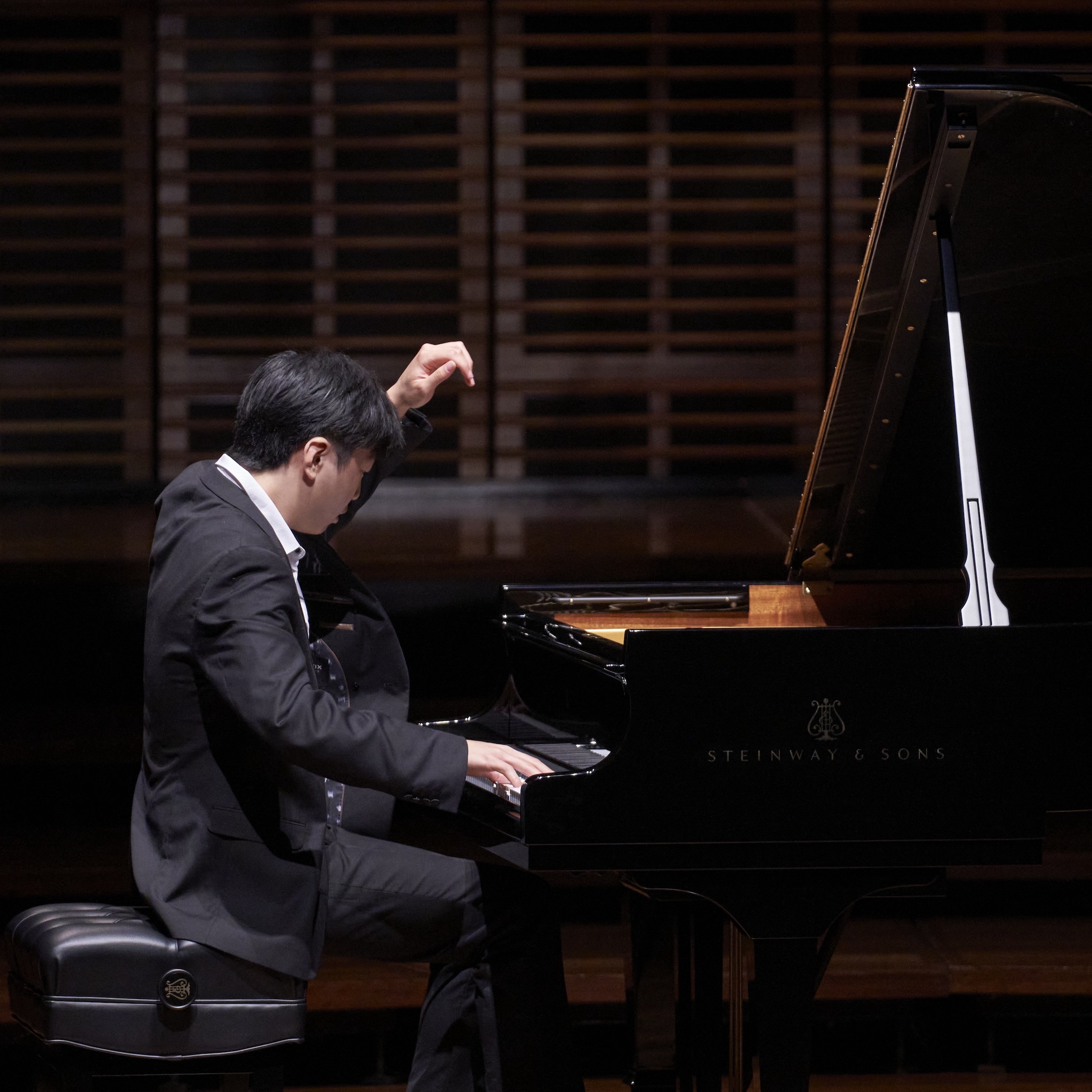
Pianist Reuben Tsang came to note at the 2016 Sydney International Piano Competition, aged just 12 when he played works by Beethoven and Chopin in the competition’s ‘Young Australian Showcase.’ Now 20 and with several awards under his belt, the Cairns-born and raised Tsang returns to Sydney as part of the  Piano + Laureate series, having won the Nancy Weir Best Australian Pianist Prize at the 2023 Sydney International Piano Competition. Tsang continues his studies at Queensland Conservatorium Griffith University.

Playing a Fazioli concert grand-piano, a somewhat bashful Tsang impressed with his technical wizardry and versatility through Baroque, Classical, Romantic and Impressionist repertoire. He opened his program with three short but charming single-movement sonatas by Domenico Scarlatti in contrasting binary form, the K 119, K 132 and K 427.

Written for the harpsichord, these sonatas are brimming with tricks aimed at sustaining the sound and creating harmonies. Repeated notes, asynchronous arpeggios, trills and other ornaments are all part of this plan. The piano however has no such limitations and Tsang was judicious in his execution of these devices on the piano, with careful pedalling and definition. Scarlatti was enamoured with Spanish style and Tsang beautifully strummed these ideas into the keyboard in the K 119, injecting Iberian passion into an otherwise restrained Baroque style.

In this bracket we were treated to Scarlatti’s innovations like hand-crossing, whilst Tsang gently lingered on other features unusual modulations and chromatic dissonances. Staying true to Scarlatti’s instructions, the monophonic K 427 was played “as fast as possible” in a major work out for the left hand.

Brahms’ Piano Sonata No.1 in C major Op.1, one of only three that he wrote, was an excellent choice for a young pianist on the cusp of a major career. Bursting with youthful ebullience and brilliance, Brahms, like Tsang was 20 years old at this point in his life. Brahms’ instructions are clear. Three of the four movements are marked Allegro; two of these are to be “with fury” and the final movement is to be played “with fury and agitation.”  Tsang gives full voice to these requests exuding contrasting moods, quiet passion, a skittish third movement Scherzo full of light and an imposing and irrepressible Finale.

We moved back in time to Mozart’s Piano Sonata No. 3 in B flat major K.280/189f. Written in his late teens, this sonata makes no concessions to youth, rather, Mozart himself described this group of early sonatas as ‘difficult.’ The middle movement is unusually marked Andante amoroso, receiving a lyrical rendering from Tsang, who also paced the final Rondo (Allegro) rather gently, allowing for certain clarity of articulation in the faster passages.

Tsang played with a shimmering lightness of touch in the trio of Impromptus by Fauré, the Opus 25, 43 and 102, delivering rippling melodies over a rolling bass and introducing a tone of motoric tension in the Opus 102.

Finally, a return to the Spanish aesthetic in an imposing bravura performance of Lizst’s Rhapsodie espagnole S. 254. The harp-like arpeggiated opening bars gave way to a growling bass over which emerged the familiar La Folia theme on which this piece is based. Tsang made blazing, broad sweeps of the 88 keys with massive double octaves and piles of chords. He brought a world of agility and expression into less than 15 minutes of music, breaking into the Jota Aragonaise and other dance forms, here the hint of a Sarabande, there, a Polonaise. In the days when composers played their own compositions, I can only image the thrall in which Liszt must have held his audience. Tsang is no less thrilling.

This recital was a panoramic snapshot of this promising young pianist whose development and maturation will no doubt be watched with great support and interest.

Shamistha de Soysa for SoundsLikeSydney©
 

Similar Posts

  • Concert Review: Splendour And Mystery/Sydney Chamber Choir

    Splendour and Mystery/ Sydney Chamber Choir
    Verbrugghen Hall, Sydney Conservatorium of Music
    Australian Digital Concert Hall
    25 March, 2023
    In Splendour and Mystery, Sydney Chamber Choir under the direction of Sam Allchurch joined forces with Camerata Antica led by Matthew Manchester and organist Thomas Wilson in an adventurous anthology of music written for double choir. Specialising in the music of the 16th and 17th centuries, the founder of Camerata Antica, Matthew Manchester playing the fiendishly difficult cornetto, was joined by Michael Wyborn, William Kinmont and Paolo Franks playing the equally challenging alto, tenor and bass sackbutts respectively.
    Bookended with pieces by Giovanni Gabrieli with one of his refreshing Canzonas in the middle, the program also contained music by living Australasian composers Clare Maclean and Brooke Shelley, Gabrieli’s contemporary and student Heinrich Schütz and 20th century composers John Tavener and Frank Martin. Together these composers explore and exploit the potential of the double choir with its opportunities for super-rich harmonies, added melodic lines, imitation, choral interplay and variations in the positioning of the singers.
    The opening motet, Gabrieli’s Jubilate Deo omnis terra, C 65 was quite literally a musical shout for joy. A major part of this journey back in time to Renaissance Venice was the unique sound of Camerata Antica. Heralded by the instruments, the 10 lines of the choir sang an uplifting, lively and tightly dotted chorus, alternating with homophonic passages. Allchurch and his ensemble clearly delineated the rhythms, changing time signatures, hemiolas and other displaced accents which created the buoyancy of this celebratory piece.
    John Tavener’s brilliant A Hymn to the Mother of God transcends the mortal and looks to the cosmic powers of Mother Mary. Writing in the style of canon, with imitative lines that start in quick succession and not necessarily in harmony, Tavener creates a sense of ‘other-worldliness’ in this simple but awe-inducing piece in three-sections. It was a slow burn as the two choirs sang with shimmering lightness and a sense of spinning through space, creating vivid colours and  clusters of clashing chords with impressive control as the voices rose in range and dynamic to its full-bodied climax.
    The program moved imperceptibly to the German Magnificat by Heinrich Schütz, as the choirs were joined by organ and instruments. This was a relevant and important inclusion as Gabrieli himself taught Schütz in this multi-choral technique which Schütz then developed in his own style.
    Clare Maclean’s moving Christ the King was sublimely sung, opening in the manner of a plainchant by the female voices which peeled off into mirroring phrases by the other voices, ending in a reprise of the plainchant. Premiered by this choir in 1984, it is precisely opportunities like these which new composers need for their music to be heard and re-heard until it becomes recognizable to listeners and enters the DNA of the concert repertoire.
    The short and brilliant burst of Gabrieli’s Canzona seconda, C 187  from Camerata Antica showcased these rudimentary instruments in all their imperfect glory as the choir positioned itself for Frank’s only unaccompanied choral work, the demanding  Mass for double choir, considered to be one of the finest and most complex pieces of 20th century choral music. The choir did ample justice to this piece which incorporates the aesthetics of Renaissance music, French Impressionism, Schoenberg’s twelve-note system and J S Bach. The altos began the Kyrie with a freely-flowing, supplicating melody; the Gloria built step-wise to cluster chords; the Credo was a business-like affirmation of faith; the canon-styled Et Resurrexit was levity, hope and word-painting to perfection; the Sanctus introduced softer harmonies from the male voices. The mass, Version 1, ended with a powerful Benedictus. Fast forward to 1926 and Martin added the Agnus Dei, the crowning glory to this choral magnum opus. The mass culminated in a glorious unification of the choirs.
    Brooke Shelley’s Heavenly Father, composed in 2022, performed in the presence of the composer was premiered in November 2022, by the Sydney Chamber Choir. A lyrical and beautifully textured piece, it is very pleasing that it has quickly been programmed again. Like the slightly older piece by Maclean, it is critical that new pieces of merit such as these, are given regular and frequent hearings so that they may be heard widely and face the test of time.
    Finally, Gabrieli’s Magnificat a 14, C 79 brought together the full instrumental and vocal forces of the ensemble. Using the 16th century Venetian technique of cori spezzati (split choirs), the brighter sound of the female voices and cornetto took to the left gallery with the male voices and the thrilling grunt of the bass and other sackbutts in the right gallery with a mixed ensemble placed and organ placed centrally on stage.
    This was an intelligent and audacious program from Allchurch, performed with glorious sound by a choir secure in technique, pitch and musicianship.

  • Concert Review: ACO/Sibelius/Mahler

    Australian Chamber Orchestra Sibelius 6 and Mahler 4 City Recital Hall, Angel Place, Sydney 17 June 2014  The Australian Chamber Orchestra and director Richard Tognetti are continually exploring new territory.  Two years ago they ventured into the world of large-scale symphonies with a performance of Beethoven’s Choral Symphony which was hugely successful and won Limelight…

  • Concert Review: Joy/ Omega Ensemble

    Joy – Farrenc and Beethoven Omega Ensemble, City Recital Hall, 25 September, 2018 Schubert’s exquisite-single movement trio piece known as Notturno in E flat major D 897 was the curtain raiser to Omega Ensemble’s Joy which featured as well, music by Beethoven, Louise Farrenc and Kats-Chernin. The music might have matched the twilight outside, but…

  • CD Review: From The Hungry Waiting Country / Halcyon / Elliot Gyger

    From the Hungry Waiting Country is a new release by Halcyon, performing the music of contemporary Australian composer, Elliot Gyger. Released on the Tall Poppies label, it contains three works by Gyger, Giving Voice (2012), Petit Testament (2008) and the cycle from which the disc takes its title, From the Hungry Waiting Country (2006). Halcyon’s…

  • Friar Alessandro, The Voice from Assisi: review

    Friar Alessandro, The Voice From Assisi (Decca) is a collection of devotional songs recorded by Friar Alessandro, of the friary of St Francis in Assisi, in Italy’s Umbria district. Many of the songs relate to the Franciscan hagiography. Born Alessandro Brustenghi, in the village of Castiglione della Valle, the 34 year old friar studied composition…