
Concert Review: The Art of Violin / Bach Akademie Australia
Concert Review: The Art of Violin
Bach Akademie Australia
Utzon Room, Sydney Opera House, Friday September 26, 2025
The Art of Violin, presented by Bach Akademie Australia in its debut performance in the Utzon Room of the Sydney Opera House, was a riveting exploration of the art of the Baroque violin at the end of the 17th century. By now, the violin had been present for nearly two hundred years, its first models attributed to Andrea Amati, an early 16th century luthier from Cremona.
Composers in Europe, were still discovering the potential of the violin, pushing the boundaries of what could be achieved technically and musically. It is this state-of-the-art which Madeleine Easton, Artistic Director of the BAA explores in an engaging and entertaining program of pivotal concertos by five geniuses of the era. These five concertos showcased the opportunity for invention and virtuosity presented by the Baroque violin with its unique structure, gut strings, absence of a chin rest and distinctive bow. Taking the solos with Easton are two principals of her ensemble, Simone Slattery and Rafael Font.
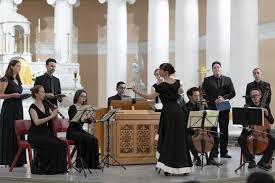
The three soloists played with irresistible charisma and mercurial brilliance. It was a privilege to hear them as soloists in their own right. Performing with the soloists was the BAA’s specialist ensemble of seven others on period instruments. The visual beauty of these instruments as part of the performing tableau is rarely acknowledged. The Utzon Room affords the exceptional opportunity to see and hear these musical works of art at close range.
Vivaldi is the earliest of this quintet of writers. His Violin Concerto RV 208 in D major, ‘Il grosso mogul’ is one of over 200 violin concertos which survive, out of 350 concertos for solo instrument and strings. One of Vivaldi’s many contributions was the use of ritornello form, where a varied refrain (ritornello) is played by the full ensemble, the soloist interjecting with free themes. It was an apt opening to the concert with its first and third ritornello movements. Easton arrived with guns blazing, playing her 1682 Grancino violin from Milan, tossing off bariolage, double stops and double thirds with aplomb. The extended cadenzas the at the end of the first and third Allegro movements were finely embroidered. Still, it was the middle movement Grave. Recitativo which captured my soul, as Easton plumbed the depths of the romantic in the Baroque leaning into dissonances with architectural phrasing.
From Italy to France. Rafael Font, presented a bravura account of the Violin Concerto No.1 Op.7 in D minor by Jean-Marie Leclair, on his 2012 instrument by Steffen Nowak in Bristol, England, modelled after Amati in 1666 Cremona. Considered the founder of the French violin school, Leclair apparently mastered the violin, dancing, and lacemaking, which implies he had fine hands, an undoubted asset to his violin playing and patterning in composition.
Leclair’s sonatas, according to a contemporary ‘appeared at first, a kind of algebra capable of rebuffing the most courageous musicians’. The left-hand ventures high, there are chunks of multiple stops and double trills. The bowing arm plays tied-bow staccatos, bariolage and a variety of techniques.
It was an exceptional and masterful performance from Font in the intimacy of the Utzon Room which leaves nowhere to hide. The first movement Allegro skipped through triplets and moved quickly to the second movement Aria (Gratioso), a graceful minuet like piece. It is tempting to motor through and not linger, but with careful placement and ritardandi, Font shaped the phrases and articulated the themes through the spritz of ornamentation, closing with a thrilling, account of the fiendishly challenging Vivace.
Simone Slattery playing her 1726 French instrument from Claude Pierray, took centre-stage for the very popular Violin Concerto in B flat major HWV 288 by G F Handel and the Violin Concerto in A minor TWV 51:A1 by Telemann, one of his 125 known concertos. Unusually, both concertos open with a slow movement. Slattery played the first movement Andante of the Handel with silken lyricism over changing harmonies, with gorgeous ornamentation on repeat. The following Adagio and Allegro were brimming with vitality. The opening movement Adagio of the Telemann exuded anguish worthy of a Passion. From here, the pulse quickened in the second movement Allegro-Adagio, a statement and echo between soloist and ensemble. The meticulous detail and clarity of the final movement Presto, were uncompromised by the breathtaking tempo.
After these ambrosian delights, Easton returned to the spotlight for a compelling rendition of J.S. Bach’s familiar Violin Concerto in E major BWV 1042, which Bach based on the Venetian model. It was a stately opening with the heraldic trio of chords. Sweet and bright, the first movement is full of light and shade. The second movement opened with a sombre six-bar motif played by the ensemble which recurs at the end. Easton spun its poignant solo phrases. More Baroque romanticism here. The exuberant Passepied-like final movement in rondo form returned repeatedly to the theme. The leaping motifs across the strings could only have been written for the violin, demonstrating Bach’s mastery in writing for the instrument and Easton’s expertise in executing it.
Three hotshot violinists, a cracking ensemble, rare instruments and technical wizardry at its best.
Shamistha de Soysa for SoundsLikeSydney©
Image credit Keith Saunders
Read our review of The BAA’s performance of Bach’s Christmas Oratorio.