Concert Review:Ottoman Baroque/Australian Brandenburg Orchestra
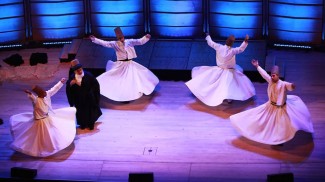
Dervishes-325x182

The sounds of the music and chanting ebbed away; the shadows on the stage faded. There was no applause, no cheering, no curtain calls. The audience rose and silently filed out of the City Recital Hall. This silence was no expression of displeasure; rather it was an acknowledgement that the concluding item on the Australian Brandenburg Orchestra’s Ottoman Baroque, the Whirling Dervishes, was grounded in religion, not performance.

Orientalism has fascinated the west for centuries. For the Ottoman Baroque series, Artistic Director of the ABO, Paul Dyer AO, curated a programme of music influenced by the Ottomans and perceptions of the east. He placed the audience in the shoes of a traveller during Baroque times, journeying from west to east and making both musical and spiritual discoveries along the way.

For this musical travelogue, the orchestra with its treasury of period instruments opened with three instrumental numbers by Lully, Marin Marais and Telemann. Guiding the audience through the evening was narrator Alan Maddox with his readings giving a historical context to the music.

 Lully’s Marche pour la cérémonie des Turcs from the opera-ballet Le bourgeois gentilhomme (1670) opened with the soft beat of the drum which rose to a crescendo as the tambourine and ensemble joined in the majestic dotted measures of the march. Marais’ Sonnerie de Sainte Geneviève du Mont-de-Paris  (1723) in Theme and Variations form for violin, viol, harpsichord and continuo and was arranged for this concert series by Alice Chance to include strings, flute and oboe. Although in a minor key it was a sprightly and captivating cameo in which the lower strings of the continuo section played an unremitting ostinato three-note ground bass above which the violin and baroque cello cavorted, playing with the melody.

Telemann’s Overture-Suite in B flat major ‘Les Nation’ TWV 55:B5 ‘Les Turcs’ closed off this trio of works before the Brandenburg Choir took the stage for Allegri’s 9 part falsobordone chant for two choirs of 4 and 5 voices, Miserere mei Deus. There were two choirs on stage with the ornamenting choir high above in the gallery, creating the perfect acoustic for the relentless high C’s that Allegri demanded. Soprano Lauren Stephenson delivered these surely and with a delicate beauty of tone. An ensemble of male voices recited the plainchant.  This was an ethereal performance of distinction and refinement delivered in the half-light, as was the custom for the service of Tenebrae . The voices were finely controlled in tone and dynamics and well blended; the tempo dignified and flowing. The audience was spellbound as the choirs came together to sing the closing bars and the lights of the hall were extinguished.

A marked change of tone with the final act of the first half – the Fandago from Boccherini’s Quintet for Guitar and Strings in D major, D 448 with soloist Tommie Andersson and flamenco dancer Yioda Wilson’s high-octane castanet playing.

There was a glimpse of the Ottoman influence in Greek dance and music with the instrumental Karsilamas performed by 5 musicians on traditional instruments including the violin, drum, oud, lyra and saz, followed by two dances, Hasapiko, which originated in the Middle Ages and was made famous in Zorba the Greek, and the faster Hasaposerviko, influenced by Serbian and Balkan aesthetics.

Finally, the pièce de résistance. The audience spellbound as the stage was bathed in an incandescent blue light. Through the shadows emerged two dervishes , swathed in dark cloaks, who prepared the stage for their ceremony, bowing in respect. They were joined by two other dervishes and their Imam with four musicians in the gallery above. They paid obeisance, discarded their cloaks to reveal their white skirts glowing and slowly started to twirl their white skirts flaring around them, working their way into a hypnotic trance.  Moving about the stage in ceaseless unison their heads were tilted to the right, as they pirouetted to the right on an axis formed by their left legs. Like our planet, they circled about themselves as well as in larger circle around their Imam who circled at a slower pace.

The Ottoman Empire was vast and endured for centuries. Its influence was extensive. Ottoman Baroque was but the small album of snapshots taken along the way to remember and savour experiences. The programme was creative and beautifully performed; the evening edifying and extremely enjoyable.

Shamistha de Soysa for SoundsLikeSydney©

Ottoman Baroque continues at the City Recital Hall on Wednesday 29th and Friday 31st October. Tickets are scarce.
Similar Posts

  • Concert Review: Vivaldi Unwired/ The Australian Brandenburg Orchestra

    The Australian Brandenburg Orchestra’s Vivaldi Unwired programme, directed by Paul Dyer, AO opened at the City Recital Hall last night with guest artists violinist Brendan Joyce and saxophonist Christina Leonard. It was an entertaining evening of convention and innovation. Opening the concert with two cornerstones of the Baroque repertoire played in conventional style on period…

  • Concert Review: Splendour And Mystery/Sydney Chamber Choir

    Splendour and Mystery/ Sydney Chamber Choir
    Verbrugghen Hall, Sydney Conservatorium of Music
    Australian Digital Concert Hall
    25 March, 2023
    In Splendour and Mystery, Sydney Chamber Choir under the direction of Sam Allchurch joined forces with Camerata Antica led by Matthew Manchester and organist Thomas Wilson in an adventurous anthology of music written for double choir. Specialising in the music of the 16th and 17th centuries, the founder of Camerata Antica, Matthew Manchester playing the fiendishly difficult cornetto, was joined by Michael Wyborn, William Kinmont and Paolo Franks playing the equally challenging alto, tenor and bass sackbutts respectively.
    Bookended with pieces by Giovanni Gabrieli with one of his refreshing Canzonas in the middle, the program also contained music by living Australasian composers Clare Maclean and Brooke Shelley, Gabrieli’s contemporary and student Heinrich Schütz and 20th century composers John Tavener and Frank Martin. Together these composers explore and exploit the potential of the double choir with its opportunities for super-rich harmonies, added melodic lines, imitation, choral interplay and variations in the positioning of the singers.
    The opening motet, Gabrieli’s Jubilate Deo omnis terra, C 65 was quite literally a musical shout for joy. A major part of this journey back in time to Renaissance Venice was the unique sound of Camerata Antica. Heralded by the instruments, the 10 lines of the choir sang an uplifting, lively and tightly dotted chorus, alternating with homophonic passages. Allchurch and his ensemble clearly delineated the rhythms, changing time signatures, hemiolas and other displaced accents which created the buoyancy of this celebratory piece.
    John Tavener’s brilliant A Hymn to the Mother of God transcends the mortal and looks to the cosmic powers of Mother Mary. Writing in the style of canon, with imitative lines that start in quick succession and not necessarily in harmony, Tavener creates a sense of ‘other-worldliness’ in this simple but awe-inducing piece in three-sections. It was a slow burn as the two choirs sang with shimmering lightness and a sense of spinning through space, creating vivid colours and  clusters of clashing chords with impressive control as the voices rose in range and dynamic to its full-bodied climax.
    The program moved imperceptibly to the German Magnificat by Heinrich Schütz, as the choirs were joined by organ and instruments. This was a relevant and important inclusion as Gabrieli himself taught Schütz in this multi-choral technique which Schütz then developed in his own style.
    Clare Maclean’s moving Christ the King was sublimely sung, opening in the manner of a plainchant by the female voices which peeled off into mirroring phrases by the other voices, ending in a reprise of the plainchant. Premiered by this choir in 1984, it is precisely opportunities like these which new composers need for their music to be heard and re-heard until it becomes recognizable to listeners and enters the DNA of the concert repertoire.
    The short and brilliant burst of Gabrieli’s Canzona seconda, C 187  from Camerata Antica showcased these rudimentary instruments in all their imperfect glory as the choir positioned itself for Frank’s only unaccompanied choral work, the demanding  Mass for double choir, considered to be one of the finest and most complex pieces of 20th century choral music. The choir did ample justice to this piece which incorporates the aesthetics of Renaissance music, French Impressionism, Schoenberg’s twelve-note system and J S Bach. The altos began the Kyrie with a freely-flowing, supplicating melody; the Gloria built step-wise to cluster chords; the Credo was a business-like affirmation of faith; the canon-styled Et Resurrexit was levity, hope and word-painting to perfection; the Sanctus introduced softer harmonies from the male voices. The mass, Version 1, ended with a powerful Benedictus. Fast forward to 1926 and Martin added the Agnus Dei, the crowning glory to this choral magnum opus. The mass culminated in a glorious unification of the choirs.
    Brooke Shelley’s Heavenly Father, composed in 2022, performed in the presence of the composer was premiered in November 2022, by the Sydney Chamber Choir. A lyrical and beautifully textured piece, it is very pleasing that it has quickly been programmed again. Like the slightly older piece by Maclean, it is critical that new pieces of merit such as these, are given regular and frequent hearings so that they may be heard widely and face the test of time.
    Finally, Gabrieli’s Magnificat a 14, C 79 brought together the full instrumental and vocal forces of the ensemble. Using the 16th century Venetian technique of cori spezzati (split choirs), the brighter sound of the female voices and cornetto took to the left gallery with the male voices and the thrilling grunt of the bass and other sackbutts in the right gallery with a mixed ensemble placed and organ placed centrally on stage.
    This was an intelligent and audacious program from Allchurch, performed with glorious sound by a choir secure in technique, pitch and musicianship.

  • Australian Singers Take Centre Stage At The ENO’s Otello

    David Alden’s new production of Verdi’s Otello opened at the English National Opera last week with two Australian born singers in the lead roles – Stuart Skelton as the Moor and Jonathan Summers as Iago. Andrew Clements in The Guardian says “It is Jonathan Summers’s totally compelling Iago who holds centre stage.” Read the review.    

  • Concert Review: Tafelmusik/ Bach And His World/ Music Viva

    Bach and his world Tafelmusik Music Viva City Recital Hall, Sydney June 4, 2018 During the course of its three tours to Australia for Musica Viva, the Toronto based baroque ensemble Tafelmusik has garnered a formidable reputation for its expert performances interwoven with captivating imagery and compelling story-telling. The latest conception, Bach and his world…

  • Whitwell and Namekawa play Glass to a sell-out house at the Perth festival

    Pianists Sally Whitwell from Sydney and Maki Namekawa from Japan, continue to stake their claim as premier performers of the music of Philip Glass after sell-out concerts at the Perth festival. The Australian’s Mark Coughlan reports: http://www.theaustralian.com.au/arts/music/the-beauty-of-ref-glass/story-fn9d2mxu-1226579787647

  • Album Review: Castle In The Sky/ Charody/ Nguyen

    Composer Chloé Charody’s new album Castle in the Sky is an anthology of her compositions for solo piano, performed by Australian-Vietnamese pianist, Van-Anh Nguyen. Released to coincide with Valentines’s Day, it is a dreamy collection of ten tracks which have a distinctly Impressionistic aesthetic. Charody’s gift is her ability to paint pictures with music. The…

Leave a Reply

Your email address will not be published. Required fields are marked *