Pinchgut Opera’s ‘Giasone’ reviewed: Recreating a 400 Year Old Soundscape
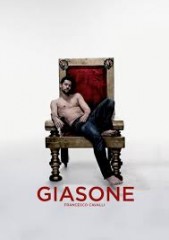
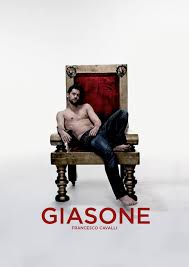
Giasone


Possibly the most challenging aspect of writing about my evening at Giasone, Pinchgut Opera’s 2013 production, has been to decide which of the many facets of this beautifully integrated production was the most memorable – was it the casting or the singing? The musical direction or the orchestra? Was it was the inventive staging – ever a challenge in a recital hall, or the opera itself – the box office hit of the 17th century with its universal themes?  All are serious contenders. Perhaps there will be an answer at the end of this chronicle – no promises.

Francesco  Cavalli’s drama musicale in a prologue and three acts with libretto by Giacinto Andrea Cicognini premiered in Venice in 1649.  Sadly, it was the only collaboration between this pair, described by a critic Crescimbeni in 1700 as ‘the first and most perfect drama in existence’. Its reflection of Venetian decadence sealed its popularity and with Giasone, Pinchgut Opera extended an alluring invitation to cast inhibitions aside and be drawn by Giasone’s hedonism for just a little while. Despite an initial fright that I might have been swept into the South Pacific by an argonaut clad in culottes, once the music poured forth I was very soon reassured that I was much nearer the Aegean and the Adriatic.

In 2012, Castor and Pollux propelled us into the cosmos with a set that was a complex mesh of glistening triangles, the likes of which had not been seen in the City Recital Hall before. This year, designers Chas Radar-Scheiber (who also directed the production) and Katren Wood created the mood with a simple curtained portal drenched in a soft light that with different colours and manipulation of curtains and backdrops, opened up the many scenes of the opera. Giasone’s acquisition of the Golden Fleece was most imaginatively depicted as a shadow dance enacted behind the curtains and illuminated from behind.

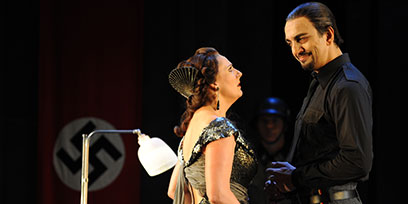
The singing was outstanding and the casting was perfection. Counter-tenor David Hansen as Giasone had an extraordinary range and shimmer; Celeste Lazarenko, as Medea, ruled by her heart over her head, goddess-like in firebrand red, epitomised by her rendition of the stark and steely aria Dell’antro magico’; Miriam Allen as the broken hearted Isifile lamenting her fate, demonstrating a hypnotic sound and beauty of phrasing especially in Infelice, che ascolto;  Andrew Goodwin as the emotionally crippled Egeo, attired stiffly in formal wear, only able to expression passion by turning it against himself; tenor Christopher Saunders who as Demo, made an absolute art of stuttering in song; Alexandra Oomens as Alinda the lady-in-waiting, focussed less on her lady than on an argonaut who would literally, sweep her off her feet; Adrian McEniery, in a stroke of genius, singing the role of Delfa, Medea’s nurse usually sung by an alto, dressed in matronly style and fretting about her age, perfectly portraying Cavalli’s comic style.

Erin Helyard conducted from the harpsichord with a physicality that was infectious. There seemed to be separate muscles and gestures for every note and ornament. The Orchestra of the Antipodes played on period instruments in their 10th Pinchgut production, achieving an astringent sound that I imagine would have been exactly the soundscape of the time.

This, dear readers, is where this production stands out – in my book at least.

Erin Helyard’s study of the history of music performance and the integration of his vast repository of knowledge into this performance offered the rare acoustic pleasure of  cascades of ornaments, typical of that time. Ornaments were notes added to the music to decorate the basic melody. They were sometimes written in by the composer but the performer too was allowed embellish the music with discretion. In Italy at the time of Cavalli, ornamentation was essential to expression but had to be performed with  ‘grace’ – a somewhat intangible aesthetic. It is a complex set of practices determined in part by whether the notes are moving up or down, their length, the tempo of the piece, the surrounding notes and the mood. Executing these grazie is another skill again, requiring the ability to sing great swathes of notes at speed – scale passages, trills and repeated notes – achieved by immaculate control of the vocal apparatus and the breath, and delivered with aplomb by the cast of Giasone.

Supported by robust programme notes, the full libretto, the provenance of the instruments,  and the careful disclaimer that visible microphones were for recording and not for amplification, Giasone offered comedy, drama, love triangles, seduction, danger and murder in an impeccable display of  creativity and musicianship.

Is there an answer to my question pinpointing the most memorable aspect? For me, it is that which Pinchgut Opera delivers best of all – the expert performance of the music of the Baroque and the unique sounds of the ornaments that hovered, glistened, slid and crunched their way in, enriching the music, drawing out the characters and enhancing the story telling.

Shamistha de Soysa for SoundsLikeSydney©


Similar Posts

  • Review roundup

    A collection of the weekend’s reviews: Stephen Hough’s Canberra concert: http://www.theaustralian.com.au/news/arts/what-a-little-bit-of-moonlight-can-do/story-e6frg8n6-1226156246934 Placido Domingo and Katherine Jenkins in Sydney: http://www.theaustralian.com.au/news/arts/domingos-wondrous-voice-rises-above-arena/story-fn9d2mxu-1226156233592 http://www.smh.com.au/entertainment/music/aptly-seduction-set-the-tenor-for-a-night-of-vocal-splendour-20111002-1l3qr.html The Vienna Philharmonic in Perth: http://www.theaustralian.com.au/news/arts/old-school-orchestra-lives-up-to-its-conservative-traditions/story-fn9d2mxu-1226156272290

  • Concert Review: Splendour And Mystery/Sydney Chamber Choir

    Splendour and Mystery/ Sydney Chamber Choir
    Verbrugghen Hall, Sydney Conservatorium of Music
    Australian Digital Concert Hall
    25 March, 2023
    In Splendour and Mystery, Sydney Chamber Choir under the direction of Sam Allchurch joined forces with Camerata Antica led by Matthew Manchester and organist Thomas Wilson in an adventurous anthology of music written for double choir. Specialising in the music of the 16th and 17th centuries, the founder of Camerata Antica, Matthew Manchester playing the fiendishly difficult cornetto, was joined by Michael Wyborn, William Kinmont and Paolo Franks playing the equally challenging alto, tenor and bass sackbutts respectively.
    Bookended with pieces by Giovanni Gabrieli with one of his refreshing Canzonas in the middle, the program also contained music by living Australasian composers Clare Maclean and Brooke Shelley, Gabrieli’s contemporary and student Heinrich Schütz and 20th century composers John Tavener and Frank Martin. Together these composers explore and exploit the potential of the double choir with its opportunities for super-rich harmonies, added melodic lines, imitation, choral interplay and variations in the positioning of the singers.
    The opening motet, Gabrieli’s Jubilate Deo omnis terra, C 65 was quite literally a musical shout for joy. A major part of this journey back in time to Renaissance Venice was the unique sound of Camerata Antica. Heralded by the instruments, the 10 lines of the choir sang an uplifting, lively and tightly dotted chorus, alternating with homophonic passages. Allchurch and his ensemble clearly delineated the rhythms, changing time signatures, hemiolas and other displaced accents which created the buoyancy of this celebratory piece.
    John Tavener’s brilliant A Hymn to the Mother of God transcends the mortal and looks to the cosmic powers of Mother Mary. Writing in the style of canon, with imitative lines that start in quick succession and not necessarily in harmony, Tavener creates a sense of ‘other-worldliness’ in this simple but awe-inducing piece in three-sections. It was a slow burn as the two choirs sang with shimmering lightness and a sense of spinning through space, creating vivid colours and  clusters of clashing chords with impressive control as the voices rose in range and dynamic to its full-bodied climax.
    The program moved imperceptibly to the German Magnificat by Heinrich Schütz, as the choirs were joined by organ and instruments. This was a relevant and important inclusion as Gabrieli himself taught Schütz in this multi-choral technique which Schütz then developed in his own style.
    Clare Maclean’s moving Christ the King was sublimely sung, opening in the manner of a plainchant by the female voices which peeled off into mirroring phrases by the other voices, ending in a reprise of the plainchant. Premiered by this choir in 1984, it is precisely opportunities like these which new composers need for their music to be heard and re-heard until it becomes recognizable to listeners and enters the DNA of the concert repertoire.
    The short and brilliant burst of Gabrieli’s Canzona seconda, C 187  from Camerata Antica showcased these rudimentary instruments in all their imperfect glory as the choir positioned itself for Frank’s only unaccompanied choral work, the demanding  Mass for double choir, considered to be one of the finest and most complex pieces of 20th century choral music. The choir did ample justice to this piece which incorporates the aesthetics of Renaissance music, French Impressionism, Schoenberg’s twelve-note system and J S Bach. The altos began the Kyrie with a freely-flowing, supplicating melody; the Gloria built step-wise to cluster chords; the Credo was a business-like affirmation of faith; the canon-styled Et Resurrexit was levity, hope and word-painting to perfection; the Sanctus introduced softer harmonies from the male voices. The mass, Version 1, ended with a powerful Benedictus. Fast forward to 1926 and Martin added the Agnus Dei, the crowning glory to this choral magnum opus. The mass culminated in a glorious unification of the choirs.
    Brooke Shelley’s Heavenly Father, composed in 2022, performed in the presence of the composer was premiered in November 2022, by the Sydney Chamber Choir. A lyrical and beautifully textured piece, it is very pleasing that it has quickly been programmed again. Like the slightly older piece by Maclean, it is critical that new pieces of merit such as these, are given regular and frequent hearings so that they may be heard widely and face the test of time.
    Finally, Gabrieli’s Magnificat a 14, C 79 brought together the full instrumental and vocal forces of the ensemble. Using the 16th century Venetian technique of cori spezzati (split choirs), the brighter sound of the female voices and cornetto took to the left gallery with the male voices and the thrilling grunt of the bass and other sackbutts in the right gallery with a mixed ensemble placed and organ placed centrally on stage.
    This was an intelligent and audacious program from Allchurch, performed with glorious sound by a choir secure in technique, pitch and musicianship.

  • Review: Tosca/Opera Australia

      Tosca  –  Giacomo Puccini Opera Australia,  Sydney Opera House, 13 January 2015  John Bell’s production of Tosca for Opera Australia was first seen 18 months ago. It was very successful then, and is perhaps even more so in the current revival. This compelling production is set in Rome in 1943 during the Nazi occupation…

Leave a Reply

Your email address will not be published. Required fields are marked *