Review: ABC Symphony Australia Young Performer of the Year Award, Grand Final 2013
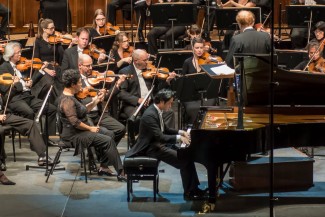
The Grand Final of the 2013 ABC Symphony Australia Young Performer of the Year Award held at the Melbourne Town Hall on October 12th 2013, was a fine exhibition of musical abilities. It was also an emotional event, due in large part to the evening’s proceedings being dedicated to the memory of John Hopkins, AM OBE, legendary conductor and a champion of young musicians throughout his stellar career.
Public interest was considerable. Many in the audience had heard the ABC Classic FM broadcasts of the preliminary rounds that were curtain-raisers to the final and which counted towards the scores. The choice of Hoang Pham as the overall winner was best received by those in the audience who had heard his earlier performances, particularly Mendelssohn’s Piano Trio No 1 in D minor Op 49.
But this night, we were there for a concert rather than a competition – and it would be a demanding critic indeed who was not satisfied with what was heard. In the line-up were two massive Russian piano concertos, with Richard Strauss’s plangent, moving oboe concerto between them.
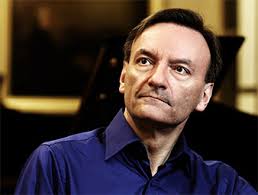
Both pianists have proved their worth on the international stage, as well as in Australia. Pianist – composer Stefan Cassomenos, chose to play Prokofiev’s Piano Concerto No 3 in C Op.26. Cassamenos has a distinctive, slightly bohemian look (mainly thanks to his hair) and a suggestion of contained strength – even before he begins playing. Just as well, as he had chosen a particularly demanding concerto.
The lyrical clarinet opening, and gentle strings to follow, did not prepare the listener for the surprise of the piano entry – a fast tempo, with emphatic chords. Cassomenos did well to be heard above the Melbourne Symphony Orchestra. However, visiting British conductor Christopher Seaman was well in control of pace and dynamics – as he was all night – and the pianist stayed on centre stage in more senses than one.
The clarinet again established the mood, tempo, and the soft harmonic blur of the orchestra as Cassomenos tackled fast fingerwork without pause in longer passages. He shaped his hands the better to chase dynamic chords up and down the keyboard, brilliantly executing more emphatic chords as he went.
In the contrasting second movement in Theme and Variations form, the balletic theme was again introduced by the clarinet. The piano entered with a trill before the length of the keyboard was again explored, then a delicate solo morphed into more trills as the orchestra swelled the sound. Octaves in both hands rounded off the movement in brilliant fashion – but more was to come.
The MSO strings had a brief pizzicato moment before an the piano entry, played with such a flourish that Cassomenos left the audience smiling – and perhaps breathless. There was more traversing the keyboard at speed, and a simple theme in which the pianist clearly felt a connection with the winds. A deceptively gentle moment (including a chromatic scale) was surely as challenging as anything he’d faced all night but, in any case, it was soon on again for all. With Seaman in control, the winds led the orchestra back into the action and Cassomenos displayed every trick in the pianist’s book for a thrilling finish – and then, great applause.
With the winds playing such an important role in the Prokofiev, it was fitting that the next finalist was oboist Andrew Kawai. Aged 15, he chose a challenging work – Strauss’ Concerto for Oboe and Orchestra – and played it with maturity and depth. In another sentimental moment on the night, it transpired that the MSO’s star oboist, Jeffrey Crellin, was not only Kawai’s mentor but had won an earlier manifestation of the YPA in this Hall, with this very concerto.
Expectations of Kawai were very high – and he did not disappoint. With minimal introduction from the orchestra, he took up the solo part in the Allegro. His sound had both clarity, depth, and a warm tone that proved to be a hallmark of his performance. There was an interesting contrast between the legato and staccato, and fine phrasing sustained throughout very long ‘solo’ passages.
The Andante has an extended piece for oboe that is very beautiful and tender, and characteristic of the composer. Kawai showed a maturity of approach beyond his years, and was evidently absorbed in the music, at times appearing to play with his whole body. The final movement, Vivace, presented challenges of a different kind, and allowed the young oboist to show a more virtuosic side to his playing. He is certainly a performer to watch.
Perhaps it was unfair that Kawai was judged against Cassomenos and Hoang Pham as his instrument was literally dwarfed by the Steinway grand piano. I believe the audience was conscious of that on the night, and it must have been a difficult decision for the judges – although the recital and chamber music sections allowed Kawai more scope. It is gratifying to note that Kawai won the People’s Choice Award – and I’d be willing to bet that many in the Grand Final audience would have voted for him.
The Grand Final winner was the pianist Hoang Pham. Like Cassomenos, he is in his late twenties, and already has an impressive list of achievements to his credit, including overseas performances. Born in Vietnam, Hoang also carried another layer of emotion onto the stage with him, that of being the son of refugees and thus an inevitable symbol of the success that can ensue from being given a new life in Australia.
From the moment he walked onto the stage in his dark suit, Hoang embodied the traditional image of the concert pianist – except, thankfully, for a complete absence of unnecessary gestures. The flourishes were in the music, at times when the composer intended. That Tchaikovsky’s Piano Concerto No 1 Op.23 No.1 is well known and loved presents its own challenges for the pianist, as everyone in the audience may have his or her own favourite recording, or memory of a concert.
There was nothing disappointing in Hoang Pham’s approach to the work, with his confident delivery of the great opening chords inspiring confidence. Octaves (in both hands) at speed were a major challenge, well met, although the performance overall was not always note-perfect. Hoang’s strength was evident in the passage that followed, the first of many lyrical moments in this concerto. Seaman and the MSO matched the mood perfectly, showing that the emotion in this performance would be true, and not just reserved for the second movement.
The brass provided a great sound, heralding what sounded like an exciting race to the finish line for the Allegro (with many in the audience wanting to break with convention, and applaud!). But the second movement, Andante, brought a calm, thanks initially to Prudence Davis’s lovely flute, with oboist Jeffrey Crellin and cellist David Berlin among those MSO musicians to contribute beautiful solos within this concerto.
Hoang was very at home with the mood, whether “accompanying” these musicians or as the centre of attention. Noteworthy moments were the measured repetition of chords, a short section of syncopation and soft trills as the theme and the oboe) re-emerged. It would hard to imagine a pianist and an orchestra playing better than this.
The concerto’s faster movements are the attention-grabbers, and so it was with the final movement, marked Allegro con fuoco. The “fire” was not just in the piano part but it seemed that way. Hoang’s fingers simply flew across the keys, with the orchestra matching the pace. It is the sense of danger in works like this that lend them excitement, and so this concerto was a great way to end the performance.
Or so it seemed, until Seaman came out to conduct the MSO in Percy Grainger’s Irish Tune from County Derry. It was a final tribute to John Hopkins, a champion of Grainger’s music, as he was an iconic figure in the promotion of fine young musicians like those who had delighted the audience on this night.
Suzanne Yanko for SoundsLikeSydney©
Suzanne Yanko has worked as a freelance writer and editor and broadcaster in Australia, Hong Kong and Papua New Guinea, and as a reviewer for the CitySearch, the Herald-Sun, the South China Morning Post, HMV VOICE and, for the past five years, artsHub Australia.
Suzanne is based in Melbourne. This is her first review for www.soundslikesydney.com.au