Review: Die Walküre, Opera Australia
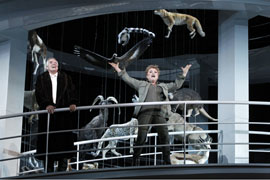
Photo credit Jeff Busby
Opera Australia: Der Ring des Nibelungen: Die Walküre
Arts Centre Melbourne/20 November 2013
*****
Now that the glitter has settled on the ‘preliminary evening’, the ‘first day’ of Wagner’s music drama in three acts has been revealed. As was the case with Das Rheingold, audience and critics may be divided on how successfully Opera Australia’s production has fulfilled its brief, but there is no doubt that many features of Wednesday evening’s performance of Die Walküre would have been applauded in any opera house in the world.
The seasoned globe-trotting Ring-goer sitting beside me deemed this to be the best Die Walküre that she had seen and my own recollections of a risibly unsteady ash tree in a Cologne production were a reminder of the perils of attempting a literal stage design. It is little wonder that Robert Cousin’s designs and Neil Armfield’s direction have sought to capture the essence of this masterpiece rather than attempt a well worn path that is fraught with all manner of difficulties and implausibility.
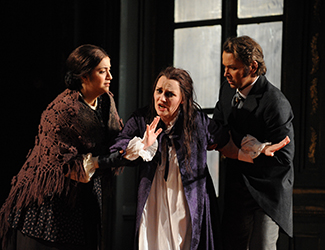
Hunding’s House was a small shed revolving under big white confetti flakes. Picturesque in its stark simplicity, it resembled the snow domes now to be found in Christmas decoration departments rather than the ominous holding of an enemy with status. As it revolved, the hut opened to reveal the cramped interior of a modern hunter’s hut, complete with a big plastic water container. A sword was planted at the edge of the revolving stage. Set design and direction certainly called upon a major suspension of disbelief at times. Much of the action took place in the snow even when Siegmund was supposedly sheltering on Hunding’s hearth and Siegmund was unable to see the vertical sword even when he was kneeling right next to it. In any case it would seem to be a poor weapon matched against Hunding’s hunting rifle. As Winter woe turned to Spring passion for Wotan’s illegitimate twins, white snowflakes became falling green leaves.
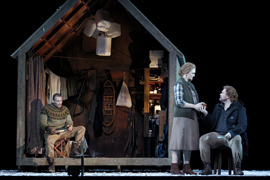
Photo credit Jeff Busby
After viewing the whole cycle in rehearsal and a repeated viewing of Das Rheingold it would seem that going with the flow, so to speak, is the most rewarding way of engaging with the concepts behind this production. The quality of the singing and acting in Act I certainly transcended any reservations one might have about the setting and Damien Cooper’s lighting worked superbly in terms of creating mood and focusing attention.
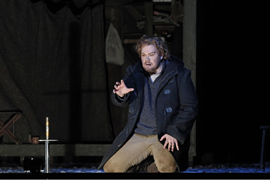
Photo credit Jeff Busby
If the hut itself lacked menace, Jud Arthur’s portrayal of Hunding did not. His penetrating, dark-hued voice and the contained threat of his body language acted as convincing motivators for Sieglinde’s despair and her longing for a friend to save her. Miriam Gordon-Stewart was the embodiment of these qualities was remarkable. Vocally she went from strength to strength as an initially cautious Sieglinde gave herself over to ecstasy. As the hunted Siegmund, Stuart Skelton was superb. His burnished ringing tone is exactly what is expected of a true Wagnerian heldentenor. The famous invocation ‘Wälse! Wälse!’ was absolutely hair-raising. Together, he and Gordon-Stewart were vocally glorious and so dramatically convincing as to leave much of the audience wiping away the tears as the curtain fell.
Gordon-Stewart and Skelton were not the only singer actors to produce inspired dramatic performances under the guiding hand of Armfield. Brünnhilde makes her first ‘Ring’ appearance in Act II of Die Walküre and Susan Bullock’s interpretation of Wotan’s favourite warrior daughter was astonishing. Those who have previously witnessed her in performance are familiar with her ability to be totally in the moment at all times. Her beautifully projected voice and fine musical intelligence invested every word with meaning and large, expressive eyes reinforced it. She is first seen as an athletic, rather Puckish adolescent, keen to serve her father by populating Valhalla with the heroes he needs to retain power and side with him against his demanding wife. Her impudent confrontation with Jacqueline Dark’s imperious Fricka on the winding ramp made a telling contrast with her easy, affectionate behaviour with her father. The way the closeness of their relationship was established in this scene amplified the pathos of their anguished separation at the end of the opera even further.
Terje Stensfold’s characterization of a grave, older Wotan complemented the youthful emotion of a daughter willing to defy him out of love for him and those he loved. His relaxed, magnificent bass-baritone resonated with authority, anger and tenderness on demand. Jacqueline Dark made the most of opportunities to display the rich power of her voice in the upper register in the Valhalla scene. Her stately progress up and down the giant spiral as she bent Wotan to her will personified triumphant self-righteousness. There may have been some misgivings as to the appropriateness of her dress, but the plain camel coloured fabric did serve to highlight the power dressing of gold jewellery and dead animal slung over one shoulder. Wotan’s long fur coat was another reminder of a world that exploits animals for superficial gratification. As with the stuffed thylacine in Das Rheingold, the chandelier of stuffed animals at the centre of the Valhalla spiral served as a comment on the egocentric treatment of nature. The spiral itself could be viewed as a link with a cosmic nebula, a DNA helix, an Escher labyrinth, a promenade of a ship bringing specimens of fauna from overseas, the Guggenheim Museum or even the hubris of the Tower of Babel. Whatever the intention, this spiral dominates the stage and when Hunding finally catches up with Siegmund and is allowed to kill him it is within the trap of the spiral’s centre.
The excitement of the arrival of the Valkyries on vertiginous lowering swings was heralded by their famous war cry. A team of eight excellent singers relished the music and the drama. Although Deborah Humble’s Waltraute was a standout, all displayed the gifts that have made them principal artists of Opera Australia. Whilst some might be disappointed at the absence of horned helmets, the commando outfits emphasised the youthful vigour of these warrior maidens.
From the opening pulsations of panting pursuit to the final iridescent flames of the ring of fire the orchestra conveyed the emotional trajectory of Wagner’s drama to telling effect. Difficult as it is to isolate particularly fine moments, the playing of the woodwinds as Brünnhilde pleaded for a merciful tempering of her fate was heart-breakingly poignant. Whilst not without the occasional blemish, under the assured baton of the dynamic Pietari Inkinen, the players were overwhelmingly impressive and a vital component of a memorable occasion.
Again, the standing ovation greeting the conclusion of this second evening of extraordinary achievement came as no surprise.
Melbourne Ring Orchestra/ Conductor: Pietari Inkinen/ Director: Neil Armfield/ Set Designer: Robert Cousins/ Costume Designer: Alice Babidge/ Lighting Designer: Damian Cooper
CAST in order of appearance: Siegmund: Stuart Skelton/ Sieglinde: Miriam Gordon-Stewart/ Hunding: Jud Arthur/ Wotan: Terje Stensvold/ Brünnhilde: Susan Bullock/ Fricka: Jacqueline Dark/ Gerhilde: Anke Höppner/S chwertleite: Dominica Matthews/ Ortlinde: Merlyn Quaife/ Waltraute: Deborah Humble/ Helmwige: Hyeseoung Kwon/ Siegrune: Sian Pendry/Grimgerde: Elizabeth Campbell/ Rossweisse: Roxane Hislop
Heather Leviston for SoundsLikeSydney©
Heather Leviston has devoted much of her life to listening to classical music and attending concerts. An addiction to vocal and string music has led her to undertake extensive training in singing and perform as a member of the Victoria State Opera chorus and as a soloist with various musical organisations. As a founding academic teacher of the Victorian College of the Arts Secondary School, she has had the privilege of witnessing the progress of many talented students, keenly following their careers by attending their performances both in Australia and overseas. As a reviewer, recently for artsHub, she has been keen to bring attention to the fine music-making that is on offer in Australia, especially in the form of live performance.