Concert Review: English Baroque/ Australian Brandenburg Orchestra/ Circa/ Jane Sheldon
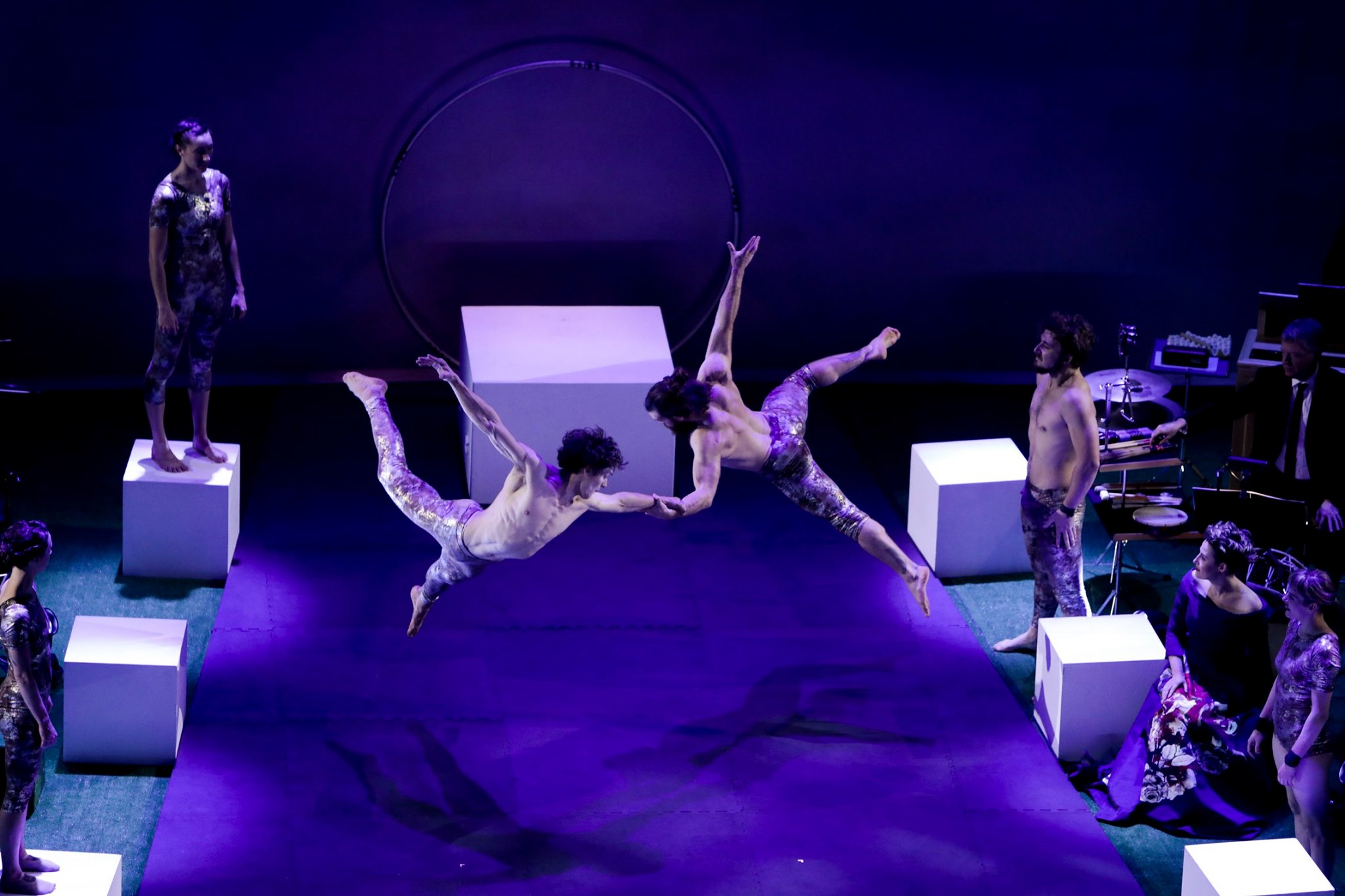
Noah Nielsen and Jake Silvestro with the Australian Brandenburg Orchestra in English Baroque, May 2019. Image courtesy Steven Godbee
Noah Nielsen and Jake Silvestro from Circa with the Australian Brandenburg Orchestra in English Baroque at the City Recital Hall, May 2019. Image courtesy Steven Godbee

English Baroque

Australian Brandenburg Orchestra, Circa, Jane Sheldon, Lauren Stephenson

City Recital Hall, Sydney

8 May, 2019

A collaboration with Circa must seem like taking a friend to a party only to find that they steal all your attention.

The Australian Brandenburg Orchestra’s third collaboration with the Brisbane based contemporary human circus company Circa, is probably its finest yet, with the currently touring English Baroque programme following on the success of the breathtaking Spanish and French Baroque series, 2 and 4 years ago. The escapades of the acrobats were transfixing, to the extent that several times, I had to force my attention back to the music. If there were to be a genre of music that was perfectly matched with acrobatics, it would have to be the Baroque style. The Brandenburg’s Paul Dyer AO and Circa’s Yaron Lifschitz created music and movement that were perfectly matched in their elements of strong, clear structural elements, embellished with breathtaking flourishes and feats of skill.

Joining the 12 musicians of the orchestra, led by violinist Shaun Lee-Chen and directed from the harpsichord (with short stints at the organ and the harmonium) by Paul Dyer AO, were seven acrobats from Circa and sopranos Jane Sheldon and Lauren Stephenson.

This was a celebration of human sound and movement. It embraced dance and drama, acrobatics and song, music and design, infused with a liberal dose of humour. The feats elicited wide-eyed tension, belly laughs and gasps from the audience. It integrated instrumentalists, singers and movement artists in a performance which bore the hallmarks of steely focus, stamina, Herculean strength and pinpoint precision that were nonetheless, touched by gracefulness.

The Baroque setting started in an imaginary court and ended at the fairground, having moved through the bedroom and the court, depicted by correspondingly themed music. Plinths adorned the set serving as pedestals (and later as props) for the acrobats brought onto the stage in the manner of statues which came to life.

Dyer’s musical curation looked to rarely heard gems from Purcell and Handel with a nod to Dowland, Corelli and a collection of traditional songs, featuring some charming arrangements by Sydney-born, London-based composer Alex Palmer, notably his realisation of the traditional Scarborough Fair. Circa director Yaron Lifschitz created a moving canvas of acrobatics that mirrored the music, from the fluid and the delicate, as in Dowland’s Behold a Wonder Here, to the more masculine, as in the excerpts from Corelli’s Concerto grosso in D major opus 6, no 4. That the acrobats were able to perform these feats in the relative confines of a recital hall stage, shared with other performers seemed miraculous in itself.

For the musicians of the Brandenburg, this was their ‘home ground’; their specialist repertoire, performed with panache. The poignant Adagio from Handel’s Organ Concerto in G minor op 4 no 3 and the instrumental elements of Scarborough Fair deserve special mention.

Jane Sheldon and Lauren Stephenson were worthy additions to the ensemble. Jane Sheldon’s pure, and shimmering tone lends itself admirably to the two ends of music’s chronological spectrum. Ornamentation, timbre and stylistic touches placed this performance firmly in the Baroque. Her rendition of Handel’s Gentle Morpheus from Alceste was transporting, as American Circa member Noah Nielsen wove his magic with first one, then two and three diabolos.

Sheldon and Stephenson performed a sublime account of De torrente in via from Handel’s Dixit Dominus as Jessica Connell transfixed us with her hula-hoop. No spoilers but, the Gartan Mother’s Lullaby, another engaging Alex Palmer arrangement sung exquisitely by Sheldon and Stephenson, was very special, integrating the acrobats into the action. Watch out for the fun and the daring in the last moments of the evening’s line-up.

The sense of cohesion, the empathy and trust, not just within each ensemble but between them as well as the soloists, along with the mastery of their craft, are clearly critical to the success of this offering which brought the house to its feet in a well-deserved ovation.

This is a ‘must -see’ – and do take the kids.

Shamistha de Soysa for SoundsLikeSydney©

‘English Baroque’ continues at the City Recital Hall, Sydney till Friday 17 May before touring to Melbourne and Brisbane.


Similar Posts

  • Concert Review: Ascension/ Bach Akademie Australia

    Ascension, Bach Akademie Australia St Francis of Assissi Church, Paddington, Sydney 29 March, 2019 Despite the innumerable words written about the music of J S Bach, there is nothing that touches the soul quite like hearing it performed by those who understand it best. JS Bach’s music  brims with inexplicable harmonies and poignant melodies against…

  • Concert Review: The Metropolitan Orchestra/ The ‘Great’

    ‘The Metropolitan Orchestra, conductor Sarah-Grace Williams Violin soloist Glenn Christensen 20 August 2016, Eugene Goossens Hall, ABC Centre, Ultimo  Written by Larry Turner The Metropolitan Orchestra is arguably the doyen of Sydney’s non-salaried symphony orchestras.  In the fourth concert of their main 2016 Sydney series they performed just two works which are now standard repertoire but neither of…

  • Concert Review: Splendour And Mystery/Sydney Chamber Choir

    Splendour and Mystery/ Sydney Chamber Choir
    Verbrugghen Hall, Sydney Conservatorium of Music
    Australian Digital Concert Hall
    25 March, 2023
    In Splendour and Mystery, Sydney Chamber Choir under the direction of Sam Allchurch joined forces with Camerata Antica led by Matthew Manchester and organist Thomas Wilson in an adventurous anthology of music written for double choir. Specialising in the music of the 16th and 17th centuries, the founder of Camerata Antica, Matthew Manchester playing the fiendishly difficult cornetto, was joined by Michael Wyborn, William Kinmont and Paolo Franks playing the equally challenging alto, tenor and bass sackbutts respectively.
    Bookended with pieces by Giovanni Gabrieli with one of his refreshing Canzonas in the middle, the program also contained music by living Australasian composers Clare Maclean and Brooke Shelley, Gabrieli’s contemporary and student Heinrich Schütz and 20th century composers John Tavener and Frank Martin. Together these composers explore and exploit the potential of the double choir with its opportunities for super-rich harmonies, added melodic lines, imitation, choral interplay and variations in the positioning of the singers.
    The opening motet, Gabrieli’s Jubilate Deo omnis terra, C 65 was quite literally a musical shout for joy. A major part of this journey back in time to Renaissance Venice was the unique sound of Camerata Antica. Heralded by the instruments, the 10 lines of the choir sang an uplifting, lively and tightly dotted chorus, alternating with homophonic passages. Allchurch and his ensemble clearly delineated the rhythms, changing time signatures, hemiolas and other displaced accents which created the buoyancy of this celebratory piece.
    John Tavener’s brilliant A Hymn to the Mother of God transcends the mortal and looks to the cosmic powers of Mother Mary. Writing in the style of canon, with imitative lines that start in quick succession and not necessarily in harmony, Tavener creates a sense of ‘other-worldliness’ in this simple but awe-inducing piece in three-sections. It was a slow burn as the two choirs sang with shimmering lightness and a sense of spinning through space, creating vivid colours and  clusters of clashing chords with impressive control as the voices rose in range and dynamic to its full-bodied climax.
    The program moved imperceptibly to the German Magnificat by Heinrich Schütz, as the choirs were joined by organ and instruments. This was a relevant and important inclusion as Gabrieli himself taught Schütz in this multi-choral technique which Schütz then developed in his own style.
    Clare Maclean’s moving Christ the King was sublimely sung, opening in the manner of a plainchant by the female voices which peeled off into mirroring phrases by the other voices, ending in a reprise of the plainchant. Premiered by this choir in 1984, it is precisely opportunities like these which new composers need for their music to be heard and re-heard until it becomes recognizable to listeners and enters the DNA of the concert repertoire.
    The short and brilliant burst of Gabrieli’s Canzona seconda, C 187  from Camerata Antica showcased these rudimentary instruments in all their imperfect glory as the choir positioned itself for Frank’s only unaccompanied choral work, the demanding  Mass for double choir, considered to be one of the finest and most complex pieces of 20th century choral music. The choir did ample justice to this piece which incorporates the aesthetics of Renaissance music, French Impressionism, Schoenberg’s twelve-note system and J S Bach. The altos began the Kyrie with a freely-flowing, supplicating melody; the Gloria built step-wise to cluster chords; the Credo was a business-like affirmation of faith; the canon-styled Et Resurrexit was levity, hope and word-painting to perfection; the Sanctus introduced softer harmonies from the male voices. The mass, Version 1, ended with a powerful Benedictus. Fast forward to 1926 and Martin added the Agnus Dei, the crowning glory to this choral magnum opus. The mass culminated in a glorious unification of the choirs.
    Brooke Shelley’s Heavenly Father, composed in 2022, performed in the presence of the composer was premiered in November 2022, by the Sydney Chamber Choir. A lyrical and beautifully textured piece, it is very pleasing that it has quickly been programmed again. Like the slightly older piece by Maclean, it is critical that new pieces of merit such as these, are given regular and frequent hearings so that they may be heard widely and face the test of time.
    Finally, Gabrieli’s Magnificat a 14, C 79 brought together the full instrumental and vocal forces of the ensemble. Using the 16th century Venetian technique of cori spezzati (split choirs), the brighter sound of the female voices and cornetto took to the left gallery with the male voices and the thrilling grunt of the bass and other sackbutts in the right gallery with a mixed ensemble placed and organ placed centrally on stage.
    This was an intelligent and audacious program from Allchurch, performed with glorious sound by a choir secure in technique, pitch and musicianship.

  • Concert Review: Revolutionary Romance/ Australian Romantic And Classical Orchestra

    Revolutionary Romance, Australian Romantic and Classical Orchestra, Chamber Soloists, CIty Recital Hall, 17 September 2017 Written by Wendy McLeod It was a gentle spring afternoon in Sydney when the Chamber Soloists of the Australian Romantic and Classical Orchestra (ARCO) gathered to present Revolutionary Romance featuring chamber works by Mozart and Spohr, showcasing Australian clarinet virtuoso,…

  • Concert Review: Sarah Grunstein/ Beethoven, Brahms And Schumann

    Sarah Grunstein, Beethoven, Brahms And Schumann Utzon Room, Sydney Opera House 23, September, 2018 Based on the concept of improvisation, pianist Sarah Grunstein performed a program of 19th century masterworks in the Utzon Room of the Sydney Opera House. It was a creative pairing of two late works – Beethoven’s Sonata no 30 in E…

Leave a Reply

Your email address will not be published. Required fields are marked *