Concert Review: Musica Viva Sessions

Capture1-325x240

Musica Viva Sessions,

The National Herbarium of NSW The Royal Botanic Garden Sydney

29 June 2017

Written by Deen Hamaker

Musica Viva’s Sessions series is a bold initiative which aims to attract new audiences and re- invigorate the way classical music is heard and where it is performed. The prospect of an unusual combination of instruments being played in an unexplored space seemed to resonate with the aims of the event. Performing were two lauded soloists – Kerryn Joyce, a percussionist renowned for her Japanese drumming and the other, Kirsty McCahon, a double bassist with serious early music credibility, renowned for her work with the Australian Brandenburg Orchestra. It was hard to imagine what to expect, the prospect was too intriguing to miss, and so, despite the chill of a Sydney winter’s evening, I was off to the National Herbarium of New South Wales in Sydney’s Royal Botanic Gardens, to find out.

What a joy this evening was!! Joyce on drums and McCahon on lower strings made an unlikely combination that worked exceptionally well. After a brief introduction over drinks in the lobby of the National Herbarium, we were led through the back-stage area of the Herbarium where we saw a selection of the diverse plant and seed samples that the institution has collected over its 164 years.

A brief walk led to the original building and in a grand Victorian room on the lower floor we were treated to music from different times and places – from Renaissance Scotland and the United States to Brazil, from contemporary Italy to Australia. Music such as we are unaccustomed to hearing – some of which was written especially for this concert.

The curtain-raiser was the premiere of a piece composed for the concert by Kerryn Joyce, featuring Joyce herself on Japanese taiko drums and McCahon on violone. Joyce played the taiko beautifully, drawing on a range of colours and expressions. Particularly wonderful was her playing of a solo version of Dedication, a contemporary piece composed by Ian Cleworth, director of Taikoz. She demonstrated her versatility by moving to the vibraphone, playing a Brazilian piece titled Bem-vindo by Ney Rosauro and accompanying Kristy McCahon in adapted versions of Elena Kats-Chernin’s Adrift, Robert Davidson’s Melody for Julia and David Anderson’s Blue Cheese and Rush Hour.

Kristy McCahon likewise showed her versatility playing Tobias Hume’s Love’s Farewell on the violone, written for the instrument in renaissance Scotland around 1600. She moved to the double bass to bring us into the 20th century playing Luciano Berio’s Psy, a complex modern piece which she played with verve, capturing the frenzy of Berio’s musical language.

The soloists’ banter, explaining and sharing their insights into the pieces and their instruments added levity to the evening which ended with a series of duets by Kats-Chernin and a double from David Anderson, in which both musicians gave virtuoso performances.  The concert over, the audience was treated to a nocturnal walk through the Royal Botanic Gardens – a rare treat even in the crisp winter weather.

Musica Viva deserves plaudits for starting this intimate series of concerts in unusual spaces. It was an evening of exceptional music played by two extraordinary artists. Hopefully Musica Viva’s Sessions will become a regular fixture in Sydney’s concert calendar.

Deen Hamaker for SoundsLikeSydney©

Deen Hamaker is a passionate opera aficionado and commentator. Introduced to theatre, opera and classical music at a very young age, he has acted in and directed several theatre productions, both in Australia and overseas. Deen lived in Japan for several years and studied the performing arts of Asia. Deen’s particular passion is opera, particularly the Russian, French and Modern repertoire. Deen was a contributing author for “Great, Grand and Famous Opera Houses”, 2012. Fluent in Japanese, Deen holds a Bachelor of Arts in Japanese from Griffith University and currently lives in Sydney.


Similar Posts

  • Macheath leaves town as Don Giovanni comes to stay

    As one lothario’s time in Sydney comes to an end, another moves in. The Sydney Theatre company’s production of the Brecht/Weill Threepenny Opera closed over the weekend as Opera Australia’s production of Mozart’s Don Giovanni opened. In many ways the two men, Macheath and Don Giovanni are similar. Murderers, rapists and, unscrupulous seducers whose evil is made…

  • Concert Review: Splendour And Mystery/Sydney Chamber Choir

    Splendour and Mystery/ Sydney Chamber Choir
    Verbrugghen Hall, Sydney Conservatorium of Music
    Australian Digital Concert Hall
    25 March, 2023
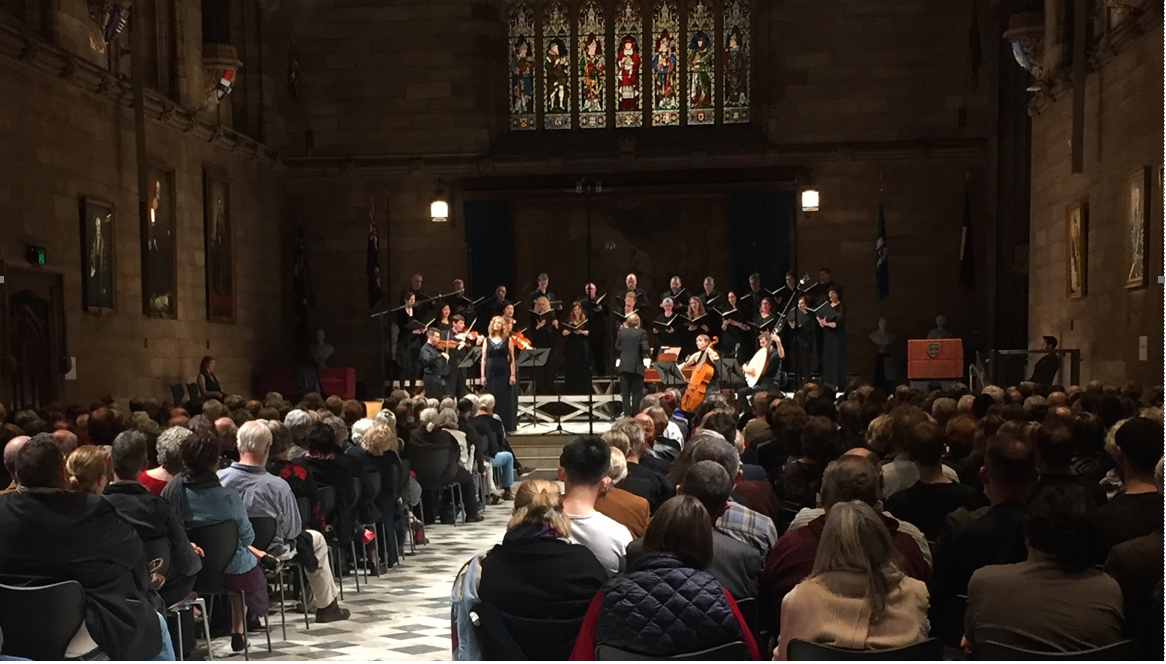
    In Splendour and Mystery, Sydney Chamber Choir under the direction of Sam Allchurch joined forces with Camerata Antica led by Matthew Manchester and organist Thomas Wilson in an adventurous anthology of music written for double choir. Specialising in the music of the 16th and 17th centuries, the founder of Camerata Antica, Matthew Manchester playing the fiendishly difficult cornetto, was joined by Michael Wyborn, William Kinmont and Paolo Franks playing the equally challenging alto, tenor and bass sackbutts respectively.
    Bookended with pieces by Giovanni Gabrieli with one of his refreshing Canzonas in the middle, the program also contained music by living Australasian composers Clare Maclean and Brooke Shelley, Gabrieli’s contemporary and student Heinrich Schütz and 20th century composers John Tavener and Frank Martin. Together these composers explore and exploit the potential of the double choir with its opportunities for super-rich harmonies, added melodic lines, imitation, choral interplay and variations in the positioning of the singers.
    The opening motet, Gabrieli’s Jubilate Deo omnis terra, C 65 was quite literally a musical shout for joy. A major part of this journey back in time to Renaissance Venice was the unique sound of Camerata Antica. Heralded by the instruments, the 10 lines of the choir sang an uplifting, lively and tightly dotted chorus, alternating with homophonic passages. Allchurch and his ensemble clearly delineated the rhythms, changing time signatures, hemiolas and other displaced accents which created the buoyancy of this celebratory piece.
    John Tavener’s brilliant A Hymn to the Mother of God transcends the mortal and looks to the cosmic powers of Mother Mary. Writing in the style of canon, with imitative lines that start in quick succession and not necessarily in harmony, Tavener creates a sense of ‘other-worldliness’ in this simple but awe-inducing piece in three-sections. It was a slow burn as the two choirs sang with shimmering lightness and a sense of spinning through space, creating vivid colours and  clusters of clashing chords with impressive control as the voices rose in range and dynamic to its full-bodied climax.
    The program moved imperceptibly to the German Magnificat by Heinrich Schütz, as the choirs were joined by organ and instruments. This was a relevant and important inclusion as Gabrieli himself taught Schütz in this multi-choral technique which Schütz then developed in his own style.
    Clare Maclean’s moving Christ the King was sublimely sung, opening in the manner of a plainchant by the female voices which peeled off into mirroring phrases by the other voices, ending in a reprise of the plainchant. Premiered by this choir in 1984, it is precisely opportunities like these which new composers need for their music to be heard and re-heard until it becomes recognizable to listeners and enters the DNA of the concert repertoire.
    The short and brilliant burst of Gabrieli’s Canzona seconda, C 187  from Camerata Antica showcased these rudimentary instruments in all their imperfect glory as the choir positioned itself for Frank’s only unaccompanied choral work, the demanding  Mass for double choir, considered to be one of the finest and most complex pieces of 20th century choral music. The choir did ample justice to this piece which incorporates the aesthetics of Renaissance music, French Impressionism, Schoenberg’s twelve-note system and J S Bach. The altos began the Kyrie with a freely-flowing, supplicating melody; the Gloria built step-wise to cluster chords; the Credo was a business-like affirmation of faith; the canon-styled Et Resurrexit was levity, hope and word-painting to perfection; the Sanctus introduced softer harmonies from the male voices. The mass, Version 1, ended with a powerful Benedictus. Fast forward to 1926 and Martin added the Agnus Dei, the crowning glory to this choral magnum opus. The mass culminated in a glorious unification of the choirs.
    Brooke Shelley’s Heavenly Father, composed in 2022, performed in the presence of the composer was premiered in November 2022, by the Sydney Chamber Choir. A lyrical and beautifully textured piece, it is very pleasing that it has quickly been programmed again. Like the slightly older piece by Maclean, it is critical that new pieces of merit such as these, are given regular and frequent hearings so that they may be heard widely and face the test of time.
    Finally, Gabrieli’s Magnificat a 14, C 79 brought together the full instrumental and vocal forces of the ensemble. Using the 16th century Venetian technique of cori spezzati (split choirs), the brighter sound of the female voices and cornetto took to the left gallery with the male voices and the thrilling grunt of the bass and other sackbutts in the right gallery with a mixed ensemble placed and organ placed centrally on stage.
    This was an intelligent and audacious program from Allchurch, performed with glorious sound by a choir secure in technique, pitch and musicianship.

  • Concert Review: Schubert Immersion Weekend / Seraphim Trio

      Seraphim Trio: Helen Ayres (violin), Anna Goldsworthy (piano), Tim Nankervis (cello) With Jacqui Cronin (viola), David Campbell (double bass)  10-11 September 2016, The Independent Theatre, North Sydney Written by Larry Turner The Seraphim Trio has nominated 2016 as ‘our year of total immersion in Schubert’.  This culminated in a splendid weekend when they presented…

  • Opera Review: Król Roger (King Roger) / Opera Australia

      Król Roger (King Roger)  –  Karol Szymanowski Opera Australia, Joan Sutherland Opera Theatre, Sydney Opera House 20 January 2017 Opera Australia’s second new production in the 2017 summer season is Król Roger (King Roger) by the early 20th century Polish composer Karol Szymanowski.  The work is rarely performed outside Poland and this co-production with…

Leave a Reply

Your email address will not be published. Required fields are marked *