Opera Review: La Traviata/ Opera Australia

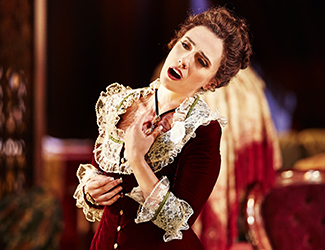
Ermonela Jaho as Violetta Valéry in Opera Australia's production of La Traviata. Photo credit: Keith Saunders
Ermonela Jaho as Violetta Valéry in Opera Australia’s production of La Traviata.
Photo credit: Keith Saunders

It’s everything you want opera to be. From its first trembling chromatics, the soloists dazzled, the chorus and orchestra were in fine form, Verdi’s music was impossible to resist and the tale oozed passion and tragedy. Add sumptuous and meticulously detailed costumes, sets and dramatic lighting and there you have the complete package.

Opera Australia’s 2017 revival of Verdi’s La Traviata opened in Sydney last week. This production, created by Elijah Moshinsky and revived by Hugh Halliday is one to treasure. Premiering in 1994, it continues to be visually stunning and perfectly in context with the tale of The Fallen Woman who vainly aspires to a more genteel life.

Opening the season in the title role of Violetta was Albanian soprano Ermonela Jaho whose performance was eagerly awaited. If Michael Yeargan’s set design represented a Renoir masterpiece then Ermonela Jaho’s performance created the finest of shading in colour, timbre and fragility mixed with broader brush strokes of tragedy and defiance topped with a shimmering coloratura. The role is fearsomely demanding. Jaho has sung Violetta in the grandest of opera houses like Munich, Paris and Vienna. She brings this experience and confidence to the Sydney stage. She sang Ah fors’è lui with the sublimest control before blossoming into a feisty cabaletta Sempre libera degg’io gives and delighting the audience with an incandescent high E flat as a finishing flourish.

Jaho gave a clear and moving account of Violetta, coming to the realisation of her fate and accepting it without sentimentality, the effervescent ornamentation of the early scenes giving way to introspection and then guttural despair in one of opera’s most intimate endings. Jaho’s second act grand duet with Giorgio Germont sung by José Carbó was beautifully balanced and very special. Carbó played his role with fatherly tenderness and suitable ambivalence as he ventured into the softer registers of his voice.

Tenor Ho-Yoon Chung sang the role of the Germont fils Alfredo. After a tentative start, his ringing light tenor bloomed in the brindisi Libiamo ne’ lieti calici and he was well on his way.

There were marvellous performances from Dominica Matthews as Flora and Samuel Dundas as Marquis d’Obigny bringing perfectly timed welcome comic relief to their cameo roles. Stirling support too from Natalie Aroyan as Annina, Adrian Tamburini as Baron Douphol, John Longmuir as Gastone, Gennadi Dubinsky as Doctor Grenvil, Jin Tea Kim as Giuseppe, Jonathan McCauley as the Messenger and Malcolm Ede as the Servant.

Renato Palumbo conducted the accomplished Opera Australia Orchestra, contrasting the grandest of sounds in merry partying to the thin, anguish of a stark and lonely death. The Opera Australia Chorus was outstanding as always under Chorus Master Anthony Hunt and well deserving of its nomination for Best Chorus in the 2017 International Opera Awards, run by BBC 3 and Opera Magazine (winners to be announced in London on May 7).

The opera itself has an intriguing history with the Venetian censors declaring that the title of the opera, (based on Alexandre Dumas fils’ novel La Dame aux Camélias) be changed to Amore e morte (‘Love and Death’), prompting Verdi to write his friend Cesare De Sanctis that it was ‘a subject of the times. Others would not have done it because of the conventions, the epoch and for a thousand other stupid scruples’.

As an aside, Dumas fils’ novel also inspired the ballet Marguerite and Armand danced to Franz Liszt’s B minor piano sonata, created in 1963 by British choreographer Sir Frederick Ashton especially for Rudolf Nureyev and Dame Margot Fonteyn.

Seeing Moshinsky’s production of La Traviata is much like enjoying Opera Australia’s recent revivals of The Barber of Seville and The Love for Three Oranges – returning to a classic as one would return to look at a masterful painting, re-read an excellent book, or be moved by classic movie. They are integral parts of the company’s history and repertory. Audiences should have the opportunity to continue to enjoy them.

La Traviata is well worth seeing – the cast and production team have created opera at its best.

Shamistha de Soysa for SoundsLikeSydney©

La Traviata is at the Joan Sutherland Theatre of the Sydney Opera House on selected evenings and afternoons till April 1, 2017. Special ticket offer for February 23 performance.


Similar Posts

  • Concert Review: Splendour And Mystery/Sydney Chamber Choir

    Splendour and Mystery/ Sydney Chamber Choir
    Verbrugghen Hall, Sydney Conservatorium of Music
    Australian Digital Concert Hall
    25 March, 2023
    In Splendour and Mystery, Sydney Chamber Choir under the direction of Sam Allchurch joined forces with Camerata Antica led by Matthew Manchester and organist Thomas Wilson in an adventurous anthology of music written for double choir. Specialising in the music of the 16th and 17th centuries, the founder of Camerata Antica, Matthew Manchester playing the fiendishly difficult cornetto, was joined by Michael Wyborn, William Kinmont and Paolo Franks playing the equally challenging alto, tenor and bass sackbutts respectively.
    Bookended with pieces by Giovanni Gabrieli with one of his refreshing Canzonas in the middle, the program also contained music by living Australasian composers Clare Maclean and Brooke Shelley, Gabrieli’s contemporary and student Heinrich Schütz and 20th century composers John Tavener and Frank Martin. Together these composers explore and exploit the potential of the double choir with its opportunities for super-rich harmonies, added melodic lines, imitation, choral interplay and variations in the positioning of the singers.
    The opening motet, Gabrieli’s Jubilate Deo omnis terra, C 65 was quite literally a musical shout for joy. A major part of this journey back in time to Renaissance Venice was the unique sound of Camerata Antica. Heralded by the instruments, the 10 lines of the choir sang an uplifting, lively and tightly dotted chorus, alternating with homophonic passages. Allchurch and his ensemble clearly delineated the rhythms, changing time signatures, hemiolas and other displaced accents which created the buoyancy of this celebratory piece.
    John Tavener’s brilliant A Hymn to the Mother of God transcends the mortal and looks to the cosmic powers of Mother Mary. Writing in the style of canon, with imitative lines that start in quick succession and not necessarily in harmony, Tavener creates a sense of ‘other-worldliness’ in this simple but awe-inducing piece in three-sections. It was a slow burn as the two choirs sang with shimmering lightness and a sense of spinning through space, creating vivid colours and  clusters of clashing chords with impressive control as the voices rose in range and dynamic to its full-bodied climax.
    The program moved imperceptibly to the German Magnificat by Heinrich Schütz, as the choirs were joined by organ and instruments. This was a relevant and important inclusion as Gabrieli himself taught Schütz in this multi-choral technique which Schütz then developed in his own style.
    Clare Maclean’s moving Christ the King was sublimely sung, opening in the manner of a plainchant by the female voices which peeled off into mirroring phrases by the other voices, ending in a reprise of the plainchant. Premiered by this choir in 1984, it is precisely opportunities like these which new composers need for their music to be heard and re-heard until it becomes recognizable to listeners and enters the DNA of the concert repertoire.
    The short and brilliant burst of Gabrieli’s Canzona seconda, C 187  from Camerata Antica showcased these rudimentary instruments in all their imperfect glory as the choir positioned itself for Frank’s only unaccompanied choral work, the demanding  Mass for double choir, considered to be one of the finest and most complex pieces of 20th century choral music. The choir did ample justice to this piece which incorporates the aesthetics of Renaissance music, French Impressionism, Schoenberg’s twelve-note system and J S Bach. The altos began the Kyrie with a freely-flowing, supplicating melody; the Gloria built step-wise to cluster chords; the Credo was a business-like affirmation of faith; the canon-styled Et Resurrexit was levity, hope and word-painting to perfection; the Sanctus introduced softer harmonies from the male voices. The mass, Version 1, ended with a powerful Benedictus. Fast forward to 1926 and Martin added the Agnus Dei, the crowning glory to this choral magnum opus. The mass culminated in a glorious unification of the choirs.
    Brooke Shelley’s Heavenly Father, composed in 2022, performed in the presence of the composer was premiered in November 2022, by the Sydney Chamber Choir. A lyrical and beautifully textured piece, it is very pleasing that it has quickly been programmed again. Like the slightly older piece by Maclean, it is critical that new pieces of merit such as these, are given regular and frequent hearings so that they may be heard widely and face the test of time.
    Finally, Gabrieli’s Magnificat a 14, C 79 brought together the full instrumental and vocal forces of the ensemble. Using the 16th century Venetian technique of cori spezzati (split choirs), the brighter sound of the female voices and cornetto took to the left gallery with the male voices and the thrilling grunt of the bass and other sackbutts in the right gallery with a mixed ensemble placed and organ placed centrally on stage.
    This was an intelligent and audacious program from Allchurch, performed with glorious sound by a choir secure in technique, pitch and musicianship.

  • Concert Review: In An Italian Garden/Les Arts Florissant/Le Jardin des Voix

    In an Italian Garden Les Arts Florissant and Le Jardin des Voix, Concert Hall, Sydney Opera House, March 12, 2015. After an absence of more than a decade, the two dozen or so instrumentalists of Les Arts Florissants and the six vocalists of their vocal academy, Le Jardin des Voix returned to perform in Sydney,…

  • Concert Review: It Takes Two/ The Marais Project

      The Marais Project: Jennifer Eriksson (director and viola da gamba), Belinda Montgomery (soprano), Tommie Andersson (lutes)  Elysian Fields: Matt Keegan (saxophones), Matt McMahon (piano), Jennifer Eriksson (electric viola da gamba), Siebe Pogson (bass), Finn Ryan (percussion)  29 January, The Independent Theatre, North Sydney Jennifer Eriksson continually seeks to provide new perspectives on old music…

  • Opera Australia Premieres New Production Of ‘Metamorphosis’ In Edgy New Performance Space

    Opera Australia presents the premiere of a new production of the chamber opera  Metamorphosis by Brian Howard, in the scenery workshop of  The Opera Centre in Surry Hills. This massive space in which OA’s sets and props are built, will be transformed into an innovative performance area, adding edgy intensity to Howard’s opera written in 1982, to…

Leave a Reply