CD Review: Pictures At An Exhibition/ Simon Tedeschi
images

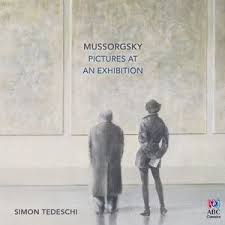
On his new recording Pictures at an Exhibition for ABC Classics, pianist Simon Tedeschi combines two works from the Russian piano repertoire which share their status as masterworks, but which are at opposite ends of the spectrum of complexity.

First on the CD is Mussorgsky’s suite of 10 pieces, from which the recording takes its name, creating 16 tracks after the linking Promenades are added in. It’s a substantial suite containing many challenges for the pianist.

Following this is Tchaikovsky’s collection of 24 cameos, Album for the Young, opus 39, which is, in contrast, written especially for the younger pianist.

Pictures at an Exhibition was Mussorgsky’s homage to the memory of his friend, the Russian artist Viktor Hartmann, who had died in 1873 at age 39. A posthumous exhibition of Hartmann’s artwork inspired Mussorgsky to capture the paintings in music. The work was completed by the summer of 1874, yet it remained unknown until well after his death in 1881, when in 1886, his friend Nikolai Rimsky-Korsakov edited and published the manuscript.The original version for piano was relegated in favour of the orchestral versions, the most popular of which was the transcription by Ravel (1922). Others including Sir Henry Wood (1918), Leopold Stokowski (1939), and Vladimir Ashkenazy (1982) also offered their interpretations of Mussorgsky’s music, not forgetting the 1971 version by the British pop group Emerson, Lake and Palmer.

Indeed, it is music that is richly textured and can be appreciated by its abstraction to the orchestral form. It was not until Russian pianist Svatislav Richter began to perform and recorded the piano version in the 1950s that the original enjoyed a renaissance (Horowitz’s 1947 piano transcription seems not have been as popular as Richter’s performances).

Tedeschi’s storytelling is compelling, affirming the mastery of Mussorgsky’s writing for the piano sans orchestral elaboration. The opening Promenade is authoritative and well paced, as are the subsequent Promenades;  Tedeschi creates a simply grotesque Gnomus delivering rapid rippling figures which portray the scurrying gnome with a tinge of pathos. Tedeschi shrouds The Old Castle in veils of faded glory turning the passing troubadour’s performance into a lilting though plaintive melody. Ponderous chords bring the lumbering Oxen to life as the beasts of burden grapple with their load. As they pass, a very finely balanced and graded decrescendo carries them off into the distance.

With a lightness of touch, brilliant technical control and more than a hint of bravura, Tedeschi injects a spritz of lightness and whimsy into the more virtuosic movements, notably the Ballet of the Chicks in Their Shells, The Market Place and The Hut on Hen’s Legs. He pulls the pace right back for the ghostly two-part Catacombs before plunging into unbridled majesty in The Great Gate of Kiev.

Tedeschi adds a personal touch with his insights published in the CD insert, drawing on his family connections to place his performance in the context of his own journey of discovering art and architecture.

Tchaikovsky wrote  Album for the Young, opus 39 for his seven-year-old nephew Vladimir ‘Bob’ Davidov. It’s technical elements and the images conveyed by the titles appeal directly to younger players.

As an adult playing children’s music, Tedeschi brings a well-balanced approach. His account is simple without being simplistic and mature without being melodramatic.  He delivers  a  well-considered rendition that is nuanced and shaded with subtleties of tempo, tone, phrasing and articulation bringing into relief the beauty of the music.

The dance movements ebb and sway, The Doll’s Funeral is achingly sad and the four folk songs are sheer delight.

We’re not told on what piano this recording has been made. Whatever the instrument, it conveys a very bright sound – particularly in the upper register with more rounded lower tones. The booklet accompanying the CD has comprehensive historical and biographical information. The recording was made in February 2015 in the Eugene Goossens Hall of the ABC Centre in Ultimo Sydney under noted recording engineer Virginia Read.

This vivid visual elements of Mussorgsky’s Pictures at an Exhibition and the appeal of Tchaikovsky’s Album for the Young make this recording apt for children. Adults will find their own level at which to appreciate it. Simon Tedeschi’s Pictures at an Exhibition is one for all ages.

Shamistha de Soysa for SoundsLikeSydney©
 

Similar Posts

  • Sydney Camerata grows with metamorphosen

    Last week, Sydney Camerata commemorated its third anniversary with a concert they called Metamorphosen,which culminated in the eponymous work for 23 strings by Richard Strauss. The resonant intimacy of North Sydney’s Independent Theatre was well suited to the size and sound of this ensemble, which chameleon like re-configures itself to adapt to what is being performed. Opening the concert with…

  • Concert Review: Chancellor’s Concert / Sydney Conservatorium Of Music Symphony Orchestra

    Chancellor’s Concert, Sydney Conservatorium of Music Symphony Orchestra, Verbrugghen Hall March 31 2017 Written by Ria Andriani The fourth in Sydney Conservatorium’s Chancellor’s Concert series, this outstanding performance brought an exciting program which Maestro Eduardo Diazmuñoz had designed as an homage to women in music as composers, performers and as muses. Aptly enough it was…

  • Movie Reviews: Enthralling Biopics About Two Opera Icons

    Two European film festival in Sydney last week saw the screening of two riveting movies about opera icons Luciano Pavarotti and Maria Callas. Pavarotti, directed by Ron “Happy Days” Howard is a 2019 documentary, shown as part of the Italian Film Festival, brimming with personal comments from Pavarotti, his first wide Adua and three adult…

  • Concert Review: Splendour And Mystery/Sydney Chamber Choir

    Splendour and Mystery/ Sydney Chamber Choir
    Verbrugghen Hall, Sydney Conservatorium of Music
    Australian Digital Concert Hall
    25 March, 2023
    In Splendour and Mystery, Sydney Chamber Choir under the direction of Sam Allchurch joined forces with Camerata Antica led by Matthew Manchester and organist Thomas Wilson in an adventurous anthology of music written for double choir. Specialising in the music of the 16th and 17th centuries, the founder of Camerata Antica, Matthew Manchester playing the fiendishly difficult cornetto, was joined by Michael Wyborn, William Kinmont and Paolo Franks playing the equally challenging alto, tenor and bass sackbutts respectively.
    Bookended with pieces by Giovanni Gabrieli with one of his refreshing Canzonas in the middle, the program also contained music by living Australasian composers Clare Maclean and Brooke Shelley, Gabrieli’s contemporary and student Heinrich Schütz and 20th century composers John Tavener and Frank Martin. Together these composers explore and exploit the potential of the double choir with its opportunities for super-rich harmonies, added melodic lines, imitation, choral interplay and variations in the positioning of the singers.
    The opening motet, Gabrieli’s Jubilate Deo omnis terra, C 65 was quite literally a musical shout for joy. A major part of this journey back in time to Renaissance Venice was the unique sound of Camerata Antica. Heralded by the instruments, the 10 lines of the choir sang an uplifting, lively and tightly dotted chorus, alternating with homophonic passages. Allchurch and his ensemble clearly delineated the rhythms, changing time signatures, hemiolas and other displaced accents which created the buoyancy of this celebratory piece.
    John Tavener’s brilliant A Hymn to the Mother of God transcends the mortal and looks to the cosmic powers of Mother Mary. Writing in the style of canon, with imitative lines that start in quick succession and not necessarily in harmony, Tavener creates a sense of ‘other-worldliness’ in this simple but awe-inducing piece in three-sections. It was a slow burn as the two choirs sang with shimmering lightness and a sense of spinning through space, creating vivid colours and  clusters of clashing chords with impressive control as the voices rose in range and dynamic to its full-bodied climax.
    The program moved imperceptibly to the German Magnificat by Heinrich Schütz, as the choirs were joined by organ and instruments. This was a relevant and important inclusion as Gabrieli himself taught Schütz in this multi-choral technique which Schütz then developed in his own style.
    Clare Maclean’s moving Christ the King was sublimely sung, opening in the manner of a plainchant by the female voices which peeled off into mirroring phrases by the other voices, ending in a reprise of the plainchant. Premiered by this choir in 1984, it is precisely opportunities like these which new composers need for their music to be heard and re-heard until it becomes recognizable to listeners and enters the DNA of the concert repertoire.
    The short and brilliant burst of Gabrieli’s Canzona seconda, C 187  from Camerata Antica showcased these rudimentary instruments in all their imperfect glory as the choir positioned itself for Frank’s only unaccompanied choral work, the demanding  Mass for double choir, considered to be one of the finest and most complex pieces of 20th century choral music. The choir did ample justice to this piece which incorporates the aesthetics of Renaissance music, French Impressionism, Schoenberg’s twelve-note system and J S Bach. The altos began the Kyrie with a freely-flowing, supplicating melody; the Gloria built step-wise to cluster chords; the Credo was a business-like affirmation of faith; the canon-styled Et Resurrexit was levity, hope and word-painting to perfection; the Sanctus introduced softer harmonies from the male voices. The mass, Version 1, ended with a powerful Benedictus. Fast forward to 1926 and Martin added the Agnus Dei, the crowning glory to this choral magnum opus. The mass culminated in a glorious unification of the choirs.
    Brooke Shelley’s Heavenly Father, composed in 2022, performed in the presence of the composer was premiered in November 2022, by the Sydney Chamber Choir. A lyrical and beautifully textured piece, it is very pleasing that it has quickly been programmed again. Like the slightly older piece by Maclean, it is critical that new pieces of merit such as these, are given regular and frequent hearings so that they may be heard widely and face the test of time.
    Finally, Gabrieli’s Magnificat a 14, C 79 brought together the full instrumental and vocal forces of the ensemble. Using the 16th century Venetian technique of cori spezzati (split choirs), the brighter sound of the female voices and cornetto took to the left gallery with the male voices and the thrilling grunt of the bass and other sackbutts in the right gallery with a mixed ensemble placed and organ placed centrally on stage.
    This was an intelligent and audacious program from Allchurch, performed with glorious sound by a choir secure in technique, pitch and musicianship.

Leave a Reply

Your email address will not be published. Required fields are marked *