Concert Review: Groove Sessions/ The Idea Of North
The Idea of North
The Idea of North

The Idea of North – Groove Sessions

Independent Theatre, North Sydney,

18 February  2018

Written by Paul Bennett

With an impressive collection of albums of various styles, ARIA awards and an extensive fan base in Australia and overseas, The Idea of North can lay claim to being one of the premier vocal groups in Australia.

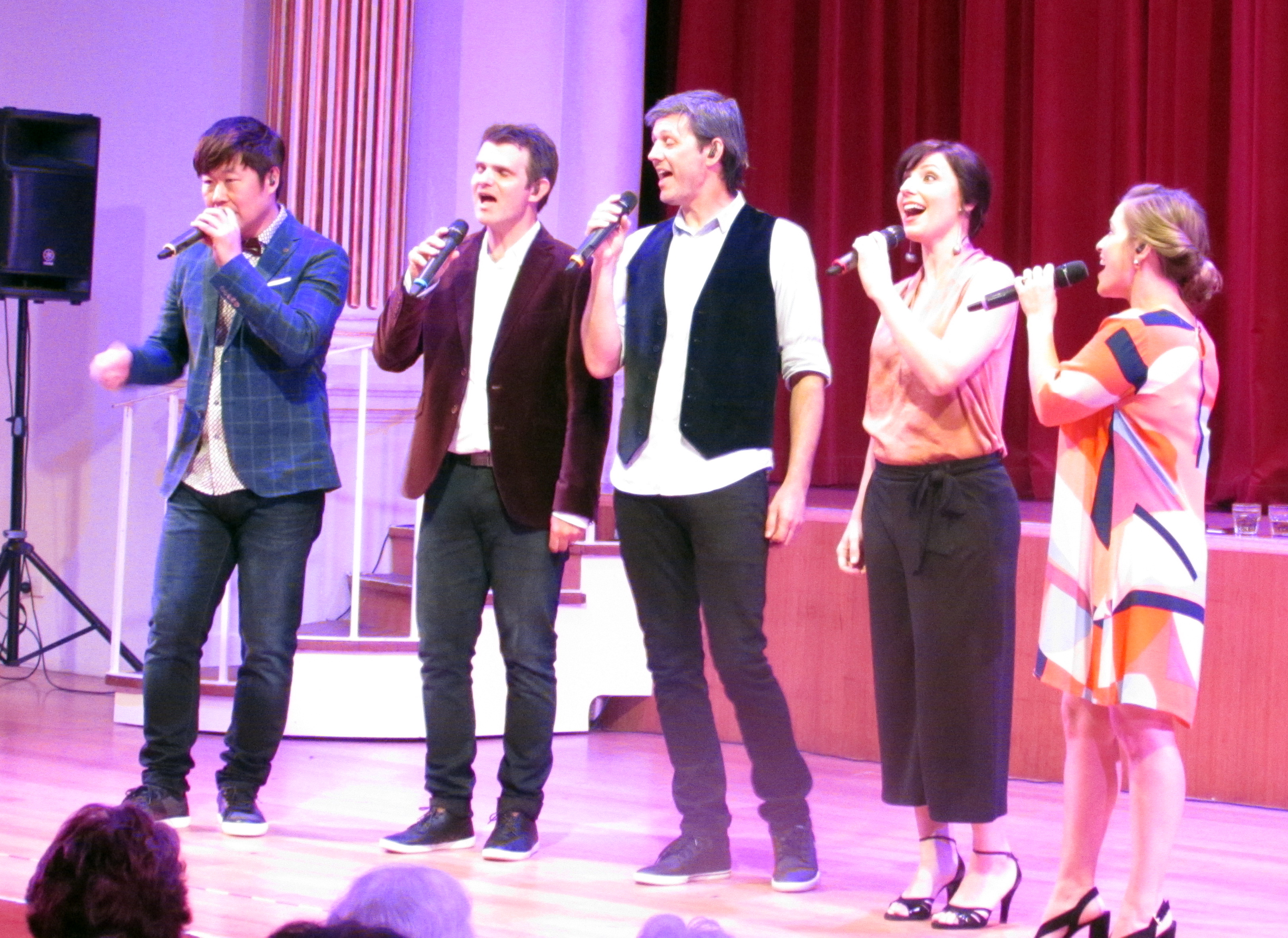
Today’s concert, Groove Sessions, showcased the latest iteration of a group that started when four students from the Canberra School of Music started singing together for fun in the mid 90’s – and it grew into a real job!

The line up has changed several times over the intervening years and two of the four principal singers we heard today are different to those whom we heard as recently as 2017. The end result is a different sound in many ways to the previous combinations but with enough similarities to keep the enthusiastic fan base happy and comfortable. These changes have afforded the space for the group to explore new territories and feels which, by and large, work well.

The new soprano and  bass voices Emma Rule and Luke Thompson, have seamlessly integrated into the tight arrangements for which  the a cappella group is known, beautifully illustrated by the interpretations of two Joni Mitchell songs, Big Yellow Taxi and Both Sides Now as well as  the ballads I Said No and Flame Trees from previous albums. The detail and the subtlety were beautifully executed and the blend of voices, while different to the previous sound, still has the ability to raise goosebumps.

The areas of exploration for the group have centered on two areas both of which are intriguing. The first is the increased contribution of the senior two members of the group, to the entertainment aspects of the program. Humour has always been part of the performance but Nick Begbie and Naomi Crellin have now made it an integral part of the show with two comedy songs done with a personality driven cabaret feel –like the Tim Minchin song I like singing in F sharp and The Cat.

The second area of exploration has been the opportunities created by the addition of a vocal percussionist, Kai Kitamura. He’s the full drum kit and more but it’s all done with voice! Beautiful jazz feels, seamless shifts in tempo and mood and sympathetic percussion patterns made the songs he contributed to a highlight of the concert.  He’s also an entertainer in his own right and his solo section was a standout with the audience.

But for all the enjoyment afforded by the rich harmonies, the comedy songs, the personalities and the addition of percussion, it’s the class of The Idea of North that is the underlying but defining characteristic of the group. The cleverness of the medley arrangements, the light and shade, the distinctive rhythmic approaches to well-known classics which find new life in refreshing ways, are the base upon which this very enjoyable concert was built. The audience had a smile on its collective face from the moment the group walked on the stage to the end of the encore. What a wonderful way to spend a Sunday afternoon!

Paul Bennett for SoundsLikeSydney©

Dr Paul Bennett is a medical musician- part of the long tradition of medical doctors whose passion is music but whose day job is medicine. Paul trained in piano at the Sydney Conservatorium under Margaret Hughes and has since been involved with many choirs and soloists as an accompanist and teacher. His special interest is jazz and he’s the pianist in the Sydney jazz trio “Not The Full List”. Paul has an active interest in the use of film and video production in medical education and he has a qualification from the Australian Film,Television and Radio School. 
 

Similar Posts

  • Concert Review: The Italian/ The Metropolitan Orchestra

    ‘The Italian’/ The Metropolitan Orchestra (TMO)/ Michael Wray, principal horn/Sarah-Grace Williams, conductor Eugene Goossens Hall, ABC Centre, Ultimo 11 June 2016 Written by Ria Andriani  The third concert in The Metropolitan Orchestra (TMO) Met series continued last weekend in the tradition of presenting excellent performances to a full house. Under the baton of conductor Sarah-Grace Williams,…

  • Concert Review: Mozart’s Fortepiano/Kristian Bezuidenhout/Australian Brandenburg Orchestra

    It was an evening when the gentlest of instruments took centre stage. The Australian Brandenburg Orchestra, performed music for fortepiano and period flute by Mozart and his contemporaries. Upstaged by its more precocious descendent the pianoforte, the fortepiano is infrequently heard as a solo instrument, often being relegated to the role of an accompanying instrument….

  • Concert Review: Splendour And Mystery/Sydney Chamber Choir

    Splendour and Mystery/ Sydney Chamber Choir
    Verbrugghen Hall, Sydney Conservatorium of Music
    Australian Digital Concert Hall
    25 March, 2023
    In Splendour and Mystery, Sydney Chamber Choir under the direction of Sam Allchurch joined forces with Camerata Antica led by Matthew Manchester and organist Thomas Wilson in an adventurous anthology of music written for double choir. Specialising in the music of the 16th and 17th centuries, the founder of Camerata Antica, Matthew Manchester playing the fiendishly difficult cornetto, was joined by Michael Wyborn, William Kinmont and Paolo Franks playing the equally challenging alto, tenor and bass sackbutts respectively.
    Bookended with pieces by Giovanni Gabrieli with one of his refreshing Canzonas in the middle, the program also contained music by living Australasian composers Clare Maclean and Brooke Shelley, Gabrieli’s contemporary and student Heinrich Schütz and 20th century composers John Tavener and Frank Martin. Together these composers explore and exploit the potential of the double choir with its opportunities for super-rich harmonies, added melodic lines, imitation, choral interplay and variations in the positioning of the singers.
    The opening motet, Gabrieli’s Jubilate Deo omnis terra, C 65 was quite literally a musical shout for joy. A major part of this journey back in time to Renaissance Venice was the unique sound of Camerata Antica. Heralded by the instruments, the 10 lines of the choir sang an uplifting, lively and tightly dotted chorus, alternating with homophonic passages. Allchurch and his ensemble clearly delineated the rhythms, changing time signatures, hemiolas and other displaced accents which created the buoyancy of this celebratory piece.
    John Tavener’s brilliant A Hymn to the Mother of God transcends the mortal and looks to the cosmic powers of Mother Mary. Writing in the style of canon, with imitative lines that start in quick succession and not necessarily in harmony, Tavener creates a sense of ‘other-worldliness’ in this simple but awe-inducing piece in three-sections. It was a slow burn as the two choirs sang with shimmering lightness and a sense of spinning through space, creating vivid colours and  clusters of clashing chords with impressive control as the voices rose in range and dynamic to its full-bodied climax.
    The program moved imperceptibly to the German Magnificat by Heinrich Schütz, as the choirs were joined by organ and instruments. This was a relevant and important inclusion as Gabrieli himself taught Schütz in this multi-choral technique which Schütz then developed in his own style.
    Clare Maclean’s moving Christ the King was sublimely sung, opening in the manner of a plainchant by the female voices which peeled off into mirroring phrases by the other voices, ending in a reprise of the plainchant. Premiered by this choir in 1984, it is precisely opportunities like these which new composers need for their music to be heard and re-heard until it becomes recognizable to listeners and enters the DNA of the concert repertoire.
    The short and brilliant burst of Gabrieli’s Canzona seconda, C 187  from Camerata Antica showcased these rudimentary instruments in all their imperfect glory as the choir positioned itself for Frank’s only unaccompanied choral work, the demanding  Mass for double choir, considered to be one of the finest and most complex pieces of 20th century choral music. The choir did ample justice to this piece which incorporates the aesthetics of Renaissance music, French Impressionism, Schoenberg’s twelve-note system and J S Bach. The altos began the Kyrie with a freely-flowing, supplicating melody; the Gloria built step-wise to cluster chords; the Credo was a business-like affirmation of faith; the canon-styled Et Resurrexit was levity, hope and word-painting to perfection; the Sanctus introduced softer harmonies from the male voices. The mass, Version 1, ended with a powerful Benedictus. Fast forward to 1926 and Martin added the Agnus Dei, the crowning glory to this choral magnum opus. The mass culminated in a glorious unification of the choirs.
    Brooke Shelley’s Heavenly Father, composed in 2022, performed in the presence of the composer was premiered in November 2022, by the Sydney Chamber Choir. A lyrical and beautifully textured piece, it is very pleasing that it has quickly been programmed again. Like the slightly older piece by Maclean, it is critical that new pieces of merit such as these, are given regular and frequent hearings so that they may be heard widely and face the test of time.
    Finally, Gabrieli’s Magnificat a 14, C 79 brought together the full instrumental and vocal forces of the ensemble. Using the 16th century Venetian technique of cori spezzati (split choirs), the brighter sound of the female voices and cornetto took to the left gallery with the male voices and the thrilling grunt of the bass and other sackbutts in the right gallery with a mixed ensemble placed and organ placed centrally on stage.
    This was an intelligent and audacious program from Allchurch, performed with glorious sound by a choir secure in technique, pitch and musicianship.

  • Poèmes – Renee Fleming

    Renee Fleming’s new CD Poèmes celebrates Gallic vocal music from Ravel’s Orientalist infused Shéhérazade, written at  the turn of the last century and Messiaen’s Poèmes pour Mi, to Deux  Sonnets de Jean Cassou and a world premiere recording of Le Temps l’horloge by living composer Henri Dutilleux. The celebrated singer comments: ” For the sheer sensual joy  of singing, no language gives…

  • Aida reviewed

    Opera Australia’s production of Verdi’s Aida, conducted by Arvo Volmer and directed and choreographed by Graeme Murphy has opened in Sydney. Peter McCallum reviews it for the Sydney Morning Herald: http://www.smh.com.au/entertainment/opera/murphys-grand-design-a-triumph-in-a-tight-space-20120718-22alj.html

Leave a Reply