
Concert Review: The Brandenburg Concertos/ Bach Akademie Australia
Concert Review: The Brandenburg Concertos
Bach Akademie Australia
The Neilson, ACO on the Pier, Dawes Point, Sydney, Saturday November 15, 2025
Bach Akademie Australia’s presentation of all six of JS Bach’s Brandenburg Concertos (BWV 1046 – BWV 1051) is an uncommon opportunity to experience these stand-alone pieces as an entity. Unhappy with his post at the court of Prince Leopold of Anhalt-Köthen, Bach gathered these concertos together in 1721 and presented the autograph full score to their dedicatee, Christian Ludwig, Margrave of Brandenburg-Schwedt, with the intention of winning an appointment at that court.
Bach’s craven letter accompanying the gift is almost tragic in the context of the brilliance and longevity of these works, referring to his own abilities as “little talents.”
“I noticed then that Your Highness took some pleasure in the little talents which Heaven has given me for Music, and as in taking Leave of Your Royal Highness, Your Highness deigned to honour me with the command to send Your Highness some pieces of my Composition: I have in accordance with Your Highness’s most gracious orders taken the liberty of rendering my most humble duty to Your Royal Highness with the present Concertos, which I have adapted to several instruments; begging Your Highness most humbly not to judge their imperfection with the rigour of that discriminating and sensitive taste, which everyone knows Him to have for musical works, but rather to take into benign Consideration the profound respect and the most humble obedience which I thus attempt to show Him.”
The six concertos were presented by Bach as Six Concertos for several instruments, a treasure trove of innovation in composition and creative instrumental writing. Each concerto is fresh, balanced and distinctive, and makes a statement showcasing Bach’s versatility and expertise in writing for a variety of forces and pioneering the use of solo and other configurations of instruments in concerto style.
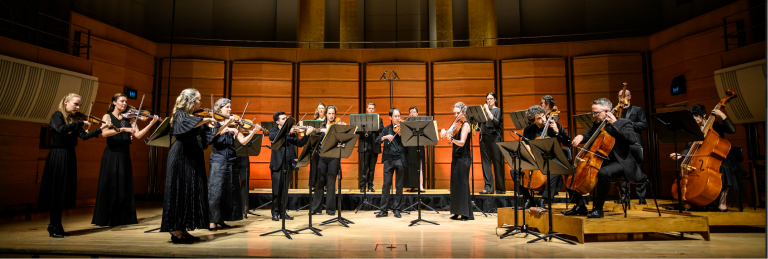
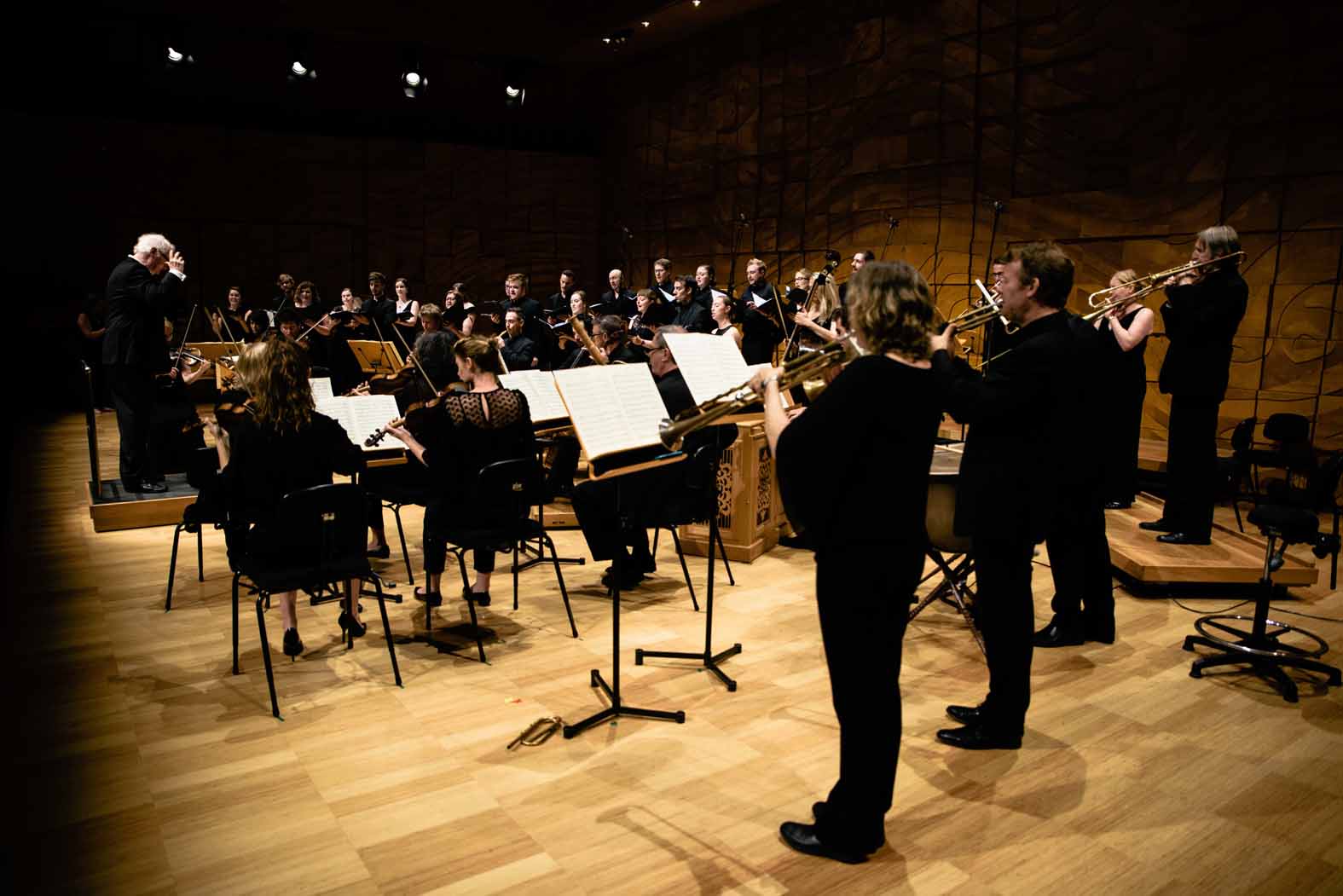
Violinist and Artistic Director of the ensemble Madeleine Easton leads an all-star cast of 20 experts playing a sumptuous array of period instruments in this exposition of invention and sparkling, finessed ensemble skills. The playing was vivacious and entertaining, absolutely cohesive and delicately balanced. Easton’s pacing was generally brisk, maintaining momentum, without compromise in the beauty, nuance, line and detail of Bach’s writing and ornamentation.
The Brandenburg Concerto No. 1 in F major, BWV 1046 (‘the one with the horns’), has the largest orchestra of the six, and is the only concerto in the collection with four movements. It’s as though Bach wanted to demonstrate not just his instrumental writing but his mastery of dance forms by adding the graceful six-part fourth movement containing Menuets and a Polacca, after the heart-racing third movement Allegro. The natural horns come to the fore in all their brassy glory, played by Michael Hugh Dixon and Jenny McLeod-Snyed. There are performances where the horns respectfully blend into the instrumental texture, but it is not their role to be discreet. They stand in front as soloists, nimble and triumphant, insistently interrupting with their dissonant harmonies, flourishes and cross rhythms, playing three against four. The Adagio second movement is a soulful dialogue between Easton and oboeist extraordinaire Adam Masters; the first Trio of the last movement features bassoonist Ben Hoadley in a soloistic role; the string contingent comprising Rafael Font, John Ma, Karina Schmitz and continuo from cellist Daniel Yeadon and Pippa MacMillan playing violone, render a graceful and spirited Polacca.
The Brandenburg Concerto No 2, BWV 1047, also in F major, (‘the one with the trumpet’), is fiendishly challenging for the trumpet soloist. Set high and requiring tremendous power and control, this is written for a baroque instrument not yet endowed with the more sophisticated valves and key mechanisms of later models. Soloist Richard Fomison meets this challenge head on with a virtuosic display of visceral skill in his solo moments, but dropping back into a more equal and blended ensemble with Easton’s violin, Masters on the oboe and Mikaela Oberg interjecting softly on the recorder, notably in the third movement Allegro.
The Brandenburg Concerto No. 3, in G major, BWV 1048 ( ‘the threes’), is all about the stringed instruments, scored for a trio each of violins, violas and cellos with Nathan Cox masterful as continuo harpsichordist throughout the concert and MacMillan again expertly playing continuo violone, subtle and unshakeable. Easton takes the soloistic thematic material and tosses it around the ensemble, defying the density of nine-part string writing. She delicately knits the two outer movements together with a brief cadenza-like Adagio. Viola player Karina Schmitz and cellist Daniel Yeadon excel in the third movement Allegro as they build the tension, joyful and vibrant with relentless energy.
The Brandenburg Concert No. 4 in G major BWV 1049 (‘violin and recorders’), has the two flautists, Mikaela Oberg and Alicia Crossley playing their echoing lines and leaping arpeggios against Easton’s violin in the style of a triple concerto, although the impossibly bravura writing for the violin, breathtakingly played by Easton, demands its own status as a concerto for violin. The middle movement Andante is unusually subdued with the soothing, woody sounds of the recorders, before the final Presto with its well-defined fugal entries and more ravishing playing from Easton.
The trills and thrills keep coming, now with the Brandenburg Concerto No, 5 in D major, BWV 1050 ( ‘the one with the solo harpsichord’) featuring Neal Peres Da Costa in a dazzling display at the harpsichord in the first keyboard concerto in musical history, originally performed by J S Bach himself. Oberg playing the flute joins Peres Da Costa and Easton. This is the only concerto of the six to feature any instrument in such an extended solo and Da Costa has the audience mesmerised with his performance. The middle movement Affettuoso is a poignant trio for the three solo instruments and the final Allegro, the lightest and merriest of Gigues.
Finally, the Brandenburg Concerto No. 6 in B flat major, BWV 1051, (‘the one with the violas’). Finely led by Karina Schmitz, she is joined by John Ma in the catch-me-if-you-can whirlwind of the violas with Yeadon playing the cello in the solo ensemble. That Bach wrote this for not just one but two violas, rarely considered as solo instruments, describes an adventurous frame of mind that was willing to challenge convention and breach boundaries.
There has never been a collection of music like this since Bach first humbly offered them up to the Margrave. To hear any of these concertos on their own is a delight; to hear them together, performed with such skill and integrity, is to gain new insights into the collection as a whole and to marvel yet again at the breadth of Bach’s genius.
Shamistha de Soysa for SoundsLikeSydney©
Read our review of the Bach Akademie Australia’s last concert The Art of Violin.