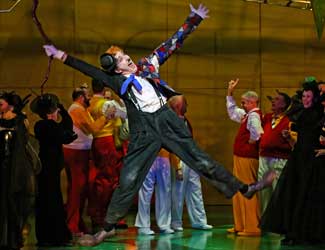
Opera Review: The Love For Three Oranges/ Opera Australia
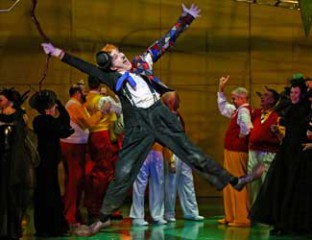
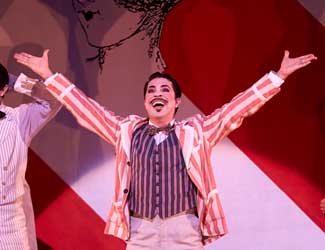
Kanen Breen performs the role of Truffaldino in Opera Australia's production of The Love for Three Oranges.  Photo credit: Prudence Upton
Kanen Breen performs the role of Truffaldino in Opera Australia’s production of The Love for Three Oranges.
Photo credit: Prudence Upton

“Oh, we’re your real opera buffs! Give us tunes that we can hum!”

So plead the Lyricists in the prologue of Prokofiev’s madcap opera The Love for Three Oranges, whilst the Tragedians demand “blood and thunder…sex and souls” and the Comedians angle for “genuine comedy”. Sadly for the Lyricists, Prokofiev did not write many “tunes that we can hum” in this, his first performed opera. Yet, Opera Australia’s revival of the 2005 production, is the ‘complete package’ and, judging from the guffaws of laughter from the audience, it has popular endorsement as well.

With a reputation as an ‘anti-opera’, the most enduring ditty from The Love for Three Oranges is the toe- tapping March – which is not even a vocal number, but an instrumental one. The clamouring chorus must seem disconcertingly like the disparate audiences that Opera Australia has to cater for and please. With this choice, though Opera Australia  is on a winner. The 2005 production left me enchanted. Revisiting it at its 2016 opening this week, affirmed those impressions.

The Love for Three Oranges is set “once upon a time, in the world of make-believe.” With its roots in the traditions of commedia dell’arte, this Francesca Zambello production, revived by Matthew Barclay (Assistant Director in 2005) contains satire, plenty of belly laughs, fantasy and high camp embedded in a riot of colour.

Prokofiev’s score is a masterpiece of musical drollery and characterisation with lots of irreverent noises from the brass section. Tom Stoppard’s wickedly witty English libretto, sits comfortably with the music, well suited to the declamatory style espoused by Prokofiev in this opera. The abundant humour is all the more effective for being able to understand it straight away rather than via a translation. There were English sur-titles on offer, but these were hardly necessary with the sharp diction from the ensemble.

Anthony Legge’s musical direction is impeccable and he brings out the best from the brilliant musicians on stage and in the pit.

The staging was ingenious, cleverly moving from various rooms of the royal palace to the desert buffeted by Farfarello’s stormy red winds, and surreal cactus plants; an eerily glowing cabalistic curtain provided the backdrop for the adroitly staged, pivotal card game. George Tsypin’s abstract sets, Mark Howett’s lighting, Denni Sayers choreography and Tanya Noginova’s innovative costumes drew out the narrative, complementing without distraction.

The perfect casting demonstrated the depth of operatic talent within the company and made it hard to single out any of the principals as they were all outstanding. However, mention must surely be made of Kanen Breen as Truffaldino – half Charlie Chaplin, half harlequin, for whom this role must surely have been created. His fine singing was polished off with a great ease of movement, slapstick, humour and pathos; Adrian Tamburini as the grotesque Cook and David Parkin as the King of Clubs were also exceptional; Antoinette Halloran as Fata Morgana and Rosario La Spina as The Prince made welcome returns to the Sydney stage; the Ridiculous Ones aided and abetted by assorted Doctors, Tragedians, Comics and silent monsters, drunks and soldiers, kept the narrative pumping along with their interpolations in the style of a Greek chorus, each faction promoting its point of view. Placing the chorus around the opera theatre as audience effectively capitalised on their role as observers and commentators – a refreshing use of spaces off the stage. Ironically it is one of the spectator groups – the Ridiculous Ones – that effects the outcome, entering the drama with life saving water for the Princess Ninetta, delicately sung by Opera Australia Young Artist Julie Lea Goodwin.

Written whilst Prokofiev was in New York, during his self-imposed post revolutionary exile, the opera had its premiere in French, in Chicago in 1921. It was translated into Russian for its first Russian outing in (Prokofiev’s absence) in Leningrad 1926 and in Moscow in 1927. Buoyed by its success Prokofiev was able to return to Russian in the 1930s.

Beyond its value as excellent entertainment Prokofiev’s opera is an allegorical exploration of how art should serve society. His cleverness also lies in his vivid painting of the characters, integrating the fragments of music built on innovative harmonies, with the different levels at which the story is told.

A sparking production, brilliantly performed. Coming in at around two hours, this is a must see – and a terrific choice for young ones to experience.

Shamistha de Soysa for SoundsLikeSydney©

The Love for Three Oranges continues in the Joan Sutherland Theatre of the Sydney Opera House on selected dates till July 9 2016.
Similar Posts

  • Concert Review: The Metropolitan Orchestra/ The ‘Great’

    ‘The Metropolitan Orchestra, conductor Sarah-Grace Williams Violin soloist Glenn Christensen 20 August 2016, Eugene Goossens Hall, ABC Centre, Ultimo  Written by Larry Turner The Metropolitan Orchestra is arguably the doyen of Sydney’s non-salaried symphony orchestras.  In the fourth concert of their main 2016 Sydney series they performed just two works which are now standard repertoire but neither of…

  • Concert Review: Splendour And Mystery/Sydney Chamber Choir

    Splendour and Mystery/ Sydney Chamber Choir
    Verbrugghen Hall, Sydney Conservatorium of Music
    Australian Digital Concert Hall
    25 March, 2023
    In Splendour and Mystery, Sydney Chamber Choir under the direction of Sam Allchurch joined forces with Camerata Antica led by Matthew Manchester and organist Thomas Wilson in an adventurous anthology of music written for double choir. Specialising in the music of the 16th and 17th centuries, the founder of Camerata Antica, Matthew Manchester playing the fiendishly difficult cornetto, was joined by Michael Wyborn, William Kinmont and Paolo Franks playing the equally challenging alto, tenor and bass sackbutts respectively.
    Bookended with pieces by Giovanni Gabrieli with one of his refreshing Canzonas in the middle, the program also contained music by living Australasian composers Clare Maclean and Brooke Shelley, Gabrieli’s contemporary and student Heinrich Schütz and 20th century composers John Tavener and Frank Martin. Together these composers explore and exploit the potential of the double choir with its opportunities for super-rich harmonies, added melodic lines, imitation, choral interplay and variations in the positioning of the singers.
    The opening motet, Gabrieli’s Jubilate Deo omnis terra, C 65 was quite literally a musical shout for joy. A major part of this journey back in time to Renaissance Venice was the unique sound of Camerata Antica. Heralded by the instruments, the 10 lines of the choir sang an uplifting, lively and tightly dotted chorus, alternating with homophonic passages. Allchurch and his ensemble clearly delineated the rhythms, changing time signatures, hemiolas and other displaced accents which created the buoyancy of this celebratory piece.
    John Tavener’s brilliant A Hymn to the Mother of God transcends the mortal and looks to the cosmic powers of Mother Mary. Writing in the style of canon, with imitative lines that start in quick succession and not necessarily in harmony, Tavener creates a sense of ‘other-worldliness’ in this simple but awe-inducing piece in three-sections. It was a slow burn as the two choirs sang with shimmering lightness and a sense of spinning through space, creating vivid colours and  clusters of clashing chords with impressive control as the voices rose in range and dynamic to its full-bodied climax.
    The program moved imperceptibly to the German Magnificat by Heinrich Schütz, as the choirs were joined by organ and instruments. This was a relevant and important inclusion as Gabrieli himself taught Schütz in this multi-choral technique which Schütz then developed in his own style.
    Clare Maclean’s moving Christ the King was sublimely sung, opening in the manner of a plainchant by the female voices which peeled off into mirroring phrases by the other voices, ending in a reprise of the plainchant. Premiered by this choir in 1984, it is precisely opportunities like these which new composers need for their music to be heard and re-heard until it becomes recognizable to listeners and enters the DNA of the concert repertoire.
    The short and brilliant burst of Gabrieli’s Canzona seconda, C 187  from Camerata Antica showcased these rudimentary instruments in all their imperfect glory as the choir positioned itself for Frank’s only unaccompanied choral work, the demanding  Mass for double choir, considered to be one of the finest and most complex pieces of 20th century choral music. The choir did ample justice to this piece which incorporates the aesthetics of Renaissance music, French Impressionism, Schoenberg’s twelve-note system and J S Bach. The altos began the Kyrie with a freely-flowing, supplicating melody; the Gloria built step-wise to cluster chords; the Credo was a business-like affirmation of faith; the canon-styled Et Resurrexit was levity, hope and word-painting to perfection; the Sanctus introduced softer harmonies from the male voices. The mass, Version 1, ended with a powerful Benedictus. Fast forward to 1926 and Martin added the Agnus Dei, the crowning glory to this choral magnum opus. The mass culminated in a glorious unification of the choirs.
    Brooke Shelley’s Heavenly Father, composed in 2022, performed in the presence of the composer was premiered in November 2022, by the Sydney Chamber Choir. A lyrical and beautifully textured piece, it is very pleasing that it has quickly been programmed again. Like the slightly older piece by Maclean, it is critical that new pieces of merit such as these, are given regular and frequent hearings so that they may be heard widely and face the test of time.
    Finally, Gabrieli’s Magnificat a 14, C 79 brought together the full instrumental and vocal forces of the ensemble. Using the 16th century Venetian technique of cori spezzati (split choirs), the brighter sound of the female voices and cornetto took to the left gallery with the male voices and the thrilling grunt of the bass and other sackbutts in the right gallery with a mixed ensemble placed and organ placed centrally on stage.
    This was an intelligent and audacious program from Allchurch, performed with glorious sound by a choir secure in technique, pitch and musicianship.

  • Review: Sydney Chamber Choir – music with a social impact.

    The Sydney Chamber Choir is certainly casting its musical net wide under Paul Stanhope, joining forces in its latest programmes not only with oud virtuoso Joseph Tawadros, but also with The Marais Project, formed by viola da gamba player Jennifer Eriksson. The second of its Palm Sunday concerts, conceived under the rubric ‘Lamentations’, featured a…

  • Concert Review: Selby and Friends ‘Basically Beethoven’

    Basically Beethoven. Selby and friends, 13th May 2014.  Pianist Kathryn Selby with violinist Susie Park and cellist Timo-Veikko Valve  performed a well-balanced program of Beethoven’s chamber music with works from each of his compositional periods. The concert began with an early Piano Trio in E flat major, WoO 38, composed in 1791 just before Beethoven…

  • Recital Review: Berg: Romantic To Maverick

    Berg: Romantic to Maverick,  Opera Australia The Opera Centre, Sydney 3 February, 2019 Berg: Romantic to Maverick, a recital of Art Song by Alban Berg and his contemporaries, discerningly complemented Opera Australia’s presentation of Alban Berg’s epochal opera Wozzeck, currently in its season at the Joan Sutherland Theatre of the Sydney Opera House. Soprano Taryn Fiebig,…

Leave a Reply

Your email address will not be published. Required fields are marked *