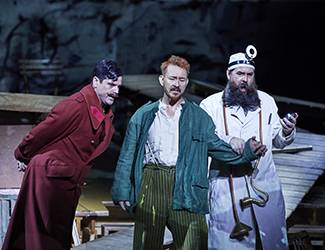
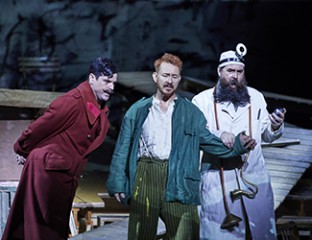
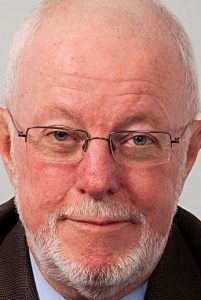
John Longmuir as The Captain, Michael Honeyman as Wozzeck and Richard Anderson as The Doctor in Opera Australia’s 2019 production of Wozzeck at the Sydney Opera House. Photo credit: Keith Saunders
Wozzeck, Opera Australia
Joan Sutherland Theatre, Sydney Opera House
25 January, 2019
Considered one of the most formidable works in the canon, Opera Australia’s presentation of Alban Berg’s era-defining opera Wozzeck, directed by William Kentridge, is brilliantly conceived and executed. An Opera Australia co-production with the Salzburg Festival, the Metropolitan Opera and The Canadian Opera Company, Sydney audiences are fortunate to see it within a year of its premiere at the Salzburg Festival in July 2018.
A one-act opera, Wozzeck is carried by 11 soloists, actors and appearances by the chorus and a children’s chorus late in the piece. Berg himself wrote the libretto, based on the 1836 play Woyzeck by Georg Büchner. Berg saw the play in 1914 and after an intensely visceral reaction to its drama, was impelled at once to set it to music. Interrupted by World War I and his conscription into the Austrian army, Berg returned to Wozzeck after the war, completing it in 1922. Not yet renowned, Berg had to borrow money to publish and promote the opera, loans that were repaid with the assistance of Alma Mahler to whom he dedicated the score. Yet, the piece presented such challenges that interest in it was scarce. By the middle of the decade however, Erich Kleiber, (father of Carlos) was a fan of the play. Recently appointed music director of the Berlin Staatsoper, he championed Wozzeck, which finally received its première in Berlin on 14 December 1925.
William Kentridge first encountered Büchner’s piece over twenty years ago when he staged the theatre play. After his productions of The Nose and Lulu, he came to Wozzeck, which he describes as “no doubt, one of the great, great operas of the last century.”
Kentridge’s deeply perceptive vision of Wozzeck underscores and develops the themes of the strongly autobiographical narrative. “There is something of me in this Wozzeck” wrote Berg to his wife. A socialist, he was attracted to the socio-political messages of the play and his libretto capitalises on the drama to reflects his own experiences of life, war and love. Wozzeck is a tormented soul, condemned to the lowest echelons of society. Too underprivileged to even observe social mores, Wozzeck is driven by nature. He has an illegitimate child with Marie, in parallel with the 17-year-old Berg who also fathered an illegitimate daughter, Albine,with a family servant.
Sabine Theunissen’s single set, without curtains is made up of a central ‘island’ (Wozzeck’s mind) on which is strewn a jumble of broken furniture and household objects. There is a sense of precarious disintegration. Surrounding this podium, projections (by Catherine Meyburgh) of naive cartoons and themes of war sketched roughly in Kentridge’s trademark charcoal style. flesh-out the story. Although Büchner’s tale is set in a garrison town c 1830, Kentridge draws on Berg’s horrific experiences of the war and sets Wozzeck in the aftermath of that catalcysm. Images of war abound, based by him on pictures of the battles in Flanders – stage hands in gas masks, crumpled bodies, wounded soldiers on crutches, medics wearing red cross uniforms, crashed fighter planes, tangles of barbed wire; in the background. a Zeppelin floats silently past over bombed out buildings and maps of troop movements.
Berg’s atonal musical language and the zig-zagging set perfectly describe the dissonances and jagged edges of Wozzeck’s mind. It is a language that evades predictability or security. His orchestration and use of form are intimately linked to the drama.
A masterful teller of stories in music, Berg uses the 12-tone system as well as leitmotifs, (emulating his idols Wagner and Mahler) in drawing the characters and unifying the action. Not all is dissonance and atonality – Berg looks to a more accessible soundscape in depicting the ländler and waltz of the tavern scene, the march from the brass band and the lullaby sung by Marie.
Michael Honeyman plays the title role engagingly, with wild-eyed tension and a sense of hopelessness. His mind has borne the brunt of too many medical experiments which he endures for its meagre payments, passed on to Marie to care for their child, depicted as marionette rendered faceless by wearing a gas mask. Lorina Gore as Marie is a woman whose dreams have come to nought. She hints at her personsl and physical sacrifice as she drapes herself across the furniture in the shape of a crucifix. Dressed in a dowdy house coat she is transfixed by the earrings given to her by her lover, the Drum-Major as she admires herself in the broken shard of a mirror. Plagued by guilt, Gore’s depiction of Marie’s search for redemption in the Biblical tale of Mary Magdalen as she tells her child a fairy story, is exquisitely touching. John Longmuir as The Captain, a buffo tenor role, gave the most exciting vocal performance of the evening despite the punishing vocal effects demanded of him. The cast was complemented by the sparkling tenor voices of The Drum-Major, sung by John Daszak from the premiere cast and Virgilio Marino as Wozzeck’s friend Andres. There were strong performances too from Richard Anderson as the crazed Doctor and Dominica Matthews as Margret.
Even the choreography is grotesque. But it is Berg’s vocal writing that needs to be mentioned. His novel vocal techniques are unashamedly challenging, yet performed admirably by the OA cast. The punishing vocal line encompasses speech, parlando, Sprechgesang (spoken song) and arioso. It is less about beauty and more about expressing brutality and horror with a generous element of vocal athleticism and stamina, ably accomplished by this cast.
Conductor Andrea Molino conducted a superb Opera Australia orchestra, deftly expressing the myriad old and new musical devices which Berg piled into his orchestral score, from fugues to whole-tone writing, to atonality. The vivid soundscapes created, matched the action on stage, realising Berg’s innovative instrumental combinations.
There is little that is sanguine about this piece. There are many complexities to Wozzeck’s musical structure, philosophical roots and personal anecdotes that go beyond the scope of this review. But they are well worth reading. It is these complexities and in particular, William Kentridge’s genius that make this production of Wozzeck so deeply engaging rather than distressing. In the very final horrific moments, the faceless child learns that its parents are dead. Its expression of resignation through the faintest of movements, are made all the more powerful for their subtlety; one of the most poignant scenes in the opera.
“Never in my wildest dreams would I have wished to reform the art-form of opera with the composition of Wozzeck. … Apart from my desire to make good music, to fulfil musically the spiritual content of Büchner’s immortal drama, to transpose his poetic language into a musical one – apart from these things I had nothing else in mind when I decided to write an opera … than to return to the theatre what is the theatre’s.” Alban Berg
Opera Australia: Der Ring des Nibelungen, Richard Wagner Second Cycle State Theatre, Melbourne 27 November – 4 December 2013 During November and December Opera Australia presented the first staging of Wagner’s Ring on the east coast of Australia for 100 years. The individual operas of the first cycle have been perceptively reviewed on this website…
The Australian Haydn Ensemble: Skye McIntosh (Artistic Director) Melvyn Tan (Fortepiano) 1 July 2017, City Recital Hall, Angel Place The Australian Haydn Ensemble’s (AHE) recent concert featured Melvyn Tan as the fortepiano soloist and took Paris as the common denominator of its program. Tan is a fortepiano pioneer of historically informed performances, and is noted…
Dusk & Dawn Amy Dickson, Sony Classics 88725479572 Sydney born saxophonist Amy Dickson’s latest CD release Dusk & Dawn won for her the title of Breakthrough Artist of the Year at the 2013 Classical Brit Awards. This was the first Classical Brit Award for an Australian as well for the saxophone. Dusk & Dawn contains 12 familiar tracks arranged for saxophone and…
Love notes: I’ll sing yours if you play mine Michael Lampard, baritone, Ross Fiddes, pianist Mosman Art Gallery, Aug 23, 7.30 pm Written by Ria Andriani Melbourne-based baritone Michael Lampard and Newcastle-based pianist and composer Ross Fiddes, delivered this rare gem of a concert in the incredibly intimate and stunning acoustic of the Mosman Art…
Mazda Opera in The Domain, Saturday February 1st, 2014. What’s not to like about opera? Everyday heroes and heroines, love triangles, sibling rivalry, parent-child conflict, murder and intrigue. Pile on gorgeous costumes, dazzling singing and lush melodies and surely those who argue that opera is not for everyone need to re-examine their views. Even…
The Rape of Lucretia, Benjamin Britten Sydney Chamber Opera/ Victorian Opera Carriageworks 19 August 2016 Written by Deen Hamaker Productions of Benjamin Britten’s operas have become a rare event in Sydney and performances of Britten’s most enigmatic work, The Rape of Lucretia, are even more rare. Last performed by The Australian Opera as part of…